
基于视觉几何组16神经网络通过太赫兹光谱区分不同蛋白质。
Distinguishing different proteins based on terahertz spectra by visual geometry group 16 neural network.
作者信息
Chen Yusa, Huang Xiwen, Wu Meizhang, Hao Jixuan, Cao Yunhao, Sun Hongshun, Ma Lijun, Li Liye, Wu Wengang, Zhao Guozhong, Meng Tianhua
机构信息
National Key Laboratory of Advanced Micro and Nano Manufacture Technology, Beijing 100871, P.R. China.
School of Integrated Circuits, Peking University, Beijing 100871, P.R. China.
出版信息
iScience. 2025 Mar 3;28(4):112148. doi: 10.1016/j.isci.2025.112148. eCollection 2025 Apr 18.
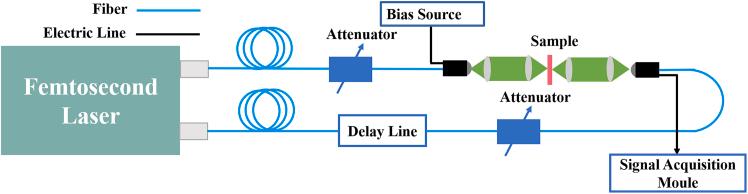
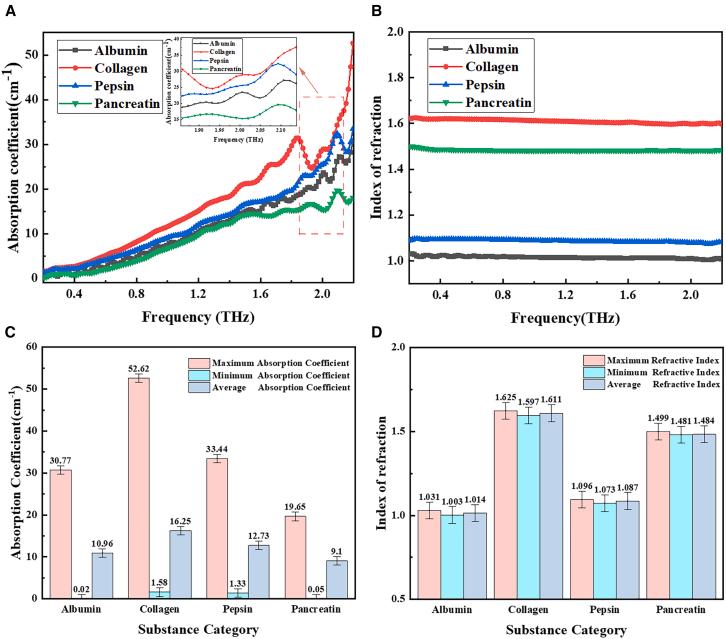
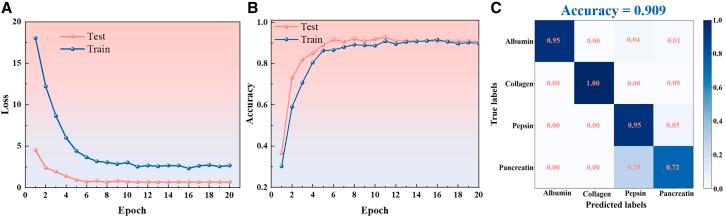
Detecting different kinds of proteins is of great significance for medical diagnosis, biological research, and other fields. We combine both terahertz (THz) absorption and refractive index spectra with the visual geometry group 16 (VGG-16) neural network to intelligently identify four proteins, namely albumin, collagen, pepsin, and pancreatin in this study. The THz absorption-refractive index spectra of the proteins were converted to two-dimensional image features by the Grassia angular summation field (GASF) method and used as a dataset, which enabled the VGG-16 model to achieve 98.8% accuracy in distinguishing the four proteins. We also compared the VGG-16 model with other machine learning models, which demonstrate that it has better performance. Overall, the VGG-16 neural network transfer learning technique proposed in this study can quickly and accurately achieve the identification of different kinds of proteins. This research might have potentially important applications in biotechnology fields, such as biosensors, biopharmaceuticals, and medicine.
检测不同种类的蛋白质对于医学诊断、生物学研究及其他领域具有重要意义。在本研究中,我们将太赫兹(THz)吸收光谱和折射率光谱与视觉几何组16(VGG - 16)神经网络相结合,以智能识别四种蛋白质,即白蛋白、胶原蛋白、胃蛋白酶和胰酶。通过格拉西亚角和场(GASF)方法将蛋白质的太赫兹吸收 - 折射率光谱转换为二维图像特征,并将其用作数据集,这使得VGG - 16模型在区分这四种蛋白质时的准确率达到了98.8%。我们还将VGG - 16模型与其他机器学习模型进行了比较,结果表明它具有更好的性能。总体而言,本研究提出的VGG - 16神经网络迁移学习技术能够快速、准确地实现对不同种类蛋白质的识别。这项研究可能在生物传感器、生物制药和医学等生物技术领域具有潜在的重要应用。





 Zotero 插件