Kamyab Golnoosh, Gagnon-Girouard Marie-Pierre, Deldar Zoha, Ghazi-Saidi Ladan, Piché Mathieu
Department of Anatomy, Université du Québec à Trois-Rivières, Trois-Rivières, QC, Canada.
Department of Psychology, Université du Québec à Trois-Rivières, Trois-Rivières, QC, Canada.
Front Sociol. 2025 Mar 28;10:1535815. doi: 10.3389/fsoc.2025.1535815. eCollection 2025.
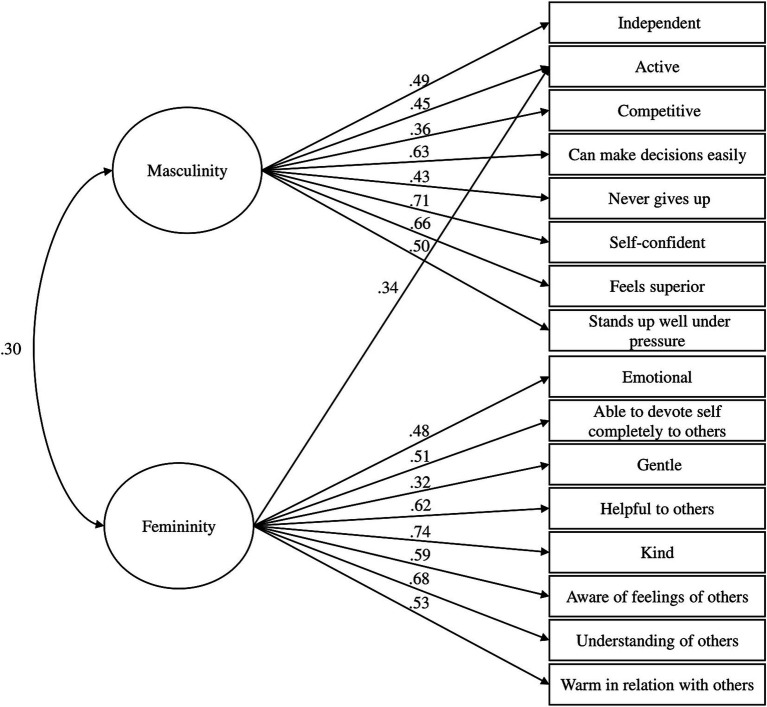
The Personal Attributes Questionnaire (PAQ) assesses gender roles, including expressivity (femininity) and instrumentality (masculinity), which reflect socially and culturally defined feminine and masculine ways of thinking, feeling, and behaving. The PAQ allows the assessment of gendered traits, beyond the traditional binary view. With the inclusion of gender-related factors in various research fields, the PAQ has been validated in multiple languages and cultures, including German, Chinese, and French. However, a Persian version has not yet been validated. This study aims to validate and examine the test-retest reliability of the culturally adapted Persian PAQ. A total of 436 native Persian speakers (302 females, 134 males) completed the questionnaire. Exploratory and confirmatory factor analyses were conducted to evaluate the factorial structure and validity of the Persian PAQ. In addition, test-retest reliability was assessed to ensure its consistency over time. Exploratory factor analysis confirmed a two-factor structure, although 'Active' loaded on both factors. The results showed a good fit (RMSEA = 0.070, GFI = 0.91 and AGFI = 0.88), acceptable internal consistency (expressivity: α = 0.70, instrumentality: α = 0.72), and moderate to excellent test-retest reliability for instrumentality (ICC = 0.92) and expressivity (ICC = 0.69). The results indicate that women and younger adults were more likely to show lower expressivity and instrumentality (undifferentiated), or higher expressivity and instrumentality (androgynous) compared with males and older adults, respectively. These findings support the validity and reliability of the Persian PAQ and show that gender role attributes are influenced by sex and age. The Persian PAQ will enable to consider the influence of gender in health, sociology, and psychology research.
个人属性问卷(PAQ)评估性别角色,包括表达性(女性特质)和工具性(男性特质),它们反映了社会和文化所定义的女性和男性的思维、感受及行为方式。PAQ能够对性别特质进行评估,超越了传统的二元观点。随着性别相关因素被纳入各个研究领域,PAQ已在多种语言和文化中得到验证,包括德语、中文和法语。然而,波斯语版本尚未得到验证。本研究旨在验证并检验经文化适应的波斯语PAQ的重测信度。共有436名以波斯语为母语的人(302名女性,134名男性)完成了问卷。进行了探索性和验证性因素分析,以评估波斯语PAQ的因子结构和效度。此外,还评估了重测信度,以确保其随时间的一致性。探索性因素分析确认了一个双因素结构,尽管“活跃性”在两个因素上都有载荷。结果显示拟合良好(RMSEA = 0.070,GFI = 0.91,AGFI = 0.88),内部一致性可接受(表达性:α = 0.70,工具性:α = 0.72),工具性(ICC = 0.92)和表达性(ICC = 0.69)的重测信度为中等至优秀。结果表明,与男性和老年人相比,女性和年轻人分别更有可能表现出较低的表达性和工具性(未分化),或较高的表达性和工具性(双性化)。这些发现支持了波斯语PAQ的效度和信度,并表明性别角色属性受性别和年龄的影响。波斯语PAQ将有助于在健康、社会学和心理学研究中考虑性别的影响。