Pillet Anne-Caroline, Lehner Benjamin, Stark Simon, van der Zant Hinne
Sup'Enr, Université de Perpignan Via Domitia, Perpignan, Occitanie, France.
Dutch Marine Energy Centre, The Hague, The Netherlands.
Open Res Eur. 2025 Jan 28;3:102. doi: 10.12688/openreseurope.15906.2. eCollection 2023.
Our oceans remain one of the last untapped large sources of renewable energy. The predictability and reliability of marine energy technologies could contribute significantly to the global energy transition. By 2022, marine energy, and in particular wave and tidal energy have reached a pre-commercial phase in their development.
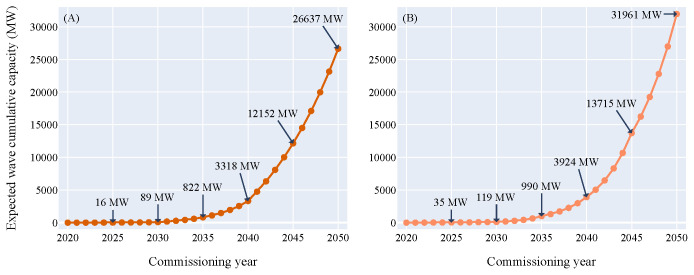
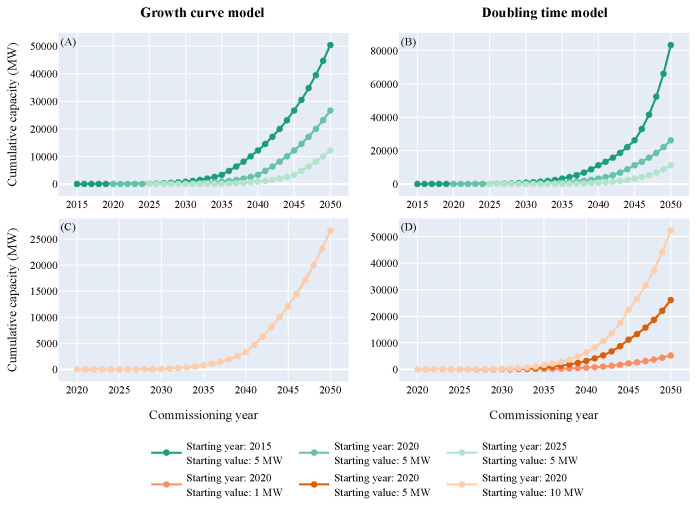
This study investigates the potential progression of the wave and tidal energy sector in the next three decades based on the offshore wind sector in the past three decades. Two different models were developed from the yearly capacity increase of offshore wind in Europe and applied to the wave and tidal energy sector.
According to both models, the 40 GW 2050 target for marine energy set by the European Commission in 2020 could be reached if European coastal countries, including countries associated to the EU-27, adopt supportive policies for both technologies immediately. A sensitivity analysis shows further that a small delay right now will have tremendous negative impacts on fulfilling the EU goals and the contribution of marine energy to the energy transition.
The ocean energy sector shows a strong growth potential and is capable of supporting the European and global climate targets substantially by 2050. Lessons learned from the offshore wind sector can help scope and support the growth of marine energy technologies.
我们的海洋仍然是最后一个未被充分开发的可再生能源大来源之一。海洋能源技术的可预测性和可靠性可为全球能源转型做出重大贡献。到2022年,海洋能源,特别是波浪能和潮汐能已进入其发展的预商业阶段。
本研究基于过去三十年的海上风电行业,调查波浪能和潮汐能行业在未来三十年的潜在发展情况。根据欧洲海上风电的年装机容量增长情况开发了两种不同的模型,并应用于波浪能和潮汐能行业。
根据这两种模型,如果包括与欧盟27国相关的国家在内的欧洲沿海国家立即对这两种技术采取支持性政策,欧盟委员会在2020年设定的2050年海洋能源40吉瓦的目标是可以实现的。敏感性分析进一步表明,现在稍有延迟将对实现欧盟目标以及海洋能源对能源转型的贡献产生巨大的负面影响。
海洋能源行业显示出强劲的增长潜力,到2050年能够为欧洲和全球气候目标提供有力支持。从海上风电行业吸取的经验教训有助于规划和支持海洋能源技术的发展。