Nørgaard Maibritt, Rusan Maria, Kondrup Karoline, Sørensen Ea Marie Givskov, Weiss Simone, Bjerre Marianne Trier, Fredsøe Jacob, Vang Søren, Jensen Jørgen Bjerggaard, De Laere Bram, Grönberg Henrik, Borre Michael, Lindberg Johan, Sørensen Karina Dalsgaard
Department of Molecular Medicine, Aarhus University Hospital, Palle Juul-Jensens Boulevard 99, Aarhus, 8200, Denmark.
Department of Clinical Medicine, Aarhus University, Aarhus, Denmark.
J Exp Clin Cancer Res. 2025 Apr 14;44(1):120. doi: 10.1186/s13046-025-03356-0.
Intrinsic and acquired resistance to second-generation anti-androgens pose a significant clinical challenge in the treatment of metastatic castration-resistant prostate cancer (mCRPC). Novel biomarkers to predict treatment response and inform alternative treatment options are urgently needed.
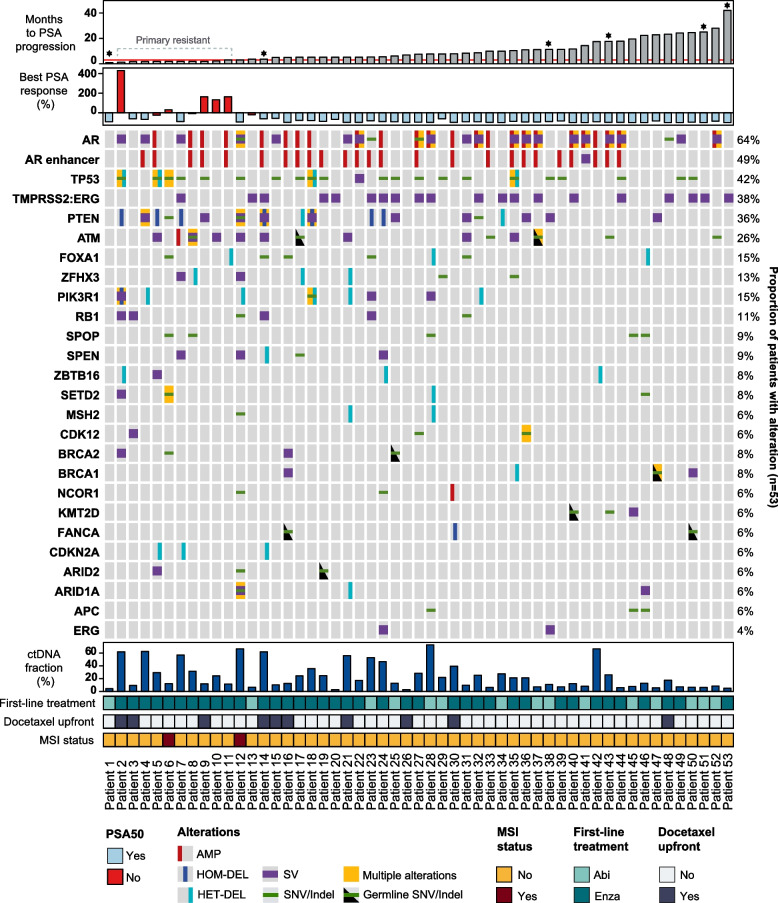
Deep targeted sequencing, with a prostate cancer-specific gene panel, was performed on circulating tumor DNA (ctDNA) and germline DNA from blood of mCRPC patients recruited in Denmark (n = 53), prior to starting first-line treatment with enzalutamide or abiraterone acetate, and for a subset of patients also at progression (n = 18). Likely clonal hematopoietic variants were filtered out. Genomic findings were correlated to clinical outcomes (PSA progression-free survival (PFS), overall survival (OS)). Intrinsic resistance candidate biomarkers were considered by enrichment analysis of nonresponders vs. responders. Genomic alterations at progression were considered as possible drivers of acquired resistance. Clinical actionability was assessed based on OncoKB and ESCAT.
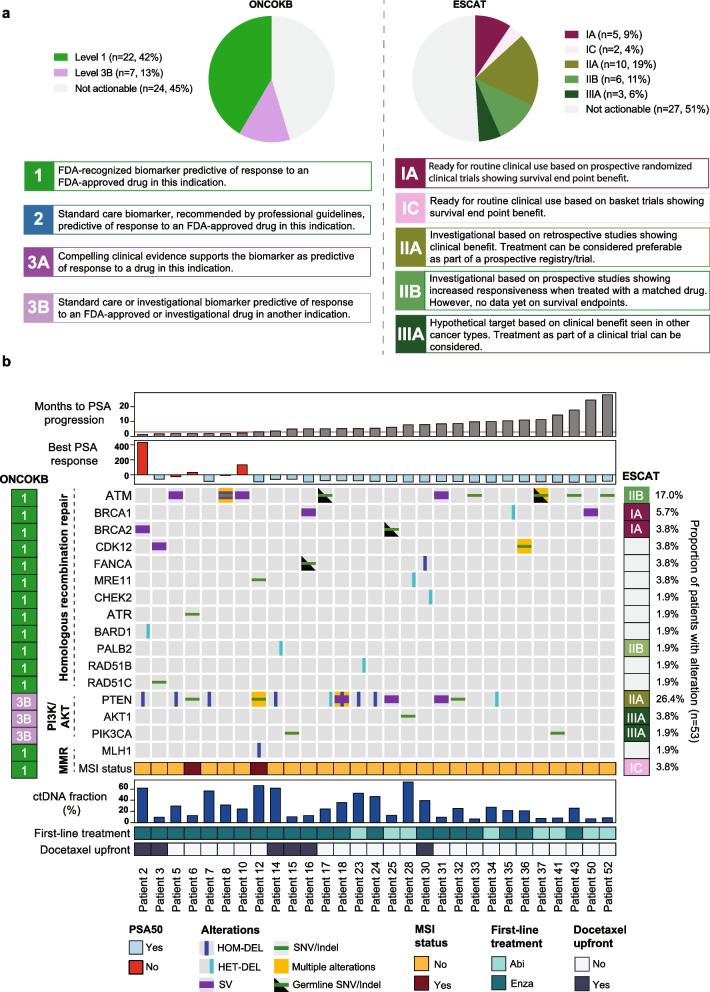
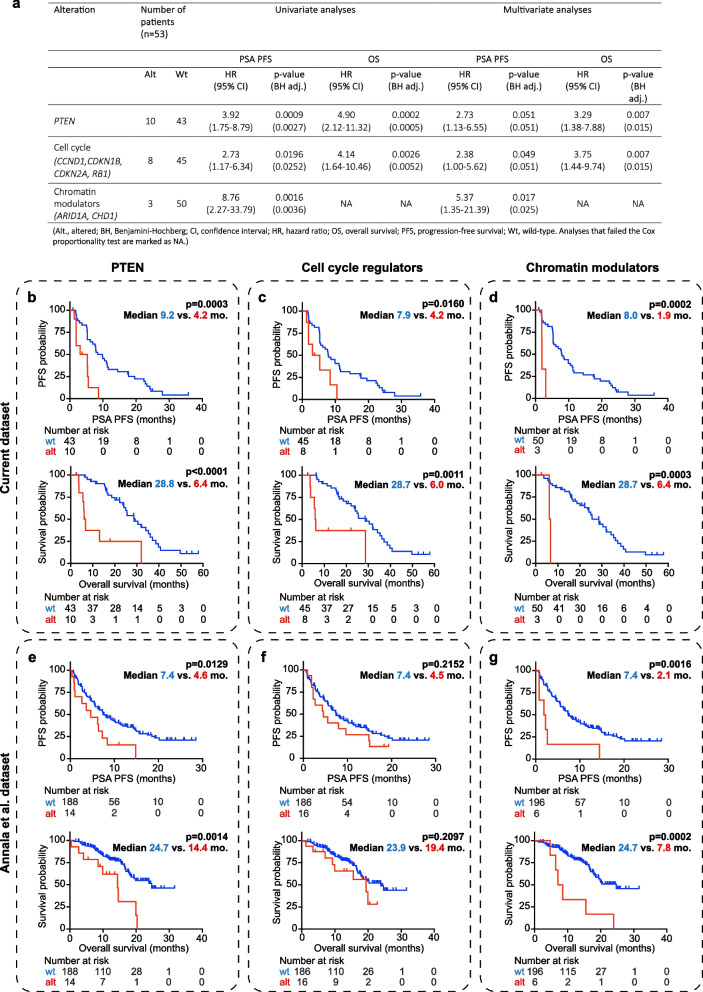
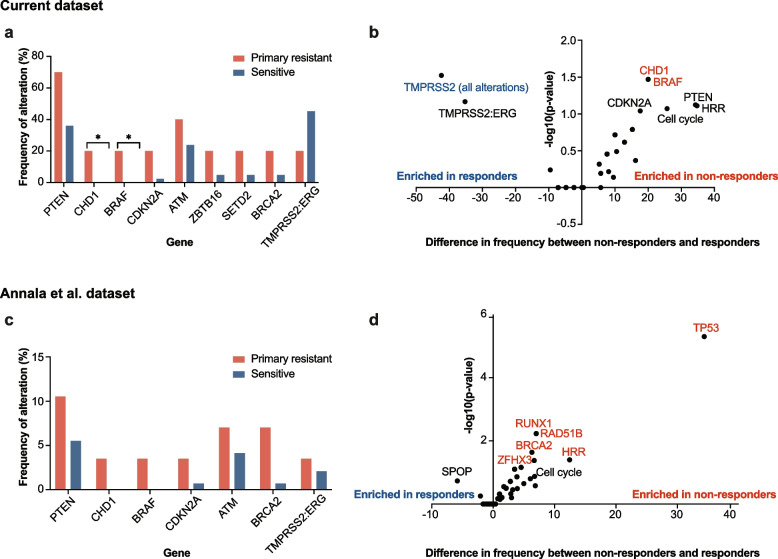
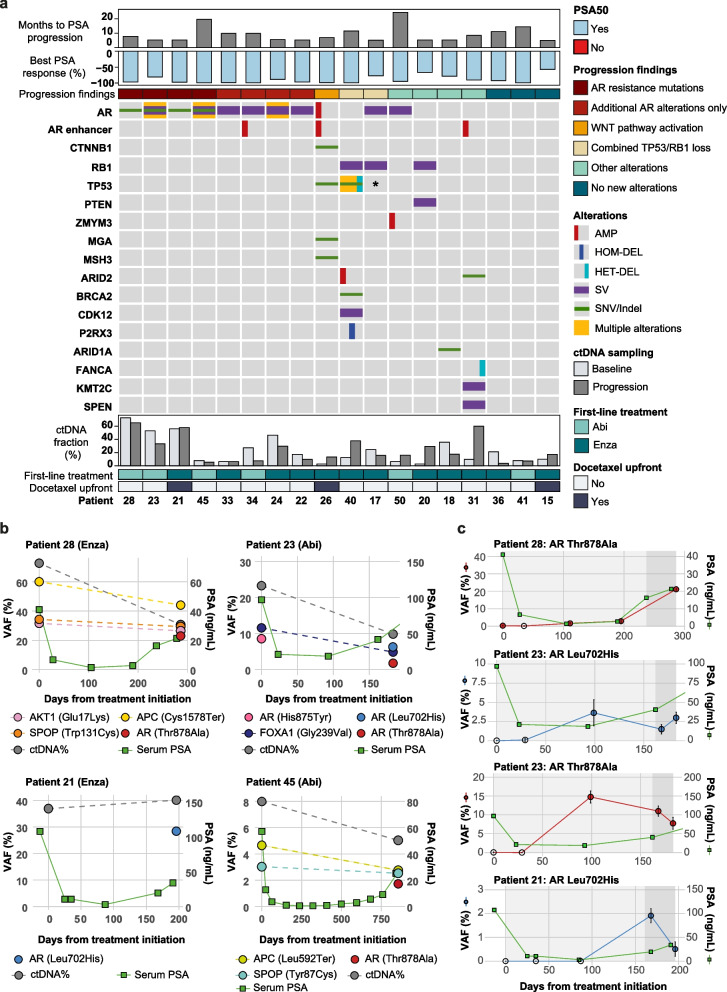
Somatic alterations in PTEN, cell cycle regulators (CCND1, CDKN1B, CDKN2A, and RB1) and chromatin modulators (CHD1, ARID1A) were associated with significantly shorter PFS and OS, also after adjusting for ctDNA% in multivariate Cox regression analysis. The associations with poorer outcomes for alterations in PTEN and chromatin modulators were validated in an external dataset. Patients with primary resistance to enzalutamide/abiraterone had enrichment for BRAF amplification and CHD1 loss, while responders had enrichment for TMPRSS2 fusions. AR resistance mutations emerged in 22% of patients at progression. These were mutually exclusive with other alterations that may confer resistance (i.e., activating CTNNB1 mutations, combined TP53/RB1 loss). Clinically actionable alterations, primarily in homologous recombination repair genes, were found in 54.7% and 49.0% of patients (OncoKB and ESCAT, respectively), with few additional alterations detected at progression. Level I alterations were identified in 41.5% of patients employing OncoKB, however only in 13.2% based on ESCAT.
Our study identifies known and novel prognostic and predictive biomarker candidates in patients with mCRPC undergoing first-line treatment with enzalutamide or abiraterone acetate. It further provides real-world evidence of the significant potential of genomic profiling of ctDNA to inform treatment in this setting. Clinical trials are warranted to advance the implementation of ctDNA-based biomarkers into clinical practice.
对第二代抗雄激素药物的内在和获得性耐药在转移性去势抵抗性前列腺癌(mCRPC)的治疗中构成了重大临床挑战。迫切需要新的生物标志物来预测治疗反应并为替代治疗方案提供依据。
对丹麦招募的mCRPC患者(n = 53)在开始使用恩杂鲁胺或醋酸阿比特龙进行一线治疗之前,以及部分患者在疾病进展时(n = 18),使用前列腺癌特异性基因panel对循环肿瘤DNA(ctDNA)和血液中的种系DNA进行深度靶向测序。滤除可能的克隆性造血变异。将基因组发现与临床结果(前列腺特异性抗原无进展生存期(PFS)、总生存期(OS))相关联。通过对无反应者与反应者的富集分析来考虑内在抗性候选生物标志物。将疾病进展时的基因组改变视为获得性耐药的可能驱动因素。基于OncoKB和ESCAT评估临床可操作性。
在多变量Cox回归分析中,即使在调整ctDNA百分比后,PTEN、细胞周期调节因子(CCND1、CDKN1B、CDKN2A和RB1)以及染色质调节剂(CHD1、ARID1A)的体细胞改变与显著更短的PFS和OS相关。PTEN和染色质调节剂改变与较差结果的关联在一个外部数据集中得到验证。对恩杂鲁胺/醋酸阿比特龙原发耐药的患者中BRAF扩增和CHD1缺失富集,而反应者中TMPRSS2融合富集。22%的患者在疾病进展时出现AR耐药突变。这些与其他可能导致耐药的改变(即激活CTNNB1突变、TP53/RB1联合缺失)相互排斥。分别在54.7%和49.0%的患者中发现了主要在同源重组修复基因中的临床可操作改变(分别基于OncoKB和ESCAT),在疾病进展时检测到的其他改变很少。使用OncoKB在41.5%的患者中鉴定出I级改变,然而基于ESCAT仅在13.2%的患者中鉴定出。
我们的研究在接受恩杂鲁胺或醋酸阿比特龙一线治疗的mCRPC患者中鉴定出已知和新的预后及预测生物标志物候选物。它进一步提供了ctDNA基因组分析在这种情况下为治疗提供信息的巨大潜力的真实世界证据。有必要进行临床试验以推进基于ctDNA的生物标志物在临床实践中的应用。