Cancer Research, Peter MacCallum Cancer Centre, Melbourne, Australia; Sir Peter MacCallum Department of Oncology, University of Melbourne, Melbourne, Australia.
Predicine Inc., Hayward, CA, USA.
EBioMedicine. 2023 Sep;95:104738. doi: 10.1016/j.ebiom.2023.104738. Epub 2023 Aug 5.
Genomic alterations in DNA damage response (DDR) genes are common in metastatic castration-resistant prostate cancer (mCRPC). Understanding how these genomic events impact prognosis and/or treatment response is vital for optimising clinical outcomes.
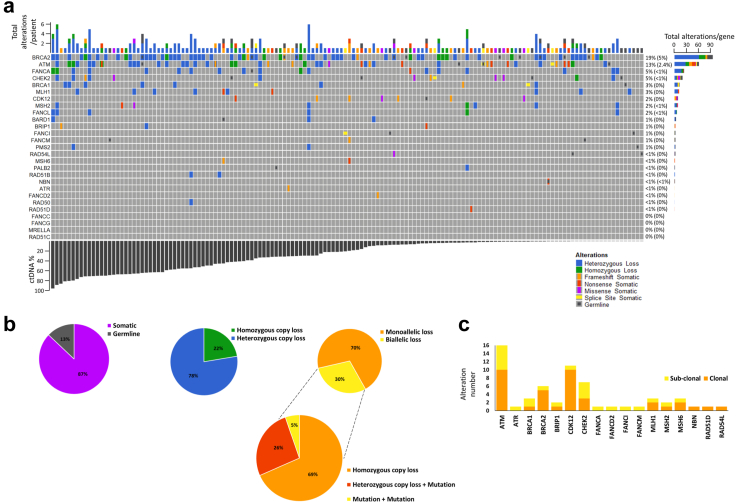
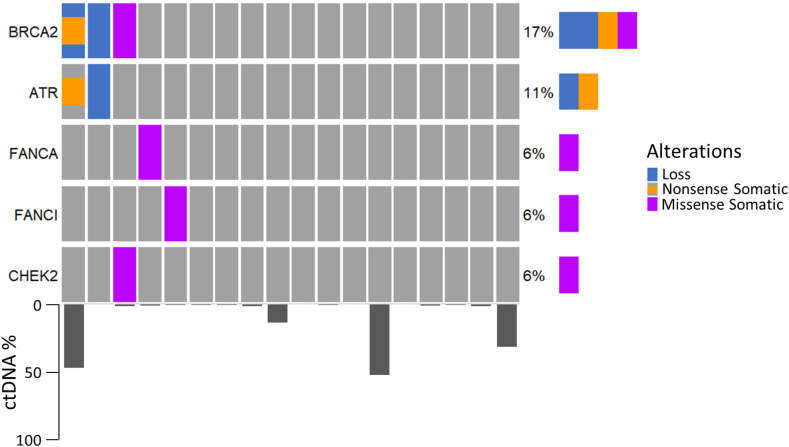
Targeted sequencing was performed on 407 plasma samples from 375 men with mCRPC. Using the CLIA-certified PredicineCARE™ cell-free DNA (cfDNA) assay, pathogenic alterations in 152 key genes (including 27 DDR-related genes) were assessed, as was the presence and mechanisms of biallelic loss in BRCA2.
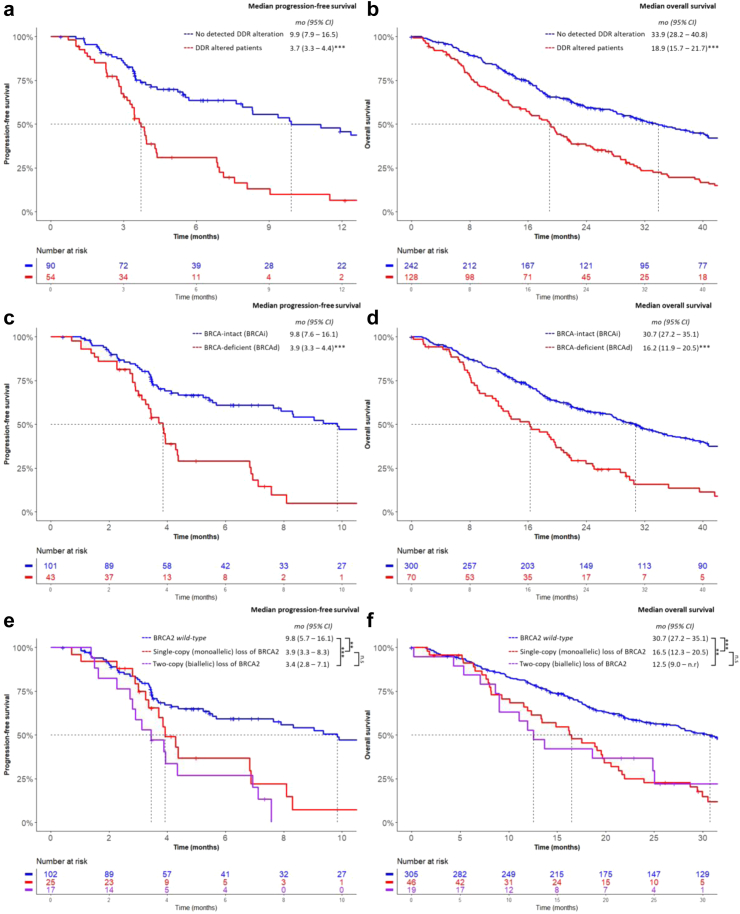
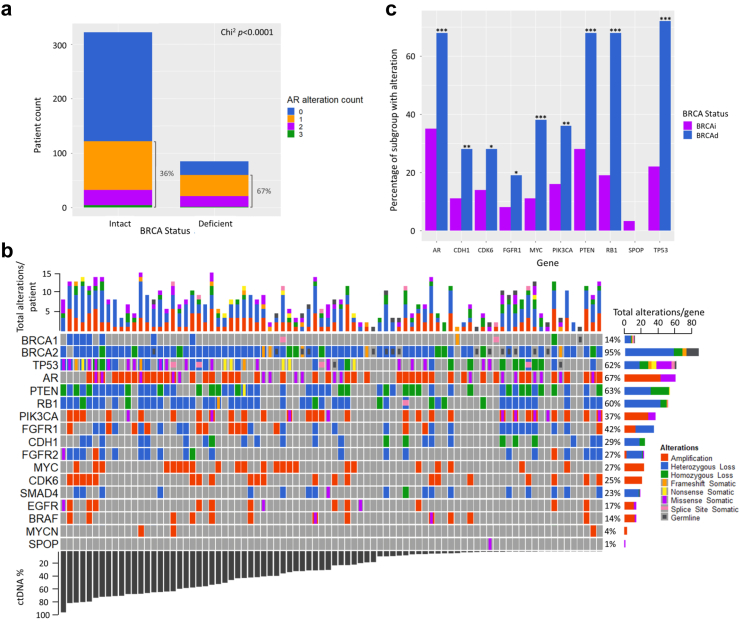
At least one DDR alteration was present in 34.5% (129/375) of patients (including monoallelic alterations). The most frequently altered DDR genes were BRCA2 (19%), ATM (13%), FANCA (5%), CHEK2 (5%) and BRCA1 (3%). Patients with BRCA alterations, especially BRCA2, had significantly worse progression-free survival (PFS) (Hazard ratio (HR) 3.3 [95% CI 1.9-6.0]; Cox regression p < 0.001), overall survival (HR 2.2 [95% CI 1.1-4.5]; Cox regression p = 0.02) and PSA response rates to androgen receptor (AR) pathway inhibitors (32% vs 60%, chi-square p = 0.02). BRCA-deficient tumours were also enriched for alterations within multiple genes including in the AR and PI3K pathways. Zygosity of BRCA2 alterations had no discernible impact on clinical outcomes, with similarly poor PFS for monoallelic vs biallelic loss (median 3.9 months vs 3.4 months vs copy neutral 9.8 months).
These data emphasise that the BRCA genes, in particular BRCA2, are key prognostic biomarkers in mCRPC. The clinical utility of BRCA2 as a marker of poor outcomes may, at least in cfDNA assays, be independent of the zygosity state detected. Enrichment of actionable genomic alterations in cfDNA from BRCA-deficient mCRPC may support rational co-targeting strategies in future clinical trials.
Several funding sources have supported this study. A full list is provided in the Acknowledgments. No funding was received from Predicine, Inc. during the conduct of the study.
在转移性去势抵抗性前列腺癌(mCRPC)中,DNA 损伤反应(DDR)基因的基因组改变很常见。了解这些基因组事件如何影响预后和/或治疗反应对于优化临床结果至关重要。
对 375 名 mCRPC 男性的 407 份血浆样本进行了靶向测序。使用 CLIA 认证的 PredicineCARE™ 游离 DNA(cfDNA)检测,评估了 152 个关键基因(包括 27 个 DDR 相关基因)中的致病性改变,以及 BRCA2 中双等位基因缺失的存在和机制。
至少有一个 DDR 改变存在于 34.5%(129/375)的患者(包括单等位基因改变)。最常改变的 DDR 基因是 BRCA2(19%)、ATM(13%)、FANCA(5%)、CHEK2(5%)和 BRCA1(3%)。BRCA 改变的患者,尤其是 BRCA2,无进展生存期(PFS)(风险比(HR)3.3[95%CI 1.9-6.0];Cox 回归 p<0.001)、总生存期(HR 2.2[95%CI 1.1-4.5];Cox 回归 p=0.02)和雄激素受体(AR)通路抑制剂的 PSA 反应率(32% vs 60%,卡方检验 p=0.02)明显更差。BRCA 缺陷型肿瘤中也存在 AR 和 PI3K 通路中多个基因的改变。BRCA2 改变的杂合性对临床结果没有明显影响,单等位基因缺失与双等位基因缺失的 PFS 相似(中位数分别为 3.9 个月、3.4 个月和拷贝中性 9.8 个月)。
这些数据强调了 BRCA 基因,尤其是 BRCA2,是 mCRPC 的关键预后生物标志物。在 cfDNA 检测中,BRCA2 作为不良预后标志物的临床效用至少独立于检测到的杂合状态。cfDNA 中 BRCA 缺陷型 mCRPC 中可操作基因组改变的富集可能支持未来临床试验中的合理联合靶向策略。
这项研究得到了多个资金来源的支持。在致谢中提供了完整的列表。在研究期间,没有收到 Predicine,Inc. 的资金。