Niederberger Marlen, Sonnberger Marco
PH Schwäbisch Gmünd, Institut für Gesundheitswissenschaften, Abt. Für Forschungsmethoden in der Gesundheitsförderung und Prävention, Oberbettringer Str. 200, Schwäbisch, Gmünd 73525, Germany.
University of Stuttgart, Department of Sociology of Technology, Risk and Environment (SOWI V), Seidenstrasse 36, Stuttgart 70174, Germany.
MethodsX. 2025 Mar 19;14:103274. doi: 10.1016/j.mex.2025.103274. eCollection 2025 Jun.
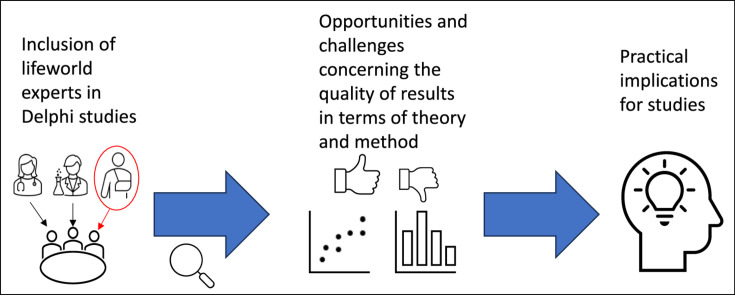
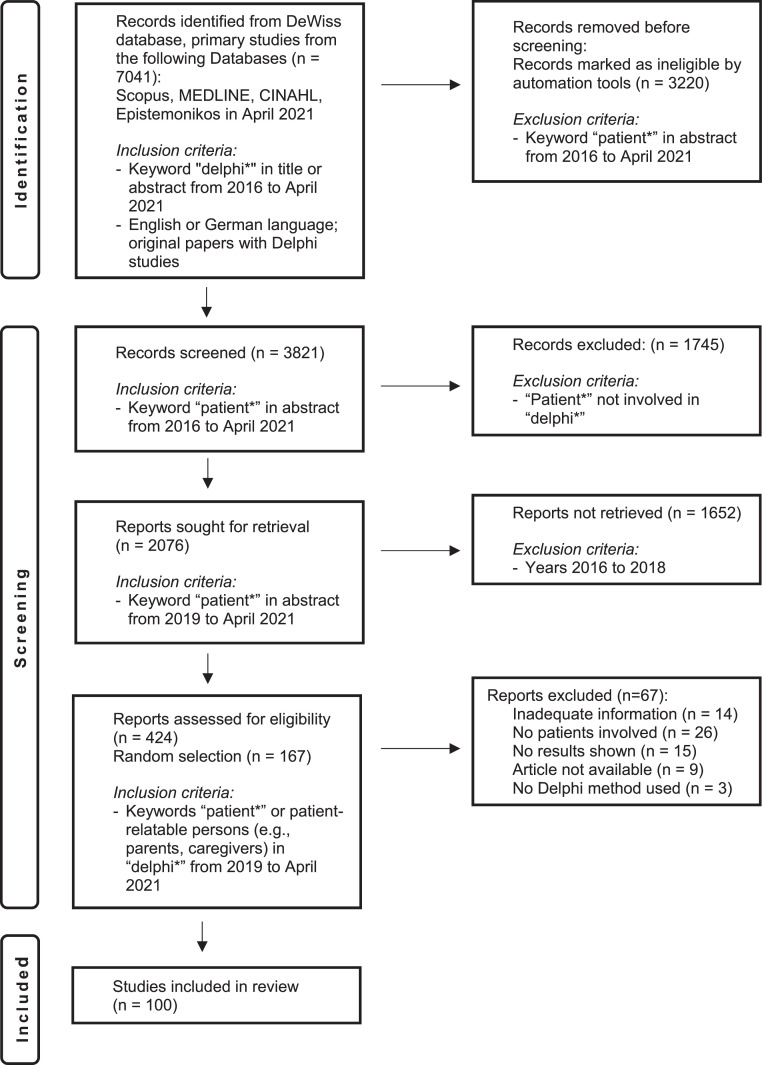
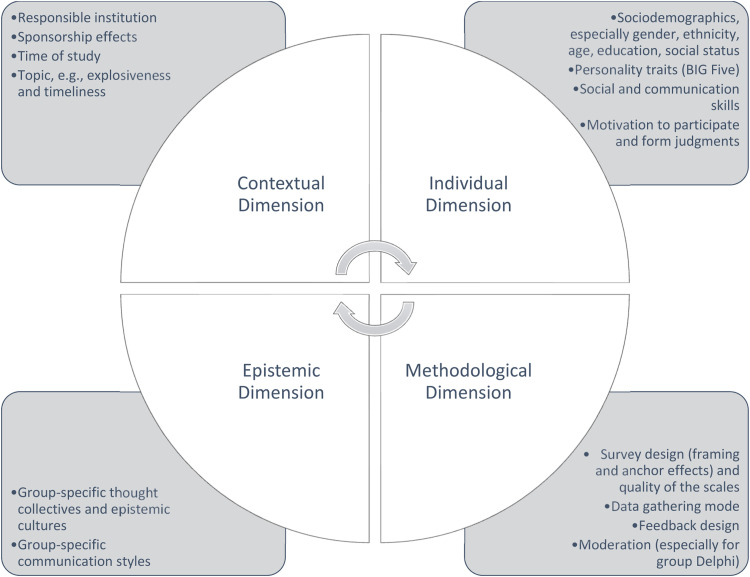
Delphi studies have established themselves in the health sciences as a means to systematically and, ideally, synthesize expert opinions into a consensus on concrete issues. As participatory health research increases in relevance, lifeworld experts (e.g., patients, caregiving relatives) are being included in Delphi surveys and their opinions placed alongside those of professional and scientific experts. Looking at the theory and methodology, we discuss the opportunities and challenges concerning result quality and derive practical implications for conducting Delphi studies involving lifeworld experts alongside scientific and/or professional experts. Delphi techniques are understood here to be social interaction processes whose outcomes are a result of the participating experts' conscious, cognitive judgment processes, and also shaped by individual, situational and cultural factors. The more heterogeneous the expert panel, in particular when lifeworld experts are participating, the more these influences vary. Expert panel composition and how diversity is handled prove significant to Delphi study results. Our argument is based on an in-depth analysis of a systematic review of Delphi studies with lifeworld experts. We found that the inclusion of lifeworld experts in Delphi studies usually occurs relatively unsystematically and, furthermore, that results are not analysed separately according to expert group, although there would be good reasons for this. We have oriented the reporting here on PRISMA. To enhance the outcomes of Delphi studies that incorporate lifeworld experts alongside scientific and/or professional experts, we put forward specific recommendations that address potential biases arising from the participation of lifeworld experts.
德尔菲研究法在健康科学领域已确立了自身地位,成为一种系统地(理想情况下)将专家意见综合为对具体问题的共识的方法。随着参与式健康研究的相关性不断提高,生活世界专家(如患者、照料亲属)被纳入德尔菲调查,他们的意见与专业和科学专家的意见并列。从理论和方法的角度来看,我们讨论了与结果质量相关的机遇和挑战,并得出了在开展涉及生活世界专家以及科学和/或专业专家的德尔菲研究时的实际启示。在这里,德尔菲技术被理解为社会互动过程,其结果是参与专家有意识的认知判断过程的产物,同时也受到个人、情境和文化因素的影响。专家小组的构成越多样化,尤其是当生活世界专家参与其中时,这些影响的差异就越大。专家小组的构成以及如何处理多样性对德尔菲研究结果至关重要。我们的论点基于对一项关于有生活世界专家参与的德尔菲研究的系统评价的深入分析。我们发现,在德尔菲研究中纳入生活世界专家通常相对缺乏系统性,此外,尽管有充分理由,但结果并未按专家组进行单独分析。我们在此处的报告遵循PRISMA标准。为了提高将生活世界专家与科学和/或专业专家相结合的德尔菲研究的成果,我们提出了具体建议,以解决因生活世界专家参与而产生的潜在偏差。