Wu Meagan, Chang Ashley E, Platukus Alana M, Massenburg Benjamin B, Byrns China N, Romeo Dominic J, Ng Jinggang J, Swanson Jordan W, Taylor Jesse A, Bartlett Scott P
From the Division of Plastic, Reconstructive, and Oral Surgery, Children's Hospital of Philadelphia, Philadelphia, PA.
Plast Reconstr Surg Glob Open. 2025 Apr 15;13(4):e6673. doi: 10.1097/GOX.0000000000006673. eCollection 2025 Apr.
This study assesses long-term results of ear molding and factors associated with improved outcomes.
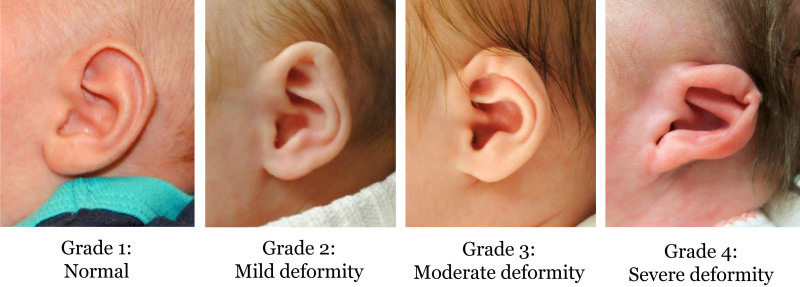
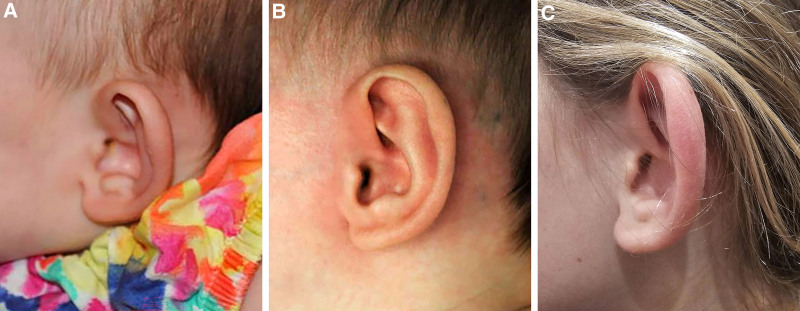
Consecutive infants treated by a single surgeon from 2012 to 2023 were reviewed. Photographs before device application (time T0) and within 6 months of device removal (time T1) were collected. Satisfaction responses and long-term photographs (time T2) were collected from parents. Deformity severity at the 3 timepoints was determined by the surgeon and participants recruited via crowdsourcing using a 4-point severity scale.
Of 97 parent respondents, 78 (80%) were satisfied, 15 (16%) were neutral, and 4 (4%) were dissatisfied with the appearance of their child's treated ear(s). Predictors of satisfaction included absence of ear prominence ( = 0.018), InfantEar use ( = 0.002), and longer follow-up ( = 0.047). Thirty patients with 47 deformities had photographs at T1 = 0.2 ± 2.8 years and T2 = 6.5 ± 2.8 years after treatment, which were evaluated by 236 laypeople. From T0 to T1, surgeon severity score decreased from a median of 3.0 [3.0-3.0] to 2.0 [1.0-2.0] (< 0.001), which further decreased to 1.0 [1.0-2.0] at T2 ( = 0.064). From T0 to T1, layperson severity score decreased from 2.4 [1.8-2.9] to 1.5 [1.2-2.1] ( < 0.001), which further decreased to 1.3 [1.1-1.5] at T2 ( = 0.015). Surgeon and layperson scores differed at T0 ( < 0.001), whereas posttreatment scores were similar ( = 0.958, = 0.495). Predictors of improved layperson scores at T2 included absence of ear prominence ( < 0.001), earlier treatment ( = 0.043), and longer follow-up ( = 0.005).
The appearance of ear deformities was significantly improved at more than 6 years after treatment and tended to normalize with growth.
本研究评估了耳部塑形的长期效果以及与改善结果相关的因素。
回顾了2012年至2023年由同一位外科医生治疗的连续婴儿病例。收集了佩戴矫治器前(时间T0)和去除矫治器后6个月内(时间T1)的照片。从家长处收集满意度反馈和长期照片(时间T2)。由外科医生和通过众包招募的参与者使用4级严重程度量表确定这3个时间点的畸形严重程度。
在97位家长受访者中,78位(80%)对孩子接受治疗后的耳朵外观感到满意,15位(16%)持中立态度,4位(4%)不满意。满意度的预测因素包括耳部无突出(P = 0.018)、使用InfantEar矫治器(P = 0.002)和随访时间更长(P = 0.047)。30例有47处畸形的患者在治疗后T1 = 0.2 ± 2.8年和T2 = 6.5 ± 2.8年时有照片,由236名非专业人士进行评估。从T0到T1,外科医生的严重程度评分中位数从3.0[3.0 - 3.0]降至2.0[1.0 - 2.0](P < 0.001),在T2时进一步降至1.0[1.0 - 2.0](P = 0.064)。从T0到T1,非专业人士的严重程度评分从2.4[1.8 - 2.9]降至1.5[1.2 - 2.1](P < 0.001),在T2时进一步降至1.3[1.1 - 1.5](P = 0.