Ji Kepeng, Wei Yaqing, Wang Xin, Liu Yu, Sun Rui, Li Yuwu, Lan Guoyu
Rubber Research Institute, Chinese Academy of Tropical Agricultural Sciences, Haikou City, Hainan Province, China.
College of Tropical Agriculture and Forestry, Hainan University, Haikou, China.
Microbiol Spectr. 2025 Jun 3;13(6):e0309224. doi: 10.1128/spectrum.03092-24. Epub 2025 Apr 17.
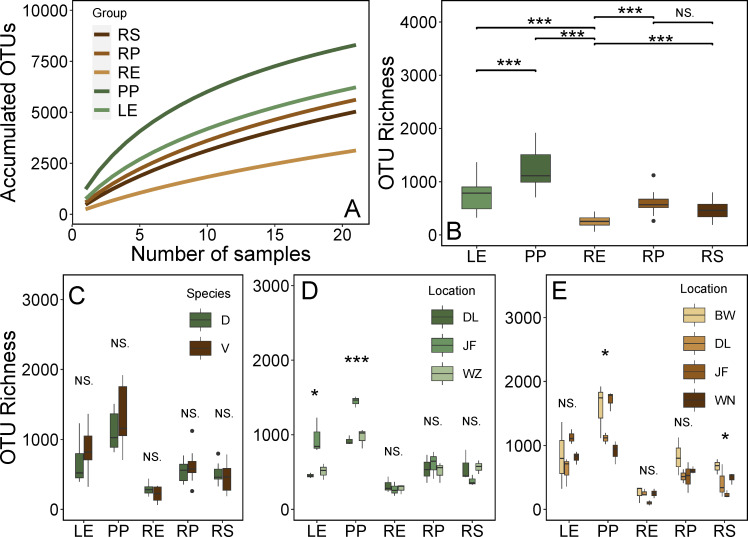
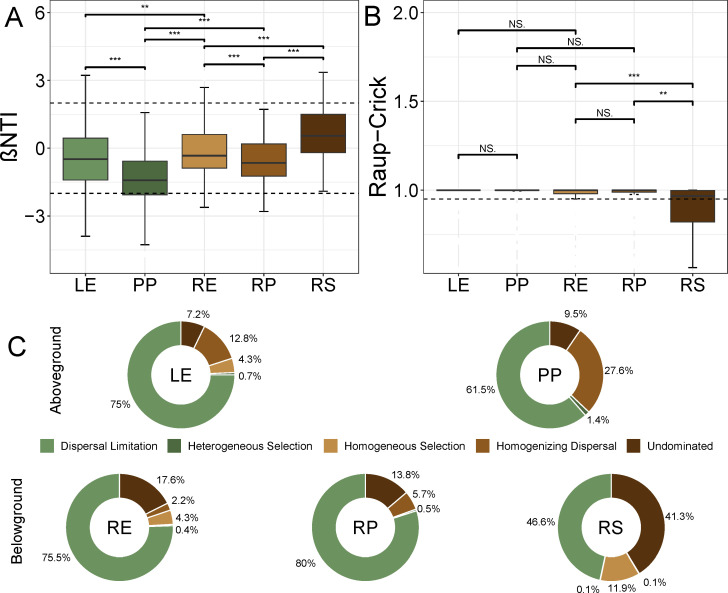
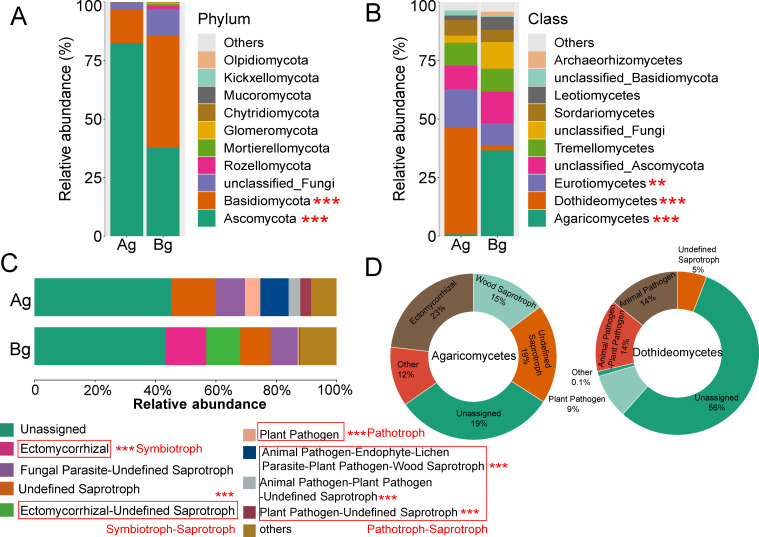
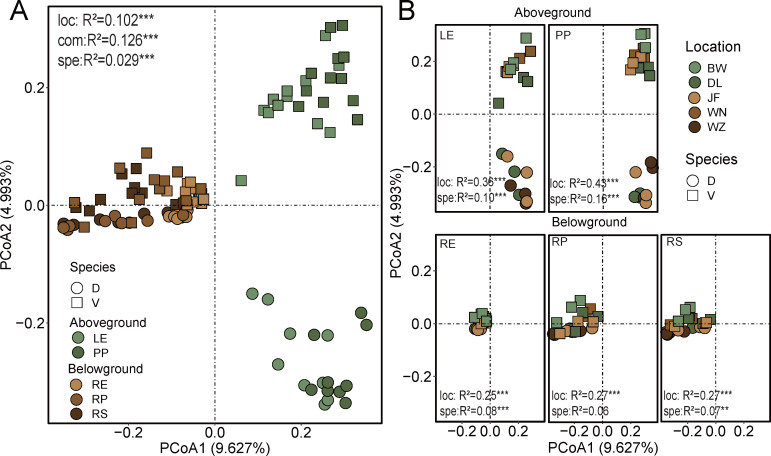
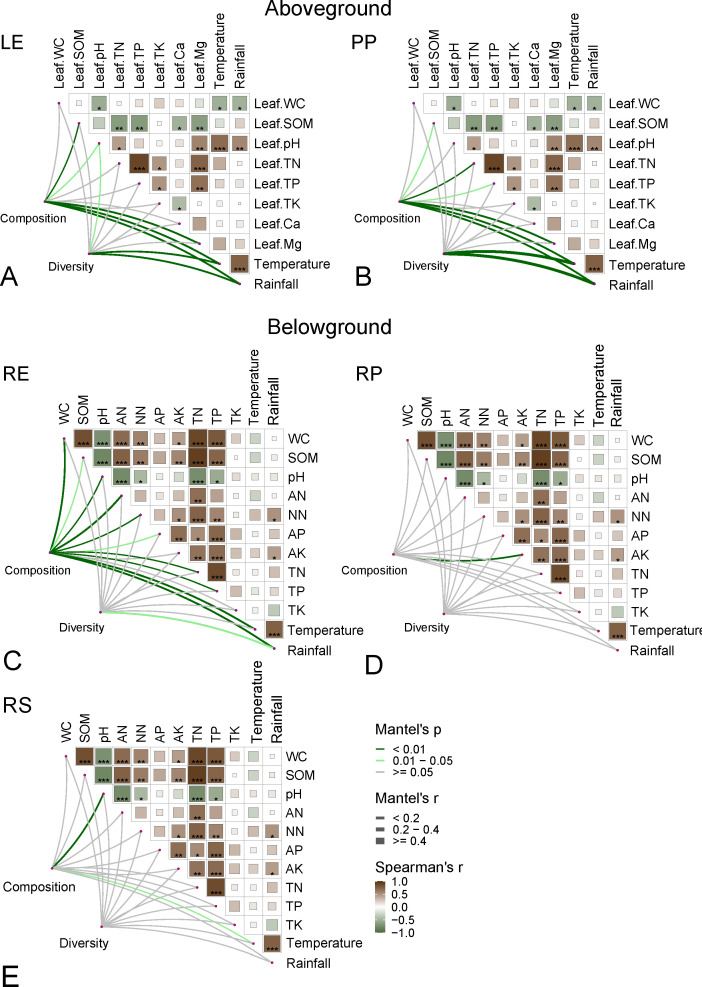
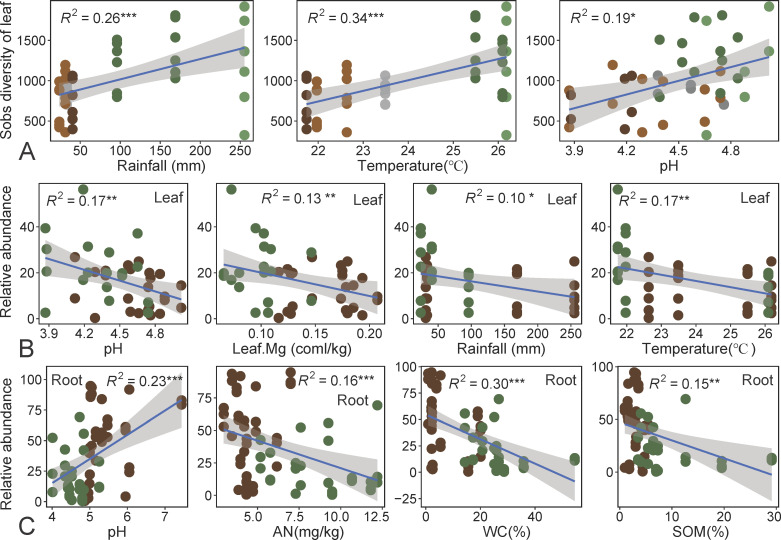
Plant microbial communities are shaped by plant compartments, but the patterns of fungal communities in aboveground and belowground compartments, and which environmental factors can affect them, remain unknown. Here, to address this research gap, high-throughput sequencing technology was performed to investigate the diversity of fungal communities in leaves' and roots' compartments of and from Hainan Island of China. Fungal communities in leaves and roots exhibited significant differences. (16.57%) and (45.57%) were predominantly found in leaves, while (36.53%) dominated in roots. Compared to the roots, the leaf compartments had higher α-diversity. According to the Mantel test, soil pH mainly influenced roots, while the main driving factors for leaves were rainfall and temperature. The proportion of dispersal-limited processes in rhizoplane (76.67%) and root endosphere (73.81%) were greater than that in leaf epiphytic (62.38%) and leaf endophytic (68.1%), driven by ectomycorrhizal fungi with known dispersal limitations. In summary, the compositions of the leaf and root fungal communities of both endangered tree species differed, partly driven by environmental factors unique to each compartment. Our results provide valuable theoretical and practical insights for preserving tropical tree species.
Understanding the assembly of microbial communities across different compartments is a prerequisite for harnessing them to enhance plant growth. Our findings reveal significant differences in fungal community structures between the root and leaf compartments. Compared to the roots, the leaf compartments exhibited higher α-diversity. While soil pH mainly influenced fungal communities in the roots, the primary drivers for the leaves were rainfall and temperature. The dispersal-limited processes of fungal communities in the roots were greater than those in the leaves, primarily influenced by mycorrhizal fungi. These findings demonstrate compartment-specific plant-microbe interactions and environmental responses, offering actionable insights for conserving tropical tree species through habitat optimization (e.g., soil pH management) and dispersal corridor preservation. This compartment-aware perspective enhances our ability to leverage microbial functions to improve the resilience of endangered trees in the face of climate change.
植物微生物群落受植物不同部位影响,但地上和地下部位真菌群落的模式以及哪些环境因素会对其产生影响仍不清楚。在此,为填补这一研究空白,利用高通量测序技术研究了中国海南岛两种濒危树种叶片和根部真菌群落的多样性。叶片和根部的真菌群落存在显著差异。炭疽菌属(16.57%)和枝顶孢属(45.57%)主要存在于叶片中,而镰刀菌属(36.53%)在根部占主导地位。与根部相比,叶片部位具有更高的α多样性。根据Mantel检验,土壤pH主要影响根部,而影响叶片的主要驱动因素是降雨和温度。受已知扩散限制的外生菌根真菌驱动,根际(76.67%)和根内生菌(73.81%)中扩散受限过程的比例高于叶附生菌(62.38%)和叶内生菌(68.1%)。总之,两种濒危树种叶片和根部真菌群落的组成不同,部分原因是每个部位独特的环境因素。我们的研究结果为保护热带树种提供了有价值的理论和实践见解。
了解不同部位微生物群落的组装是利用它们促进植物生长的前提。我们的研究结果揭示了根和叶部位真菌群落结构的显著差异。与根部相比,叶片部位表现出更高的α多样性。虽然土壤pH主要影响根部的真菌群落,但影响叶片的主要驱动因素是降雨和温度。根部真菌群落的扩散受限过程大于叶片,主要受菌根真菌影响。这些发现表明了特定部位的植物 - 微生物相互作用和环境响应,为通过栖息地优化(如土壤pH管理)和扩散走廊保护来保护热带树种提供了可操作的见解。这种考虑部位的观点增强了我们利用微生物功能提高濒危树木在气候变化面前恢复力的能力。