Salazar Hector, Gleason Carey E, Lingler Jennifer H
Department of Health and Community Systems, University of Pittsburgh, Pittsburgh, Pennsylvania, USA.
Department of Medicine, University of Wisconsin-Madison, Madison, Wisconsin, USA.
Innov Aging. 2025 Feb 13;9(4):igaf015. doi: 10.1093/geroni/igaf015. eCollection 2025.
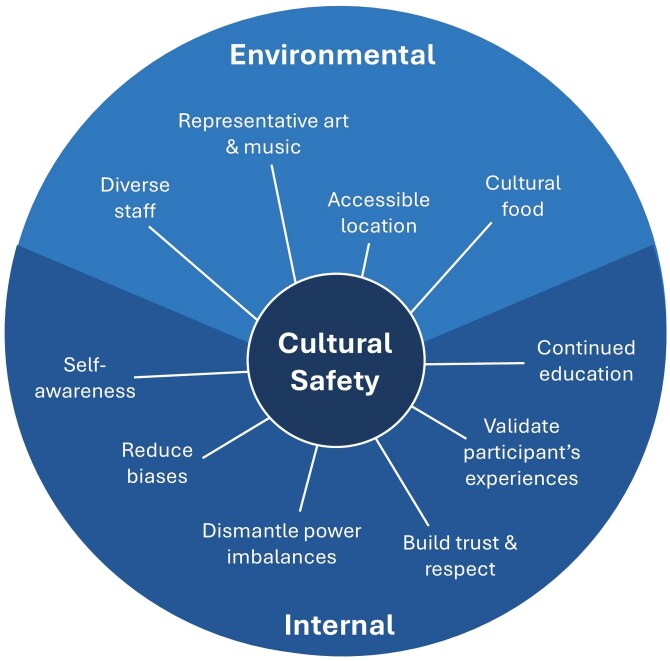
Black Americans are two to three times more likely to develop ADRD than their white counterparts, yet Black Americans make up only 2.4% of ADRD clinical trial participants. Here we provide an overview of the current state of initiatives to maximize racial and ethnic inclusivity in clinical research, particularly among ethnoracialized groups, and introduce the Indigenous-rooted concept of cultural safety through an integrative review and outline of its applicability to the research context. Cultural safety ensures that cultural identities, values, and experiences of minoritized persons are respected, understood, and integrated in their health care journey, empowering them to define and evaluate their own experiences. Implementing cultural safety challenges individuals to confront and critically examine their own perspectives on the dominant culture's traditions and values, as well as their implicit racism, biases, privileges, and inherent power structures. We extend prior conceptual work on cultural safety by proposing two subdimensions: environmental and internal. These must be synergistically integrated to heal fractured relationships between communities of color and researchers. By championing cultural safety, we can create a workforce of self-aware researchers who embody cultural safety's true essence as defined by the communities they serve. Community-engaged research serves as an ideal platform for cultural safety to be meaningfully implemented and sustained. This approach can uplift previously silenced voices in research, build long-term relationships, and generate empirical data that substantiates its positive effects. Importantly, applying environmental and internal cultural safety can empower participants in ADRD research where it is critically needed.
美国黑人患老年痴呆症和相关痴呆症(ADRD)的可能性是白人的两到三倍,但参与ADRD临床试验的美国黑人仅占2.4%。在此,我们概述了当前为使临床研究(尤其是在种族化群体中)实现最大程度的种族和族裔包容性而采取的举措的现状,并通过综合综述介绍了源于本土的文化安全概念,并概述了其在研究背景下的适用性。文化安全确保少数群体的文化身份、价值观和经历在其医疗保健过程中得到尊重、理解和整合,使他们能够定义和评估自己的经历。实施文化安全要求个人面对并批判性地审视自己对主流文化传统和价值观的看法,以及他们潜在的种族主义、偏见、特权和固有的权力结构。我们通过提出两个子维度:环境维度和内部维度,扩展了先前关于文化安全的概念性工作。这两个维度必须协同整合,以修复有色人种社区与研究人员之间破裂的关系。通过倡导文化安全,我们可以打造一支有自我意识的研究人员队伍,他们体现其所服务社区所定义的文化安全的真正内涵。社区参与研究是切实实施和维持文化安全的理想平台。这种方法可以提升研究中以前被忽视的声音,建立长期关系,并生成实证数据来证实其积极影响。重要的是,应用环境文化安全和内部文化安全可以增强ADRD研究中急需的参与者的能力。