Ohseto Hisashi, Ishikuro Mami, Obara Taku, Narita Akira, Takahashi Ippei, Shinoda Genki, Noda Aoi, Murakami Keiko, Orui Masatsugu, Iwama Noriyuki, Kikuya Masahiro, Metoki Hirohito, Sugawara Junichi, Tamiya Gen, Kuriyama Shinichi
Graduate School of Medicine, Tohoku University, Sendai, Miyagi, Japan.
Tohoku Medical Megabank Organization, Tohoku University, Sendai, Miyagi, Japan.
Sci Rep. 2025 Apr 21;15(1):13743. doi: 10.1038/s41598-025-97291-x.
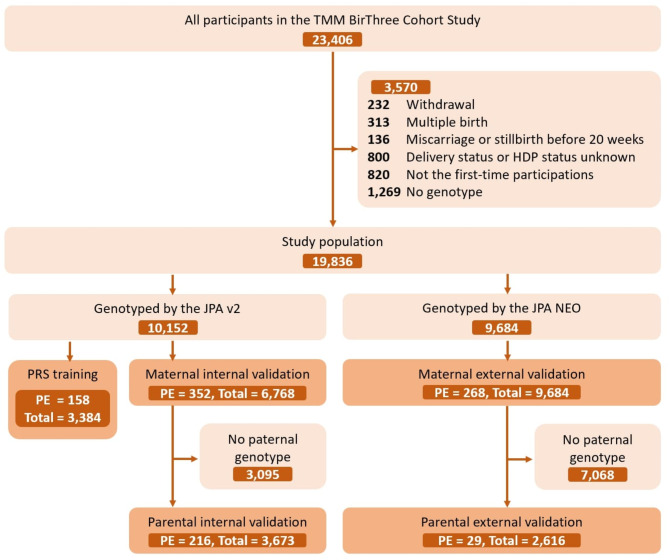
Genomic information from pregnant women and the paternal parent of their fetuses may provide effective biomarkers for preeclampsia (PE). This study investigated the association of parental polygenic risk scores (PRSs) for blood pressure (BP) and PE with PE onset and evaluated predictive performances of PRSs using clinical predictive variables. In the Tohoku Medical Megabank Project Birth and Three-Generation Cohort Study, 19,836 participants were genotyped using either Affymetrix Axiom Japonica Array v2 (further divided into two cohorts-the PRS training cohort and the internal-validation cohort-at a ratio of 1:2) or Japonica Array NEO (external-validation cohort). PRSs were calculated for systolic BP (SBP), diastolic BP (DBP), and PE and hyperparameters for PRS calculation were optimized in the training cohort. PE onset was associated with maternal SBP-, DBP-, and PE-PRSs and paternal SBP- and DBP-PRSs only in the external-validation cohort. Meta-analysis revealed overall associations with maternal PRSs but highlighted significant heterogeneity between cohorts. Maternal DBP-PRS calculated using "LDpred2" presented the most improvement in prediction models and provided additional predictive information on clinical predictive variables. Paternal DBP-PRS improved prediction models in the internal-validation cohort. In conclusion, Parental PRS, along with clinical predictive variables, is potentially useful for predicting PE.
孕妇及其胎儿父系的基因组信息可能为子痫前期(PE)提供有效的生物标志物。本研究调查了父母的血压(BP)和PE多基因风险评分(PRSs)与PE发病的关联,并使用临床预测变量评估了PRSs的预测性能。在东北医学大数据项目出生及三代队列研究中,19836名参与者使用Affymetrix Axiom Japonica Array v2(进一步按1:2的比例分为两个队列——PRS训练队列和内部验证队列)或Japonica Array NEO(外部验证队列)进行基因分型。计算了收缩压(SBP)、舒张压(DBP)和PE的PRSs,并在训练队列中优化了PRS计算的超参数。仅在外部验证队列中,PE发病与母亲的SBP、DBP和PE-PRSs以及父亲的SBP和DBP-PRSs相关。荟萃分析揭示了与母亲PRSs的总体关联,但突出了队列之间的显著异质性。使用“LDpred2”计算的母亲DBP-PRS在预测模型中表现出最大的改善,并提供了关于临床预测变量的额外预测信息。父亲的DBP-PRS在内部验证队列中改善了预测模型。总之,父母的PRS与临床预测变量一起,可能有助于预测PE。