• 文献检索
  • 文档翻译
  • 深度研究
  • 学术资讯
  • Suppr Zotero 插件Zotero 插件
  • 邀请有礼
  • 套餐&价格
  • 历史记录
应用&插件
Suppr Zotero 插件Zotero 插件浏览器插件Mac 客户端Windows 客户端微信小程序
定价
高级版会员购买积分包购买API积分包
服务
文献检索文档翻译深度研究API 文档MCP 服务
关于我们
关于 Suppr公司介绍联系我们用户协议隐私条款
关注我们

Suppr 超能文献

核心技术专利:CN118964589B侵权必究
粤ICP备2023148730 号-1Suppr @ 2026

文献检索

告别复杂PubMed语法,用中文像聊天一样搜索,搜遍4000万医学文献。AI智能推荐,让科研检索更轻松。

立即免费搜索

文件翻译

保留排版,准确专业,支持PDF/Word/PPT等文件格式,支持 12+语言互译。

免费翻译文档

深度研究

AI帮你快速写综述,25分钟生成高质量综述,智能提取关键信息,辅助科研写作。

立即免费体验

抑郁症状、教育程度、性别与移民史——一项基于德国国民队列研究(NAKO)数据的交叉性分析

Depressive symptoms, education, gender and history of migration - an intersectional analysis using data from the German National Cohort (NAKO).

作者信息

Vonneilich Nico, Becher Heiko, Berger Klaus, Bohmann Patricia, Brenner Hermann, Castell Stefanie, Dragano Nico, Harth Volker, Jaskulski Stefanie, Karch André, Keil Thomas, Krist Lilian, Lange Berit, Leitzmann Michael, Massag Janka, Meinke-Franze Claudia, Mikolajczyk Rafael, Obi Nadia, Pischon Tobias, Reuter Marvin, Schmidt Börge, Velásquez Ilais Moreno, Völzke Henry, Wiessner Christian, von dem Knesebeck Olaf, Lüdecke Daniel

机构信息

Institute of Medical Sociology, University Medical Center Hamburg-Eppendorf, Hamburg, Germany.

Institute of Global Health, University Hospital Heidelberg, Heidelberg, Germany.

出版信息

Int J Equity Health. 2025 Apr 21;24(1):108. doi: 10.1186/s12939-025-02479-2.

DOI:10.1186/s12939-025-02479-2
PMID:40259268
原文链接:https://pmc.ncbi.nlm.nih.gov/articles/PMC12010676/
Abstract

BACKGROUND

The educational gradient in depressive symptoms is well documented. Gender and history of migration have also been found to be associated with depressive symptoms. Intersectional approaches enable the analysis of the interplay of different social factors at a time to gain a deeper understanding of inequalities in depressive symptoms. In this study, intersectional inequalities in depressive symptoms according to education, gender and history of migration are analysed.

METHODS

The German National Cohort (NAKO, N = 204,783) collected information on depressive symptoms (PHQ-9), which was used as an outcome variable. Educational attainment (ISCED-97), gender, and history of migration constituted the different social strata in the analyses. The predicted probabilities of depressive symptoms for 30 social strata were calculated. Multilevel analysis of individual heterogeneity and discriminatory accuracy (MAIHDA) was applied, using logistic regression and social strata were introduced as higher-level unit interaction terms.

RESULTS

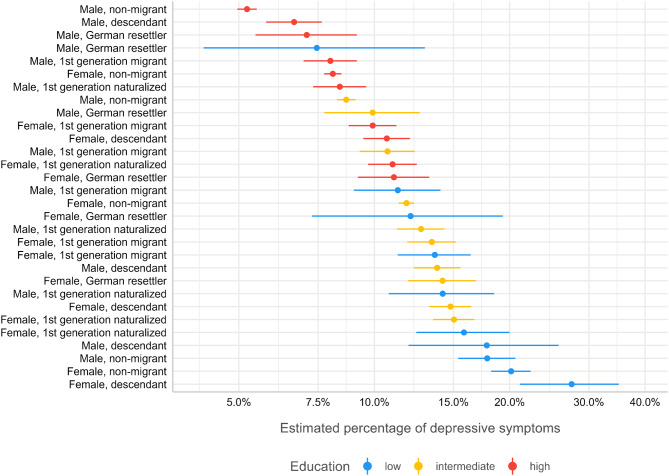
The analyses revealed an educational gradient in depressive symptoms, with differences within each educational group when gender and history of migration were introduced to the models. The predicted probabilities of depressive symptoms varied between the most advantaged and the most disadvantaged social strata by more than 20% points. Among the three studied variables, education contributed the most to the variance explained by the MAIHDA models. The between-strata differences were largely explained by additive effects.

CONCLUSIONS

We observed a robust educational gradient in depressive symptoms, but gender and history of migration had substantial contribution on the magnitude of educational inequalities. An intersectional perspective on inequalities in depressive symptoms enhances current knowledge by showing that different social dimensions may intersect and contribute to inequalities in depressive symptoms. Future studies on inequalities in depression may greatly benefit from an intersectional approach, as it reflects lived inequalities in their diversity.

摘要

背景

抑郁症状的教育梯度已有充分记录。性别和移民史也被发现与抑郁症状有关。交叉性方法能够同时分析不同社会因素之间的相互作用,以更深入地理解抑郁症状方面的不平等现象。在本研究中,分析了根据教育程度、性别和移民史划分的抑郁症状交叉不平等情况。

方法

德国国民队列研究(NAKO,N = 204,783)收集了关于抑郁症状(PHQ - 9)的信息,该信息被用作结果变量。教育程度(国际标准教育分类法 - 97)、性别和移民史构成了分析中的不同社会阶层。计算了30个社会阶层抑郁症状的预测概率。应用个体异质性和判别准确性的多水平分析(MAIHDA),使用逻辑回归,并将社会阶层作为更高级别的单位交互项引入。

结果

分析揭示了抑郁症状的教育梯度,当将性别和移民史纳入模型时,每个教育组内部存在差异。最具优势和最弱势社会阶层之间抑郁症状的预测概率差异超过20个百分点。在研究的三个变量中,教育对MAIHDA模型解释的方差贡献最大。阶层间差异在很大程度上由加性效应解释。

结论

我们观察到抑郁症状存在稳健的教育梯度,但性别和移民史对教育不平等的程度有重大贡献。从交叉性角度看待抑郁症状的不平等现象,通过表明不同社会维度可能相互交叉并导致抑郁症状的不平等,增强了当前的知识。未来关于抑郁症不平等现象的研究可能会从交叉性方法中受益匪浅,因为它反映了现实生活中多样化的不平等现象。
https://cdn.ncbi.nlm.nih.gov/pmc/blobs/9118/12010676/a2273bb023c5/12939_2025_2479_Fig1_HTML.jpg

相似文献

1
Depressive symptoms, education, gender and history of migration - an intersectional analysis using data from the German National Cohort (NAKO).抑郁症状、教育程度、性别与移民史——一项基于德国国民队列研究(NAKO)数据的交叉性分析
Int J Equity Health. 2025 Apr 21;24(1):108. doi: 10.1186/s12939-025-02479-2.
2
Intersectional analysis of social disparities in type 2 diabetes risk among adults in Germany: results from a nationwide population-based survey.德国成年人 2 型糖尿病风险的社会差异的交叉分析:一项全国性基于人群的调查结果。
BMC Public Health. 2024 Feb 16;24(1):498. doi: 10.1186/s12889-024-17903-5.
3
Mapping intersectional sociodemographic inequalities in measurement and prevalence of depressive symptoms: a intersectional multilevel analysis of individual heterogeneity and discriminatory accuracy using data from a population-based nationwide survey in Germany.绘制交叉社会人口学不平等现象在抑郁症状的测量和流行中的图:基于德国全国性人口普查数据的个体异质性和歧视准确性的交叉多水平分析。
J Clin Epidemiol. 2024 Sep;173:111446. doi: 10.1016/j.jclinepi.2024.111446. Epub 2024 Jul 2.
4
Intersectional inequalities in mental health by education, income, gender, and age before and during the COVID-19 pandemic in the Netherlands: a longitudinal study.荷兰在 COVID-19 大流行前后,按教育、收入、性别和年龄划分的心理健康交叉不平等:一项纵向研究。
Int J Equity Health. 2024 Nov 25;23(1):250. doi: 10.1186/s12939-024-02338-6.
5
Non-response in a national health survey in Germany: An intersectionality-informed multilevel analysis of individual heterogeneity and discriminatory accuracy.德国国家健康调查中的无应答问题:基于交叉性视角的个体异质性和歧视准确性的多层次分析。
PLoS One. 2020 Aug 10;15(8):e0237349. doi: 10.1371/journal.pone.0237349. eCollection 2020.
6
Intersectional inequalities in health anxiety: multilevel analysis of individual heterogeneity and discriminatory accuracy in the SOMA.SOC study.健康焦虑的交叉不平等:SOMA.SOC 研究中个体异质性和歧视准确性的多层次分析。
Front Public Health. 2024 Jun 26;12:1388773. doi: 10.3389/fpubh.2024.1388773. eCollection 2024.
7
Mental Health and the Intersection of Perceived Discrimination and Social Inequalities Among Students in Germany - a Quantitative Intersectional Study.德国学生的心理健康以及感知到的歧视与社会不平等的交叉研究——一项定量交叉性研究
Int J Public Health. 2025 Jan 15;69:1607826. doi: 10.3389/ijph.2024.1607826. eCollection 2024.
8
Chronic Obstructive Pulmonary Disease in Sweden: An intersectional multilevel analysis of individual heterogeneity and discriminatory accuracy.瑞典的慢性阻塞性肺疾病:个体异质性与判别准确性的交叉多层次分析
SSM Popul Health. 2018 Mar 20;4:334-346. doi: 10.1016/j.ssmph.2018.03.005. eCollection 2018 Apr.
9
Precision public health: Mapping socioeconomic disparities in opioid dispensations at Swedish pharmacies by Multilevel Analysis of Individual Heterogeneity and Discriminatory Accuracy (MAIHDA).精准公共卫生:通过个体异质性和判别准确性的多层次分析(MAIHDA)对瑞典药店阿片类药物配给的社会经济差异进行映射。
PLoS One. 2019 Aug 27;14(8):e0220322. doi: 10.1371/journal.pone.0220322. eCollection 2019.
10
Socioeconomic differences in body mass index in Spain: An intersectional multilevel analysis of individual heterogeneity and discriminatory accuracy.西班牙身体质量指数的社会经济差异:个体异质性和歧视准确性的交叉多层次分析。
PLoS One. 2018 Dec 10;13(12):e0208624. doi: 10.1371/journal.pone.0208624. eCollection 2018.

本文引用的文献

1
Intersectional inequalities in health anxiety: multilevel analysis of individual heterogeneity and discriminatory accuracy in the SOMA.SOC study.健康焦虑的交叉不平等:SOMA.SOC 研究中个体异质性和歧视准确性的多层次分析。
Front Public Health. 2024 Jun 26;12:1388773. doi: 10.3389/fpubh.2024.1388773. eCollection 2024.
2
Clarifications on the intersectional MAIHDA approach: A conceptual guide and response to Wilkes and Karimi (2024).对交叉 MAHIDA 方法的澄清:概念指南及对 Wilkes 和 Karimi(2024)的回应。
Soc Sci Med. 2024 Jun;350:116898. doi: 10.1016/j.socscimed.2024.116898. Epub 2024 Apr 24.
3
A tutorial for conducting intersectional multilevel analysis of individual heterogeneity and discriminatory accuracy (MAIHDA).
个体异质性与判别准确性的交叉多层次分析(MAIHDA)操作指南
SSM Popul Health. 2024 Mar 26;26:101664. doi: 10.1016/j.ssmph.2024.101664. eCollection 2024 Jun.
4
The "Why" behind including "Y" in your imputation model.纳入“Y”的推断模型背后的“原因”。
Stat Methods Med Res. 2024 Jun;33(6):996-1020. doi: 10.1177/09622802241244608. Epub 2024 Apr 16.
5
Health Service Use Among Migrants in the German National Cohort-The Role of Birth Region and Language Skills.德国国家队列研究中的移民健康服务利用——出生地区和语言技能的作用。
Int J Public Health. 2024 Mar 6;69:1606377. doi: 10.3389/ijph.2024.1606377. eCollection 2024.
6
Impairments in psychological functioning in refugees and asylum seekers.难民和寻求庇护者的心理功能障碍。
Front Psychol. 2024 Jan 8;14:1295031. doi: 10.3389/fpsyg.2023.1295031. eCollection 2023.
7
Associations of Migration, Socioeconomic Position and Social Relations With Depressive Symptoms - Analyses of the German National Cohort Baseline Data.移民、社会经济地位和社会关系与抑郁症状的关联 - 德国国家队列基线数据的分析。
Int J Public Health. 2023 Jul 18;68:1606097. doi: 10.3389/ijph.2023.1606097. eCollection 2023.
8
Traumatic Life Events and Association With Depression, Anxiety, and Somatization Symptoms in Female Refugees.创伤性生活事件与女性难民的抑郁、焦虑和躯体化症状的关系。
JAMA Netw Open. 2023 Jul 3;6(7):e2324511. doi: 10.1001/jamanetworkopen.2023.24511.
9
Health of people with selected citizenships: results of the study GEDA Fokus.特定国籍人群的健康状况:德国成人精神疾病调查聚焦研究结果
J Health Monit. 2023 Mar 21;8(1):7-33. doi: 10.25646/11143. eCollection 2023 Mar.
10
Framework and baseline examination of the German National Cohort (NAKO).德国国家队列研究(NAKO)的框架和基线检查。
Eur J Epidemiol. 2022 Oct;37(10):1107-1124. doi: 10.1007/s10654-022-00890-5. Epub 2022 Oct 19.