Ezzat Heba A M, Younis Nermin A, Zafer Mai M, Kamal Amel M, Abdelhady Mohamed I S, Mady Mohamed S
Department of Pharmacognosy, Faculty of Pharmacy, Ahram Canadian University, Giza, Egypt.
Department of Microbiology and Immunology, Faculty of Pharmacy, Ahram Canadian University, Cairo, Egypt.
BMC Complement Med Ther. 2025 Apr 21;25(1):144. doi: 10.1186/s12906-025-04826-w.
Myrtaceae and Podocarpaceae botanical families include several aromatic species that have been proven to have diverse pharmacological potential, especially antimicrobial effects. Additionally, plants of both families were reported for their benefits in traditional medicine. The current study demonstrated the chemical profile, antimicrobial of four investigated plant species (C. subulatus, C. rigidus, P. gracilior, and P. elongatus) leaves cultivated in the same place in Egypt and propose in-silico modeling for the antibacterial mechanistic action.
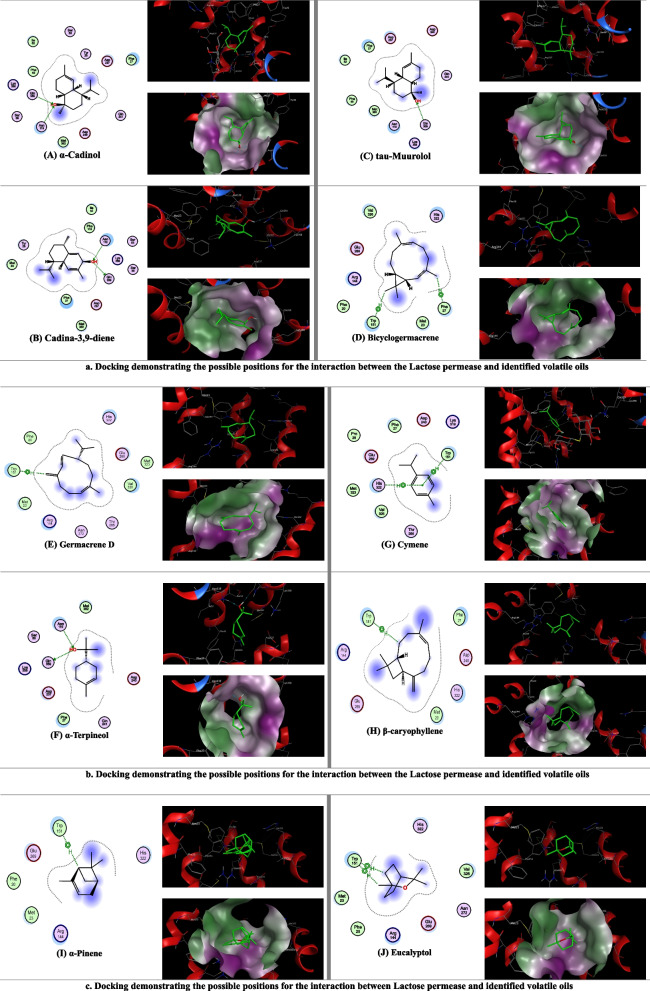
The essential oils samples were prepared via hydrodistillation and headspace extraction protocol and GC analysis was conducted to obtain a comparative chemical profile. The antimicrobial activity of the obtained hydrodistillation essential oil samples was screened via agar diffusion, and the MIC was calculated via broth microdilution assays. An in silico molecular docking study was performed to investigate the inhibition of the LacY protease efflux pump.
GC results revealed that the percentage of oxygenated monoterpenes was highest in the oil samples from Callistemon species (60.38 and 82.68%). In contrast, sesquiterpene hydrocarbons constituted the highest percentage of volatile classes in the oil samples from Podocarpus species (57.37 and 43.16%). C. rigidus-EO shows significant inhibitory activity against Gram-negative and Gram-positive pathogens, especially E. coli and S. viridans, with a calculated MIC of 0.878 ml, whereas P. elongatus EO shows notable activity against coagulase-negative Staphylococcus and the activity was comparable to that of the positive control antibiotics used (ciprofloxacin & doxycycline). Ultimately, an in silico molecular docking study on the binding site of the LacY protease enzyme revealed a significant binding affinity of the major docked volatile constituents.
The plant species investigated are considered a vital source of safe antimicrobial volatile constituents that are recommended as bioactive entities for controlling microbial infection topically or systemically. The proposed mechanistic action encourages further modification of the major EOs chemical structure by adding more polar substitutions to improve the binding affinity and produce more active semisynthetic analogues.
桃金娘科和罗汉松科植物包含多种芳香植物,已被证明具有多种药理潜力,尤其是抗菌作用。此外,这两个科的植物在传统医学中也有诸多益处。本研究展示了在埃及同一地点种植的四种被调查植物(细枝红千层、硬枝红千层、纤细罗汉松和长叶罗汉松)叶片的化学特征、抗菌性能,并对其抗菌作用机制进行了计算机模拟建模。
通过水蒸馏和顶空萃取法制备精油样品,并进行气相色谱分析以获得比较化学特征。通过琼脂扩散法筛选所得水蒸馏精油样品的抗菌活性,并通过肉汤微量稀释法计算最低抑菌浓度(MIC)。进行了计算机模拟分子对接研究,以研究对LacY蛋白酶外排泵的抑制作用。
气相色谱结果显示,红千层属植物精油样品中氧化单萜的百分比最高(分别为60.38%和82.68%)。相比之下,罗汉松属植物精油样品中倍半萜烃在挥发性成分中所占百分比最高(分别为57.37%和43.16%)。硬枝红千层精油对革兰氏阴性和革兰氏阳性病原体,尤其是大肠杆菌和草绿色链球菌具有显著抑制活性,计算得出的MIC为0.878毫升,而长叶罗汉松精油对凝固酶阴性葡萄球菌具有显著活性,且该活性与所用阳性对照抗生素(环丙沙星和强力霉素)相当。最终,对LacY蛋白酶的结合位点进行的计算机模拟分子对接研究表明,主要对接的挥发性成分具有显著的结合亲和力。
所研究的植物物种被认为是安全抗菌挥发性成分的重要来源,推荐将其作为生物活性物质用于局部或全身控制微生物感染。所提出的作用机制鼓励通过添加更多极性取代基来进一步修饰主要精油的化学结构,以提高结合亲和力并生产出更具活性的半合成类似物。