Darvishi Nahid, Farhadi Mehran, Poorolajal Jalal
Department of Psychology, Sanandaj Branch, Islamic Azad University, Sanandaj, Iran.
Department of Psychology, Faculty of Economics and Social Sciences, Bu-Ali Sina University Hamadan, Iran.
J Res Health Sci. 2025 Apr 1;25(2):e00643. doi: 10.34172/jrhs.2025.178.
Despite extensive research examining the relationship between emotional intelligence (EI) and suicide, the extent to which EI can prevent suicidal behaviors remains unclear. This systematic review and meta-analysis aimed to investigate this relationship. This is a systematic review and meta-analysis study.
A comprehensive search was conducted on PubMed, Web of Science, and Scopus databases up to September 8, 2024. Studies exploring the relationship between mean EI scores and suicidal behaviors were included. Between-study heterogeneity was assessed using I statistics, and the likelihood of publication bias was evaluated using Begg's and Egger's tests. The primary outcome was the standardized mean difference (SMD) in EI scores between individuals with and without suicidal behaviors or ideation using a random-effects model.
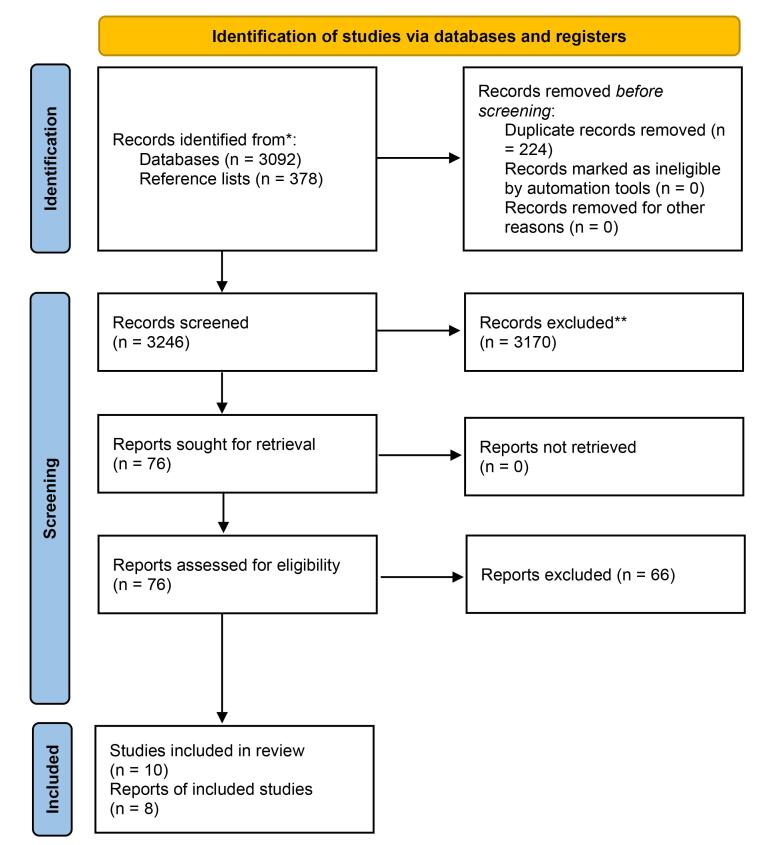
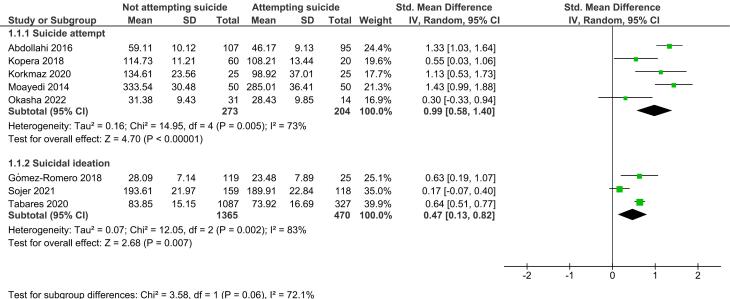
Out of 3470 studies initially identified, 10 studies (including 2532 participants) met the eligibility criteria. The results showed that individuals without suicidal attempts had significantly higher overall EI scores than those who did (SMD=0.99; 95% CI: 0.58-1.40; <0.001). Similarly, individuals without suicidal ideation had significantly higher EI scores (SMD=0.47; 95% CI: 0.13-0.82; =0.007). No evidence of publication bias was found (=0.525).
These findings suggest that higher EI is associated with a reduced risk of suicidal ideation and attempts. Incorporating EI into psychological treatments and suicide prevention programs may be beneficial in mitigating suicidal behaviors.
尽管对情商(EI)与自杀之间的关系进行了广泛研究,但情商在多大程度上能够预防自杀行为仍不明确。本系统评价和荟萃分析旨在研究这种关系。这是一项系统评价和荟萃分析研究。
截至2024年9月8日,对PubMed、科学网和Scopus数据库进行了全面检索。纳入探讨平均情商得分与自杀行为之间关系的研究。使用I统计量评估研究间的异质性,并使用Begg检验和Egger检验评估发表偏倚的可能性。主要结局是采用随机效应模型,有自杀行为或想法者与无自杀行为或想法者之间情商得分的标准化均数差(SMD)。
在最初识别的3470项研究中,10项研究(包括2532名参与者)符合纳入标准。结果显示,无自杀未遂者的总体情商得分显著高于有自杀未遂者(SMD = 0.99;95%CI:0.58 - 1.40;P < 0.001)。同样,无自杀意念者的情商得分显著更高(SMD = 0.47;95%CI:0.13 - 0.82;P = 0.007)。未发现发表偏倚证据(P = 0.525)。
这些发现表明,较高的情商与自杀意念和自杀未遂风险降低相关。将情商纳入心理治疗和自杀预防项目可能有助于减轻自杀行为。