Sposato Alessio, Del Sambro Laura, Castellana Stefano, Catalano Elisabetta, Galgano Michela, Castellana Antonella, Caffò Annamaria, Manzulli Viviana, Caruso Marta, Marino Leonardo, Milano Angelica, Addante Luciana
Department of Public Health, Experimental and Forensic Medicine, University of Pavia, Via Carlo Forlanini 2, 27100 Pavia, Italy.
Istituto Zooprofilattico Sperimentale della Puglia e della Basilicata, Via Manfredonia 20, 71121 Foggia, Italy.
Vet Sci. 2025 Mar 19;12(3):286. doi: 10.3390/vetsci12030286.
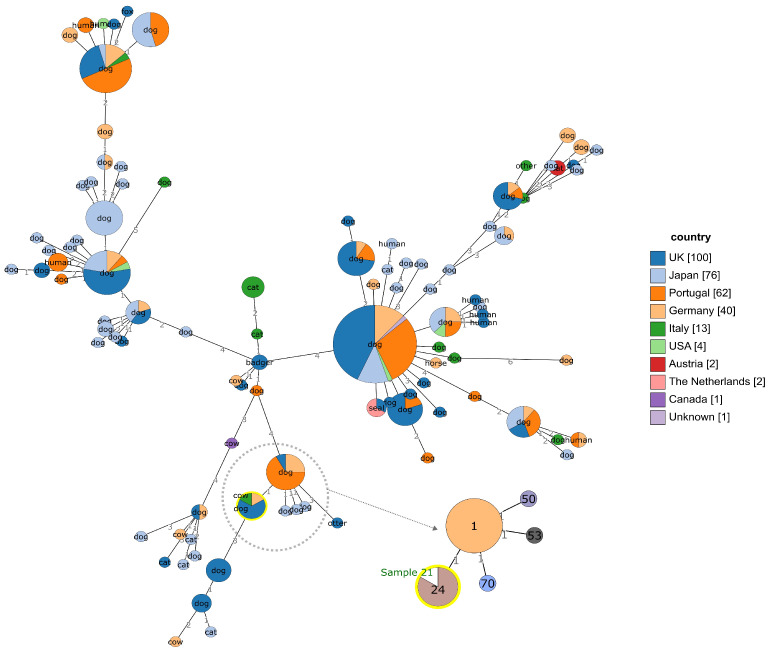
In the present study, we isolated from milk samples in a dairy farm with suspicions of subclinical mastitis. Milk samples testing positive on California Mastitis Test (CMT) were collected from different cows for bacteriological and genomic analyses to identify the causative pathogen, and somatic cell counts (SCC) were determined. A multiplex qPCR assay was conducted to detect 15 potential pathogens, and all samples showed negative results. Conventional bacteriology procedures were performed; DNA of the bacterial strains was extracted, sequenced, and submitted to bioinformatic analysis. Three CMT positive milk samples showed SCC > 200 × 10 cell/mL. However, these same three samples were positive for bacteria phenotypically identified as Streptococci, and the strains were confirmed as using MS MALDI-TOF methodology. In susceptibility testing, resistance against tetracycline was detected, revealing a potential chronic infection in one cow, while the presence of the same bacteria was observed in two other cows. Genomic DNA from four isolates, obtained in the first and second sampling, was sequenced. Genetic relationships revealed a unique sequence type (ST24). The gene () related with resistance to TE was highlighted. Although the association between and mastitis is not routinely detected, early diagnosis of bacterial infections and the study of the antimicrobial profile are crucial for effective therapy. Pets could act as a potential reservoir, so improving hygienic conditions is needed to prevent new infections.
在本研究中,我们从一个怀疑存在亚临床乳腺炎的奶牛场的牛奶样本中进行分离。对加利福尼亚乳腺炎检测(CMT)呈阳性的牛奶样本从不同奶牛采集,用于细菌学和基因组分析以鉴定致病病原体,并测定体细胞计数(SCC)。进行了多重定量聚合酶链反应(qPCR)检测15种潜在病原体,所有样本结果均为阴性。进行了常规细菌学程序;提取细菌菌株的DNA,进行测序,并提交生物信息学分析。三个CMT阳性牛奶样本的SCC>200×10⁵细胞/mL。然而,这相同的三个样本经表型鉴定为链球菌的细菌呈阳性,并且这些菌株使用基质辅助激光解吸电离飞行时间质谱(MS MALDI-TOF)方法得到确认。在药敏试验中,检测到对四环素的耐药性,揭示一头奶牛存在潜在的慢性感染,同时在另外两头奶牛中也观察到相同细菌的存在。对在第一次和第二次采样中获得的四株分离株的基因组DNA进行测序。遗传关系显示出一种独特的序列类型(ST24)。突出显示了与对四环素耐药相关的基因(tet)。尽管tet与乳腺炎之间的关联并非常规检测到,但细菌感染的早期诊断和抗菌谱的研究对于有效治疗至关重要。宠物可能作为潜在的储存宿主,因此需要改善卫生条件以预防新的感染。