State Key Laboratory for Diagnosis and Treatment of Infectious Diseases, National Clinical Research Center for Infectious Diseases, Collaborative Innovation Center for Diagnosis and Treatment of Infectious Diseases, The Department of Infectious Diseases, The First Affiliated Hospital, School of Medicine, Zhejiang University, 79, QingChun Road, Hangzhou, 310003, China.
Ningbo Medical Center Lihuili Hospital, Ningbo, 315000, China.
BMC Microbiol. 2021 Jan 6;21(1):11. doi: 10.1186/s12866-020-02074-1.
Although gut microbiota dysbiosis has been reported in HIV infected individuals recently, the relationship between the gut microbiota and immune activation in patients with different immune responses to highly active antiretroviral therapy (HAART) is still not well understood. Gut microbiota and immune activation were studied in 36 non-HIV-infected subjects (healthy controls) and 58 HIV-infected individuals, including 28 immunological responders (IR) and 30 immunological non-responders (INR) (≥500 and < 200 CD4+ T-cell counts/μl after 2 years of HIV-1 viral suppression respectively) without comorbidities.
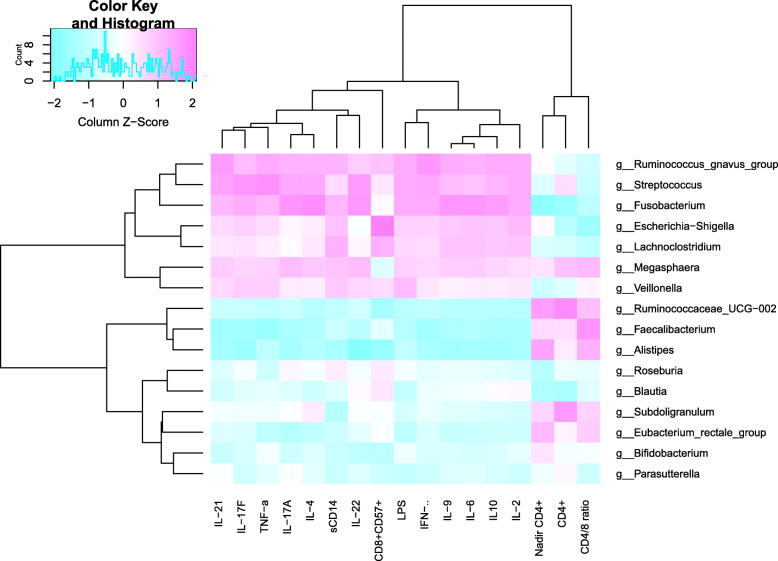
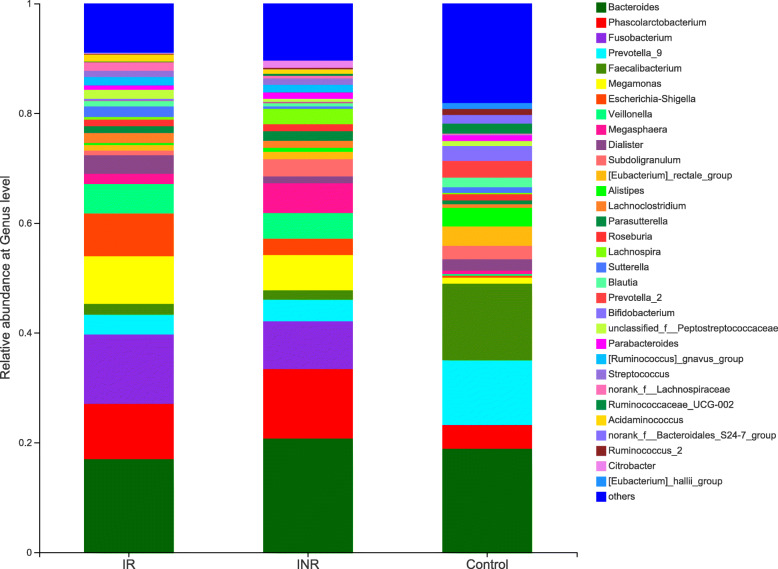
Metagenome sequencing revealed that HIV-infected immunological responders and immunological non-responders could not recover completely from the gut microbiota dysbiosis. At a 97% similarity level, the relative abundances of Fusobacterium, Ruminococcus gnavus and Megamonas were greater, whereas Faecalibacterium, Alistipes, Bifidobacterium, Eubacterium rectale and Roseburia were more depleted in the IR and INR groups than those in the healthy controls. Ruminococcaceae and Alistipes were positively correlated with nadir and current CD4+ T-cell counts, but negatively correlated with CD8 + CD57+ T-cell counts. Inflammation markers and translocation biomarkers (LPS) levels were positively correlated with the abundances of genera Ruminococcus and Fusobacterium but were negatively correlated with the genus Faecalibacterium. The relative abundances of Escherichia-Shigella and Blautia were significantly higher in the IR than those in the INR group. Escherichia-Shigella were negatively correlated with the CD4/CD8 ratio but positively correlated with the amount of CD8 + CD57+ T-cells. Roseburia and Blautia were negatively associated with nadir CD4+ T-cell and positively associated with CD8 + CD57+ T-cell counts.
Gut microbiota dysbiosis may be one of the factors contributing to different immune responses and treatment outcomes to HAART.
虽然最近有报道称 HIV 感染者存在肠道菌群失调,但对于不同高效抗逆转录病毒治疗(HAART)免疫反应患者的肠道菌群与免疫激活之间的关系仍了解甚少。本研究在 36 名非 HIV 感染者(健康对照)和 58 名 HIV 感染者中研究了肠道菌群和免疫激活,其中包括 28 名免疫应答者(IR)和 30 名免疫无应答者(INR)(分别在 2 年 HIV-1 病毒抑制后 CD4+T 细胞计数≥500 和<200/μl),且无合并症。
宏基因组测序显示,HIV 感染的免疫应答者和免疫无应答者不能从肠道菌群失调中完全恢复。在 97%相似水平上,IR 和 INR 组中梭菌属、罗氏真杆菌和巨单胞菌的相对丰度较高,而粪杆菌、真杆菌属、双歧杆菌属、直肠真杆菌和罗氏菌属的相对丰度则低于健康对照组。瘤胃球菌科和真杆菌属与 CD4+T 细胞计数的最低值和当前值呈正相关,但与 CD8+CD57+T 细胞计数呈负相关。炎症标志物和易位生物标志物(LPS)水平与 Ruminococcus 和 Fusobacterium 属的丰度呈正相关,与 Faecalibacterium 属的丰度呈负相关。IR 组中大肠杆菌-志贺菌属和布劳特氏菌属的相对丰度明显高于 INR 组。大肠杆菌-志贺菌属与 CD4/CD8 比值呈负相关,与 CD8+CD57+T 细胞数量呈正相关。罗氏菌属和布劳特氏菌属与最低 CD4+T 细胞计数呈负相关,与 CD8+CD57+T 细胞计数呈正相关。
肠道菌群失调可能是导致不同 HAART 免疫反应和治疗结果的因素之一。