
COVID-19大流行之前、期间和之后上消化道鳞状细胞癌治疗决策与治疗实施之间的一致性:一项回顾性分析
Alignment Between Treatment Decision and Treatment Administration for Squamous Cell Carcinoma of the Upper Aerodigestive Tract Before, During, and After the COVID-19 Pandemic: A Retrospective Analysis.
作者信息
Reliquet Benjamin, Thibault Thomas, Elhomsy Paul, Chbihi Dounia, Folia Mireille, Guigou Caroline
机构信息
Department of Otolaryngology-Head and Neck Surgery, Dijon University Hospital, 21000 Dijon, France.
Department of Internal Medicine, Dijon University Hospital, 21000 Dijon, France.
出版信息
J Clin Med. 2025 Apr 10;14(8):2613. doi: 10.3390/jcm14082613.
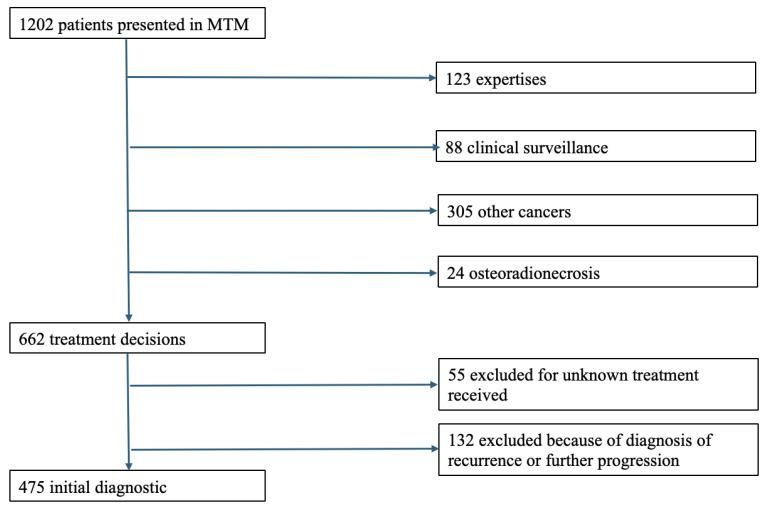
: The aim of this study was to assess the impact of the COVID-19 pandemic on the adequacy between treatment decisions made in multidisciplinary team meetings (MTMs) and therapy administered to patients with upper aerodigestive tract cancers. Secondary aims included assessing treatment administration times at different periods and identifying factors explaining discrepancies. : A retrospective, monocentric study was conducted at a university hospital center from 2019 to 2021, including 475 first-line patients. Patients were divided into two groups: those with matching treatments (MTMs vs. delivered) and those with discrepancies. Alignment between treatment decision and treatment delivery was compared among the three periods (before, during, and after the COVID-19 pandemic), and factors influencing non-alignment were analyzed using univariate and multivariate analysis. : Of the 475 patients, 106 (23%) received treatments differing from MTM decisions. The pandemic period saw more advanced cancers (4.8% metastatic in 2019 vs. 12% in 2020), poorer general condition, and undernutrition. The pandemic did not significantly affect treatment matching ( = 0.4). Factors linked to mismatches included worse general condition (PS ≥ 2, < 0.001) and more locally advanced tumors (T3/4, = 0.002). Shorter processing times were noted during the pandemic and post-pandemic periods. : Despite more advanced cancers and poorer general condition, patients treated during the pandemic had continuous care and similar treatment alignment as before. This study shows the effectiveness of ongoing care during the pandemic, ensuring treatment adherence.
本研究的目的是评估2019冠状病毒病大流行对上消化道癌症患者多学科团队会议(MTM)做出的治疗决策与给予患者的治疗之间的适配性的影响。次要目的包括评估不同时期的治疗给药时间,并确定解释差异的因素。:2019年至2021年在一家大学医院中心进行了一项回顾性单中心研究,纳入475例一线患者。患者分为两组:治疗匹配组(MTM决策与实际给予的治疗)和存在差异组。比较了三个时期(2019冠状病毒病大流行之前、期间和之后)治疗决策与治疗实施之间的一致性,并使用单因素和多因素分析来分析影响不一致的因素。:在475例患者中,106例(23%)接受的治疗与MTM决策不同。大流行期间癌症进展更为严重(2019年转移率为4.8%,2020年为12%),一般状况较差,且存在营养不良。大流行对治疗匹配度没有显著影响(P = 0.4)。与不匹配相关的因素包括一般状况较差(PS≥2,P<0.001)和局部肿瘤进展更严重(T3/4,P = 0.002)。在大流行期间和大流行后时期,处理时间较短。:尽管癌症进展更严重且一般状况较差,但在大流行期间接受治疗的患者仍获得了持续护理,且治疗匹配度与之前相似。本研究显示了大流行期间持续护理的有效性,确保了治疗依从性。
 Zotero 插件