Asakura Shinnosuke, Kamogashira Teru, Funayama Hideaki, Kataoka Toshitaka, Shoji Shizuka, Koizumi Megumi, Ishimoto Shinichi, Yamasoba Tatsuya
Department of Clinical Examination, JR Tokyo General Hospital, Tokyo 151-8528, Japan.
Department of Otolaryngology, JR Tokyo General Hospital, Tokyo 151-8528, Japan.
J Clin Med. 2025 Apr 17;14(8):2766. doi: 10.3390/jcm14082766.
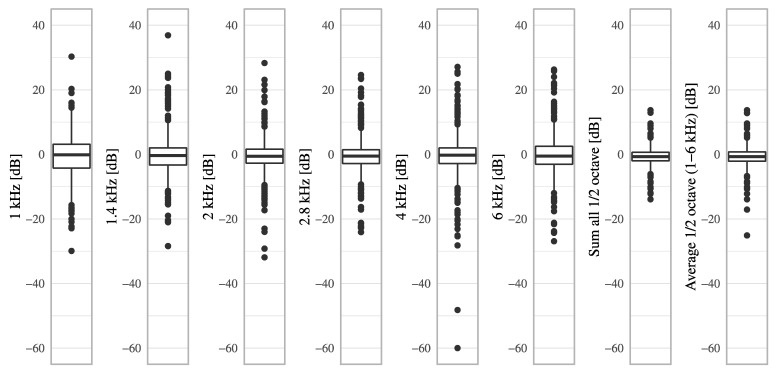
: The objective of this study is to determine whether the strong acoustic stimuli used in vestibular evoked myogenic potential (VEMP) testing contribute to distortion product otoacoustic emission (DPOAE) level reduction due to noise-induced hearing loss. : The DPOAE levels were measured routinely to evaluate vestibular balance disorders with sensorineural hearing loss and to monitor changes in cochlear function before and after VEMP. The changes in DPOAE levels after VEMP testing in 174 patients (80 males and 94 females; median age, 53 years [interquartile range, 39-67 years; range, 15-85 years]) who were examined in the vertigo outpatient clinic between June 2021 and December 2024 were retrospectively analyzed. : The DPOAE levels decreased significantly after VEMP testing at 1.4 kHz, 2 kHz, 2.8 kHz, sum all 1/2 octave, and average 1/2 octave (1-6 kHz). The decrease in DPOAE levels at 6 kHz exhibited a significant negative linear correlation with age (the coefficient of determination: 0.0189, = 0.01), but not sex or side. : The strong sound stimulation used in VEMP testing can decrease DPOAE levels. The frequencies at which DPOAE levels decreased significantly were overtones of the stimulus frequency, suggesting a possible effect of acoustic stimulation. VEMP testing can be an invasive test method and should be performed with detailed consideration of the risks and benefits. The age factor can influence the decrease in DPOAE levels in VEMP testing.
本研究的目的是确定前庭诱发肌源性电位(VEMP)测试中使用的强声刺激是否会因噪声性听力损失导致畸变产物耳声发射(DPOAE)水平降低。常规测量DPOAE水平,以评估感音神经性听力损失患者的前庭平衡障碍,并监测VEMP前后耳蜗功能的变化。对2021年6月至2024年12月在眩晕门诊接受检查的174例患者(80例男性和94例女性;年龄中位数为53岁[四分位间距为39 - 67岁;范围为15 - 85岁])进行VEMP测试后DPOAE水平的变化进行回顾性分析。VEMP测试后,1.4 kHz、2 kHz、2.8 kHz、所有1/2倍频程总和以及平均1/2倍频程(1 - 6 kHz)处的DPOAE水平显著下降。6 kHz处DPOAE水平的下降与年龄呈显著负线性相关(决定系数:0.0189,P = 0.01),但与性别或患侧无关。VEMP测试中使用的强声刺激可降低DPOAE水平。DPOAE水平显著下降的频率是刺激频率的泛音,提示存在声刺激效应。VEMP测试可能是一种有创检查方法,应在充分考虑风险和益处的情况下进行。年龄因素可影响VEMP测试中DPOAE水平的下降。