Quan Haiyan, Yin Hongguo, Wang Zhen, Lv Yuan, Sun Qiong, Yin Ting
Hunan Polytechnic of Environment and Biology, Hengyang, Hunan, China.
Department of Ophthalmology, The Second Affiliated Hospital, University of South China, Hengyang, Hunan, China.
Braz J Otorhinolaryngol. 2025 Apr 25;91(4):101618. doi: 10.1016/j.bjorl.2025.101618.
Nasopharyngeal Carcinoma (NPC) is a highly malignant cancer with a high incidence in East and Southeast Asia, including southern China. Despite advances in treatment, the prognosis for advanced NPC remains poor due to high recurrence and metastasis rates. The molecular mechanisms driving NPC progression are not fully understood, and identifying key genes and potential therapeutic agents is critical. This study aims to uncover critical genes and screen therapeutic drugs, providing insights into NPC pathogenesis and novel treatment strategies.
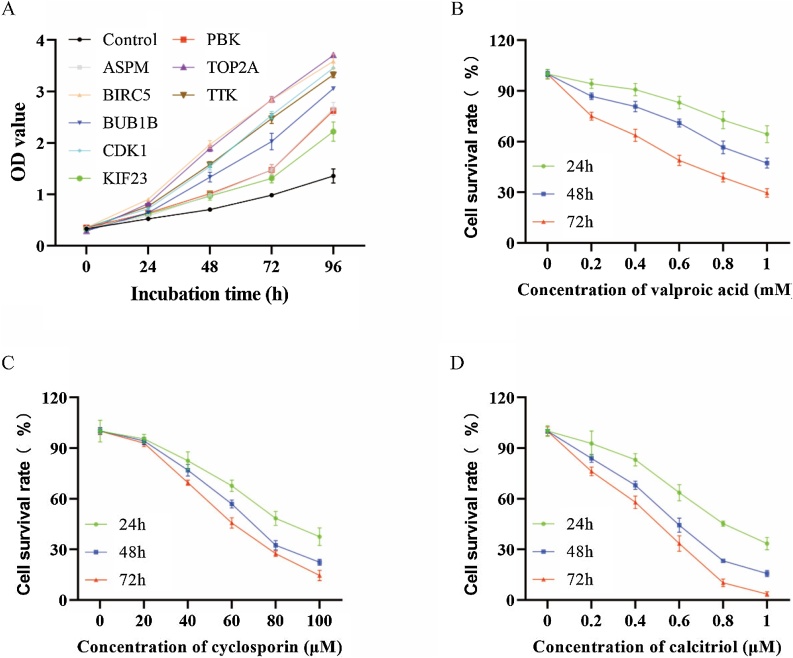
Three GEO datasets (GSE12452, GSE53819, and GSE61218) were analyzed to identify overlapping Differentially Expressed Genes (DEGs) in NPC. Gene Ontology (GO), Kyoto Encyclopedia of Genes and Genomes (KEGG), and Gene Set Enrichment Analysis (GSEA) were used to explore the biological roles of DEGs. Protein-Protein Interaction (PPI) and mRNA-miRNA-lncRNA interaction networks were constructed to identify key hub genes. Potential therapeutic drugs were predicted via a Drug-Gene Interaction network. The overexpression of hub genes was validated in NPC cells using CCK-8 assays, and the anti-proliferative effects of three drugs ‒ valproic acid, cyclosporine, and calcitriol ‒ were tested.
Eight hub genes (ASPM, BIRC5, BUB1B, CDK1, KIF23, PBK, TOP2A, and TTK) were identified, with ASPM reported for the first time in the context of NPC. Overexpression of these genes significantly promoted NPC cell proliferation. Among the tested drugs, calcitriol exhibited the most potent anti-proliferative effect, with IC50 values of 0.90 μM, 0.47 μM, and 0.31 μM at 24-, 48-, and 72-hs, respectively.
This study identified eight key genes as potential biomarkers for NPC and validated calcitriol as a promising therapeutic agent, providing a foundation for further research into NPC treatment.
Level 2 (Individual cross-sectional studies or systematic review of surveys that allow matching to local circumstances).
鼻咽癌(NPC)是一种高度恶性的癌症,在东亚和东南亚地区,包括中国南方,发病率较高。尽管治疗取得了进展,但由于高复发率和转移率,晚期鼻咽癌的预后仍然很差。驱动鼻咽癌进展的分子机制尚未完全了解,识别关键基因和潜在治疗药物至关重要。本研究旨在揭示关键基因并筛选治疗药物,为鼻咽癌的发病机制和新的治疗策略提供见解。
分析三个基因表达综合数据库(GEO)数据集(GSE12452、GSE53819和GSE61218),以识别鼻咽癌中重叠的差异表达基因(DEG)。利用基因本体论(GO)、京都基因与基因组百科全书(KEGG)和基因集富集分析(GSEA)来探索DEG的生物学作用。构建蛋白质-蛋白质相互作用(PPI)和mRNA- miRNA- lncRNA相互作用网络,以识别关键的枢纽基因。通过药物-基因相互作用网络预测潜在的治疗药物。使用CCK-8试验在NPC细胞中验证枢纽基因的过表达,并测试三种药物——丙戊酸、环孢素和骨化三醇——的抗增殖作用。
鉴定出八个枢纽基因(ASPM、BIRC5、BUB1B、CDK1、KIF23、PBK、TOP2A和TTK),其中ASPM在鼻咽癌背景下首次被报道。这些基因的过表达显著促进了NPC细胞的增殖。在所测试的药物中,骨化三醇表现出最有效的抗增殖作用,在24小时、48小时和72小时时的IC50值分别为0.90 μM、0.47 μM和0.31 μM。
本研究确定了八个关键基因作为鼻咽癌的潜在生物标志物,并验证了骨化三醇作为一种有前景的治疗药物,为进一步研究鼻咽癌治疗提供了基础。
2级(允许与当地情况相匹配的个体横断面研究或系统综述)。