Lian Hui, Wang Guangjian, Zhang Hongmin, Wang Xiaoting, He Wei
Department of Health Care, Peking Union Medical College Hospital, Chinese Academy of Medical Sciences and Peking Union Medical College, 1 Shuaifuyuan, Dongcheng District, Beijing, 100730, China.
Department of Critical Care Medicine, Peking Union Medical College Hospital, Chinese Academy of Medical Sciences and Peking Union Medical College, 1 Shuaifuyuan, Dongcheng District, Beijing, 100730, China.
BMC Infect Dis. 2025 Apr 26;25(1):610. doi: 10.1186/s12879-025-11011-4.
The dysregulated stress response is a key pathological mechanism underlying sepsis and is strongly associated with poor clinical outcomes. Stress hyperglycemia, a common manifestation of this response, may provide valuable prognostic information in sepsis patients. The stress hyperglycemia ratio (SHR) offers a more accurate reflection of the stress response and may be instrumental in assessing sepsis prognosis.
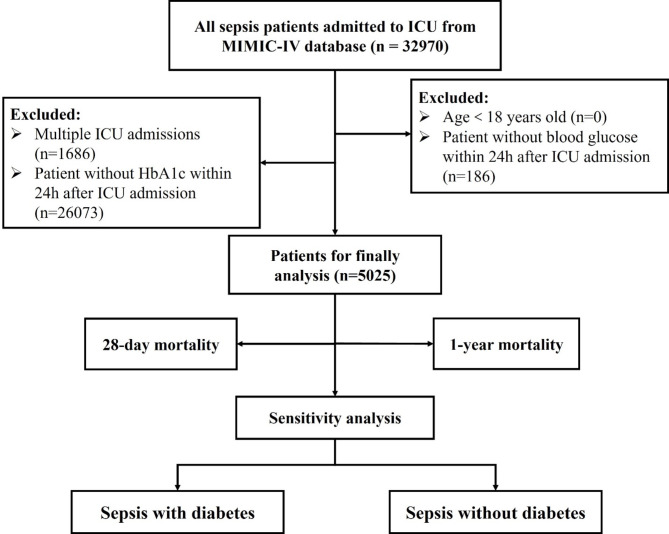
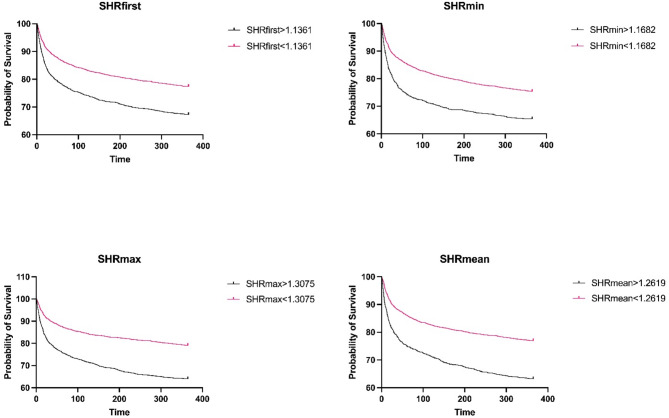
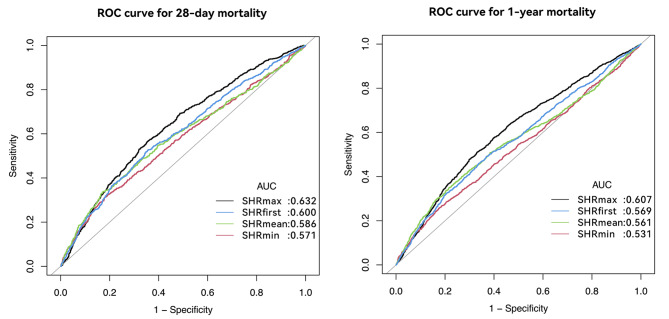
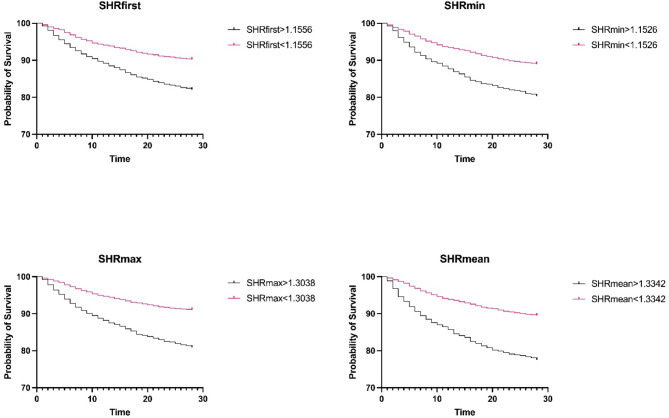
This study aimed to investigate the relationship between SHRs and clinical outcomes in sepsis patients. Data were obtained from the Medical Information Mart for Intensive Care IV database. Demographic information, intensive care unit (ICU) parameters within the first 24 h, laboratory results, insulin administration, survival time, and outcomes were extracted for analysis. Four SHR metrics (SHRfirst, SHRmin, SHRmax, and SHRmean) were calculated based on blood glucose values during the first 24 h of ICU admission (first, minimum, maximum, and mean, respectively). The predictive performance of each SHR metric was compared using the area under the receiver operating characteristic (ROC) curve. Kaplan-Meier survival analysis was performed to assess survival rates across groups defined by ROC curve-generated cut-off values. Associations between SHR and 28-day as well as 1-year mortality were further examined using both univariate and multivariate Cox regression analyses.
A total of 5,025 sepsis patients were included, of whom 656 died within 28 days of ICU admission. SHR was significantly higher in the non-survivor group. Among the SHR metrics, SHRmax demonstrated the highest predictive value for both 28-day and 1-year mortality. Higher SHR values were consistently associated with increased mortality (all P < 0.001). For SHRmax, each 1-unit increase was associated with a 77% increase in mortality in univariate analysis and a 71.6% increase in multivariate analysis. Sensitivity analyses indicated that the relationship between SHR and mortality was stronger in patients without diabetes.
SHR serves as a robust marker of the dysregulated stress response in sepsis and holds significant prognostic value, particularly SHRmax, in predicting mortality. These findings underscore the potential clinical utility of SHR in guiding therapeutic strategies aimed at modulating the stress response and blood glucose levels in critically ill sepsis patients. Further research is warranted to explore SHR-targeted interventions in sepsis management.
应激反应失调是脓毒症的关键病理机制,与不良临床结局密切相关。应激性高血糖作为这种反应的常见表现,可能为脓毒症患者提供有价值的预后信息。应激性高血糖比值(SHR)能更准确地反映应激反应,可能有助于评估脓毒症的预后。
本研究旨在探讨脓毒症患者SHR与临床结局之间的关系。数据来自重症监护医学信息集市IV数据库。提取人口统计学信息、入住重症监护病房(ICU)首24小时内的参数、实验室检查结果、胰岛素使用情况、生存时间和结局进行分析。根据入住ICU首24小时内的血糖值(分别为首值、最小值、最大值和均值)计算四个SHR指标(SHRfirst、SHRmin、SHRmax和SHRmean)。使用受试者工作特征(ROC)曲线下面积比较每个SHR指标的预测性能。进行Kaplan-Meier生存分析以评估由ROC曲线生成的截断值定义的各组的生存率。使用单变量和多变量Cox回归分析进一步研究SHR与28天及1年死亡率之间的关联。
共纳入5025例脓毒症患者,其中656例在入住ICU后28天内死亡。非存活组的SHR显著更高。在SHR指标中,SHRmax对28天和1年死亡率均显示出最高的预测价值。较高的SHR值始终与死亡率增加相关(所有P<0.001)。对于SHRmax,在单变量分析中,每增加1个单位,死亡率增加77%,在多变量分析中增加71.6%。敏感性分析表明,在无糖尿病患者中,SHR与死亡率之间的关系更强。
SHR是脓毒症应激反应失调的有力标志物,在预测死亡率方面具有重要的预后价值,尤其是SHRmax。这些发现强调了SHR在指导旨在调节危重症脓毒症患者应激反应和血糖水平的治疗策略方面的潜在临床应用价值。有必要进一步研究探索针对SHR的脓毒症管理干预措施。