Huang Yu, Xu Jie, Fan Zhengkang, Hu Yu, He Xing, Chen Aokun, Liu Yuxi, Yin Rui, Guo Jingchuan, DeKosky Steven T, Jaffee Michael, Zhou Manqi, Su Chang, Wang Fei, Guo Yi, Bian Jiang
Indiana University.
University of Florida.
Res Sq. 2025 Apr 7:rs.3.rs-6257332. doi: 10.21203/rs.3.rs-6257332/v1.
Understanding the heterogeneity of neurodegeneration in Alzheimer's disease (AD) development, as well as identifying AD progression pathways, is vital for enhancing diagnosis, treatment, prognosis, and prevention strategies. To identify disease progression subphenotypes in patients with mild cognitive impairment (MCI) and AD using electronic health records (EHRs).
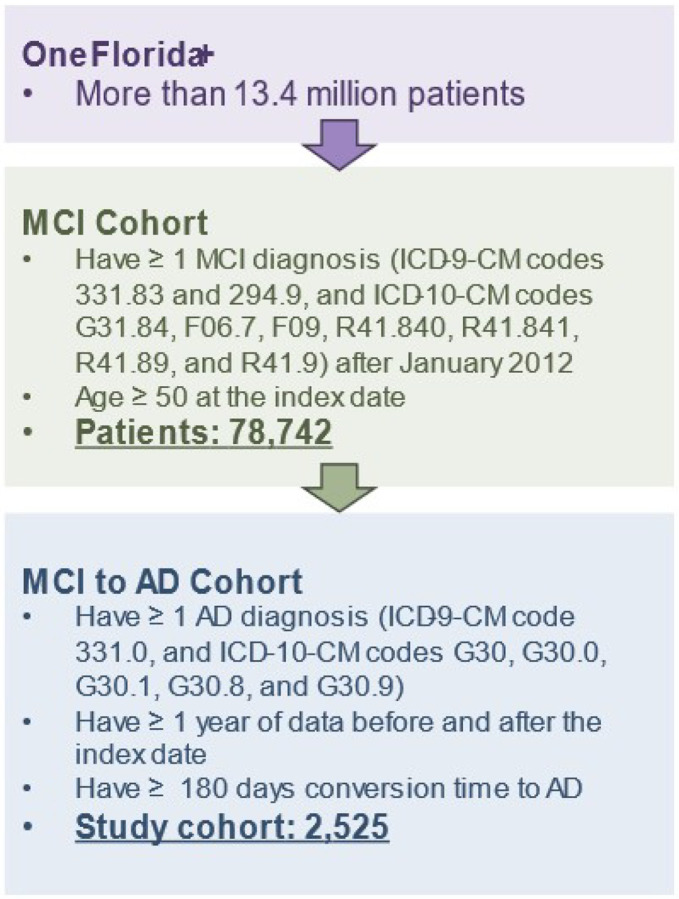
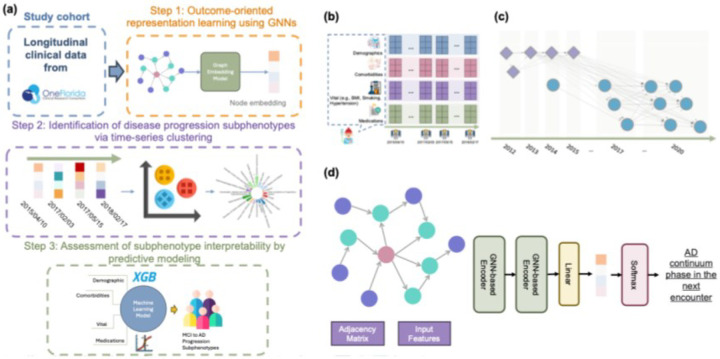
We identified patients with mild cognitive impairment (MCI) and AD from the electronic health records from the OneFlorida+ Clinical Research Consortium. We proposed an outcome-oriented graph neural network-based model to identify progression pathways from MCI to AD.
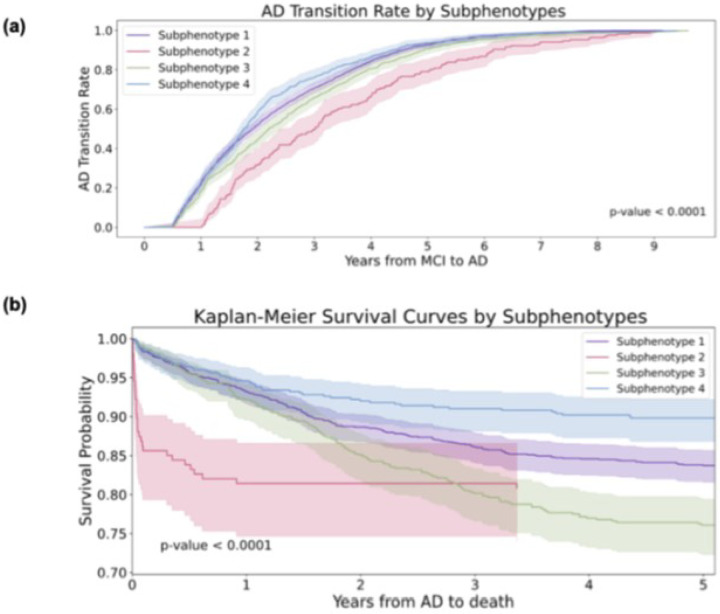
Of the included 2,525 patients, 61.66% were female, and the mean age was 76. In this cohort, 64.83% were Non-Hispanic White (NHW), 16.48% were Non-Hispanic Black (NHB), and 2.53% were of other races. Additionally, there were 274 Hispanic patients, accounting for 10.85% of the total patient population. The average duration from the first MCI diagnosis to the transition to AD was 891 days. We identified four progression subphenotypes, each with distinct characteristics. The average progression times from MCI to AD varied among these subphenotypes, ranging from 805 to 1,236 days.
The findings suggest that AD does not follow uniform transitions of disease states but rather exhibits heterogeneous progression pathways. Our proposed framework holds the potential to identify AD progression subphenotypes, providing valuable and explainable insights for the development of the disease.
了解阿尔茨海默病(AD)发展过程中神经退行性变的异质性,并确定AD的进展途径,对于加强诊断、治疗、预后和预防策略至关重要。利用电子健康记录(EHR)识别轻度认知障碍(MCI)和AD患者的疾病进展亚表型。
我们从OneFlorida+临床研究联盟的电子健康记录中识别出轻度认知障碍(MCI)和AD患者。我们提出了一种基于结果导向的图神经网络模型,以识别从MCI到AD的进展途径。
在纳入的2525名患者中,61.66%为女性,平均年龄为76岁。在这个队列中,64.83%为非西班牙裔白人(NHW),16.48%为非西班牙裔黑人(NHB),2.53%为其他种族。此外,有274名西班牙裔患者,占患者总数的10.85%。从首次MCI诊断到转变为AD的平均持续时间为891天。我们确定了四种进展亚表型,每种都有不同的特征。这些亚表型从MCI到AD的平均进展时间各不相同,从805天到1236天不等。
研究结果表明,AD并非遵循疾病状态的统一转变,而是表现出异质性的进展途径。我们提出的框架有潜力识别AD进展亚表型,为该疾病的发展提供有价值且可解释的见解。