Ho Pei-Hsuan, Ou Ju-Chi, Ma Hon-Ping, Wong Chung-Shun, Lin Hua-Chen, Hsu Chia-Hung
Emergency Medicine, Linkou Chang Gung Memorial Hospital, Taoyuan, Taiwan.
TMU Neuroscience Research Center, Taipei Medical University, Taipei, Taiwan.
Sci Rep. 2025 Apr 29;15(1):15039. doi: 10.1038/s41598-025-99263-7.
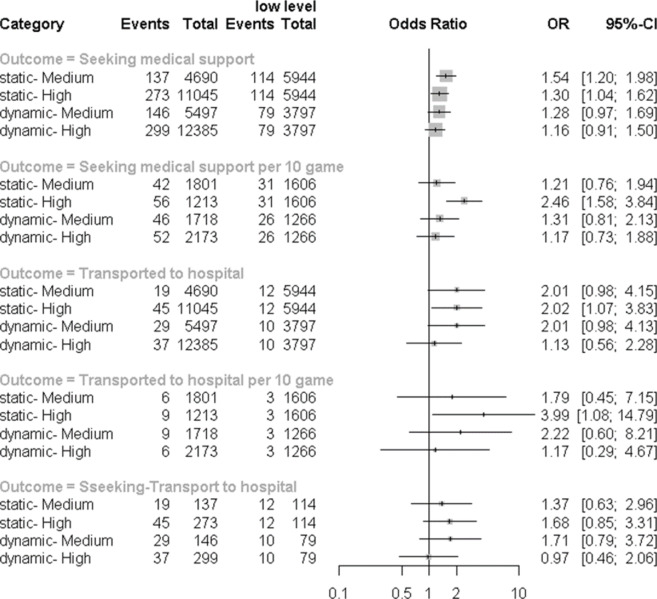
Mass gatherings, particularly in the context of sporting events, pose distinct public health challenges, particularly regarding the medical needs of athletes. Despite the critical role of on-site medical care in reducing hospital transfers, studies that directly compare injury patterns across various sporting events are scarce. This study analyzed injury rates and severity among athletes participating in various sports during the National Games in Taiwan. By doing so, the study aimed to enhance medical preparedness for future large-scale sporting events. This retrospective study involved a chart review of athletes who sought medical support during the National Games in Taiwan in 2017, 2019, and 2021. Data on patient demographics, event type, injury characteristics, and the need for hospital transport were collected. Sports were categorized in accordance with the American Heart Association and American College of Cardiology classifications ( based on their static and dynamic components). Statistical analyses were conducted to determine injury rates and identify factors associated with hospital transfers. Over the three years, 20,585 athletes participated in the games, with 527 (2.56%) seeking medical support. Injury rates significantly varied among the groups of sports with differing static and dynamic demands. Sports classified as having both high static and dynamic demands had the highest injury rates. Handball, martial arts, and rowing resulted in the highest rates of medical support-seeking behavior. The need for hospital transport was more frequently associated with sports that involved both high static and dynamic demands. The study highlights the varying injury patterns across different sports in mass gatherings, with sports involving higher physical demands posing greater risks of injury. These findings underscore the importance of developing tailored medical preparedness strategies for different types of sports to ensure timely and effective provision of medical care during large-scale sporting events.
大型集会,尤其是在体育赛事背景下,带来了独特的公共卫生挑战,特别是在运动员医疗需求方面。尽管现场医疗护理在减少转院方面发挥着关键作用,但直接比较各类体育赛事中损伤模式的研究却很匮乏。本研究分析了参加台湾地区全运会的各类运动员的受伤率和严重程度。通过这样做,该研究旨在加强对未来大型体育赛事的医疗准备。这项回顾性研究涉及对2017年、2019年和2021年在台湾地区全运会期间寻求医疗支持的运动员病历进行审查。收集了患者人口统计学、赛事类型、损伤特征以及转院需求等数据。体育项目根据美国心脏协会和美国心脏病学会的分类(基于其静态和动态成分)进行归类。进行统计分析以确定受伤率并识别与转院相关的因素。在这三年中,20585名运动员参加了比赛,其中527人(2.56%)寻求医疗支持。在具有不同静态和动态需求的体育项目组中,受伤率存在显著差异。被归类为具有高静态和动态需求的体育项目受伤率最高。手球、武术和赛艇导致寻求医疗支持行为的发生率最高。转院需求更常与涉及高静态和动态需求的体育项目相关。该研究突出了大型集会中不同体育项目的损伤模式差异,涉及更高体能需求的体育项目受伤风险更大。这些发现强调了为不同类型体育项目制定针对性医疗准备策略的重要性,以确保在大型体育赛事期间及时有效地提供医疗护理。