Yin Hang, Zhang Jia, Lian Menglong, Zhang Yajing
Department of Sport Studies, Faculty of Educational Studies, Universiti Putra Malaysia, Serdang, Malaysia.
School of Physical Education, Chongqing University, Chongqing City, China.
BMC Public Health. 2025 May 1;25(1):1601. doi: 10.1186/s12889-025-22829-7.
Extensive research has demonstrated the effectiveness of high-intensity interval training (HIIT) in children and adults; however, evidence specific to university students remains limited. This study aimed to evaluate the effects of HIIT on promoting physical health in university students and to identify potential factors influencing intervention outcomes.
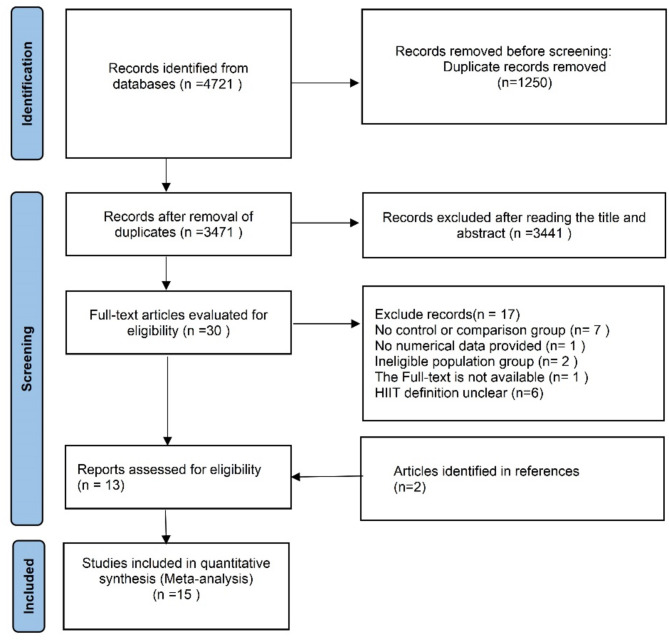
A systematic search was conducted across five electronic databases (Web of Science, Scopus, PubMed, SportDiscus, and MEDLINE) up to December 2024 using Boolean operators and keywords related to HIIT and university students.
(1) Experimental studies; (2) Physical-related outcomes; (3) Intervention duration of at least 3 weeks; (4) Meets the definition of high-intensity activity; (5) Participants are general university students. A meta-analysis was conducted using RevMan 5.4 software, comparing intervention and control groups. Effect sizes were calculated using Cohen's d, and heterogeneity was assessed with the I² statistic. Subgroup analyses were performed based on intervention duration and rest interval duration.
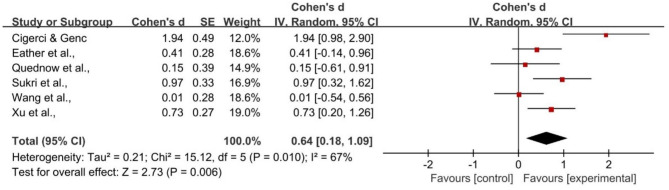
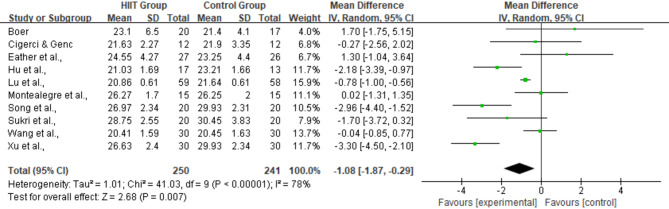
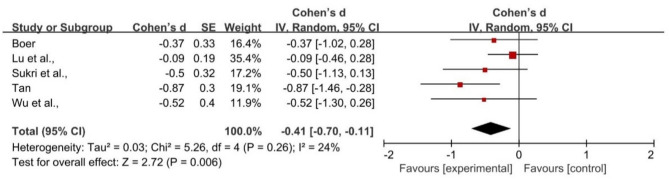
Results showed that HIIT significantly reduced BMI, body fat percentage, waist-to-hip ratio, and heart rate, while significantly improving VOmax and muscle strength in university students. Interventions lasting longer than eight weeks demonstrated greater improvements in muscle strength compared to those lasting eight weeks or less. However, there are no significant differences in rest interval across any of the groups. Notably, HIIT also has positive effects on agility and speed with varying effect sizes.
The unique characteristics of university students make HIIT a time-efficient and effective intervention strategy for this population. Future studies should consider the specific needs of the university environment, incorporating the latest technological advancements and developing tailored intervention strategies that align with students' preferences.
广泛的研究已证明高强度间歇训练(HIIT)对儿童和成年人有效;然而,针对大学生的具体证据仍然有限。本研究旨在评估HIIT对促进大学生身体健康的影响,并确定影响干预效果的潜在因素。
截至2024年12月,使用布尔运算符以及与HIIT和大学生相关的关键词,在五个电子数据库(科学网、Scopus、PubMed、SportDiscus和MEDLINE)中进行了系统检索。
(1)实验研究;(2)与身体相关的结果;(3)干预持续时间至少3周;(4)符合高强度活动的定义;(5)参与者为普通大学生。使用RevMan 5.4软件进行荟萃分析,比较干预组和对照组。使用Cohen's d计算效应量,并使用I²统计量评估异质性。根据干预持续时间和休息间隔时间进行亚组分析。
结果表明,HIIT显著降低了大学生的体重指数、体脂百分比、腰臀比和心率,同时显著提高了最大摄氧量和肌肉力量。持续时间超过八周的干预措施与持续时间为八周或更短的措施相比,在肌肉力量方面有更大的改善。然而,各小组在休息间隔方面没有显著差异。值得注意的是,HIIT对敏捷性和速度也有积极影响,效果大小各不相同。
大学生的独特特征使HIIT成为针对该人群的一种省时有效的干预策略。未来的研究应考虑大学环境的具体需求,纳入最新的技术进步,并制定符合学生偏好的量身定制的干预策略。