Li Yuqing, Zhao Wanjun, Yang Qi
Orthopedic Department, Hunan Children's Hospital (The Affiliated Children's Hospital of Xiangya School of Medicine, Central South University), Changsha, Hunan, China.
Hunan Provincial Key Laboratory of Pediatric Orthopedics, Changsha, Hunan, China.
Front Physiol. 2025 Apr 17;16:1554222. doi: 10.3389/fphys.2025.1554222. eCollection 2025.
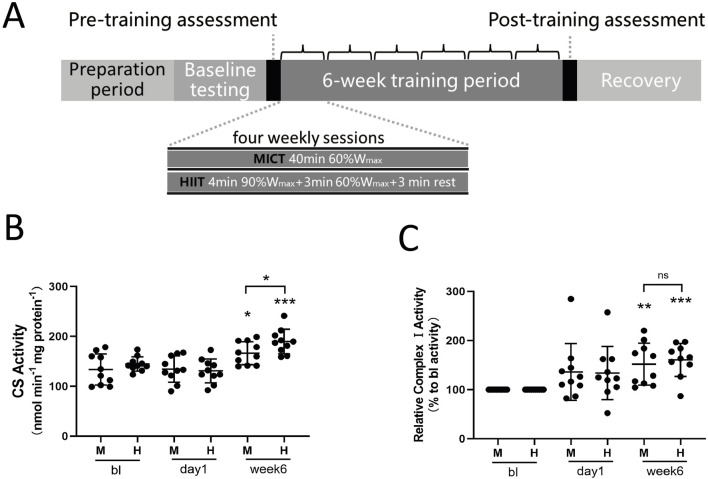
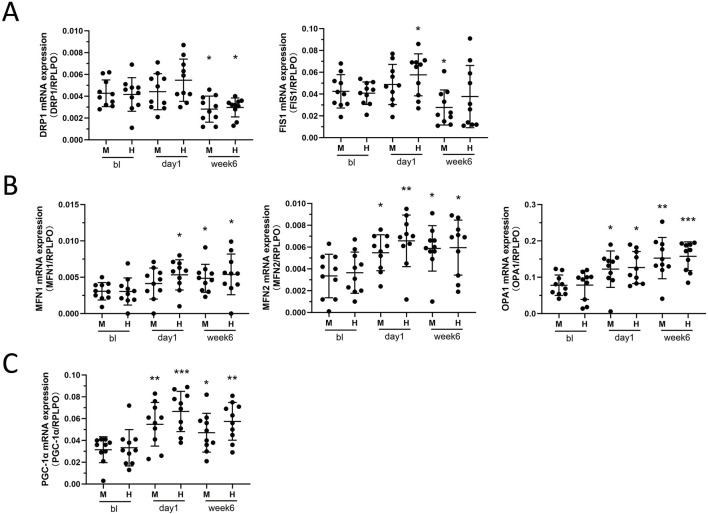
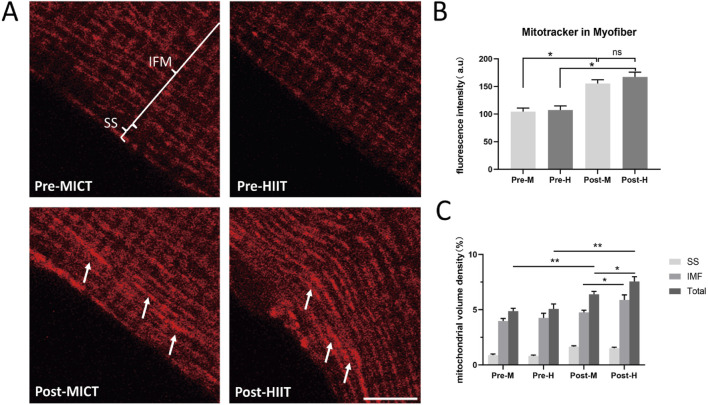
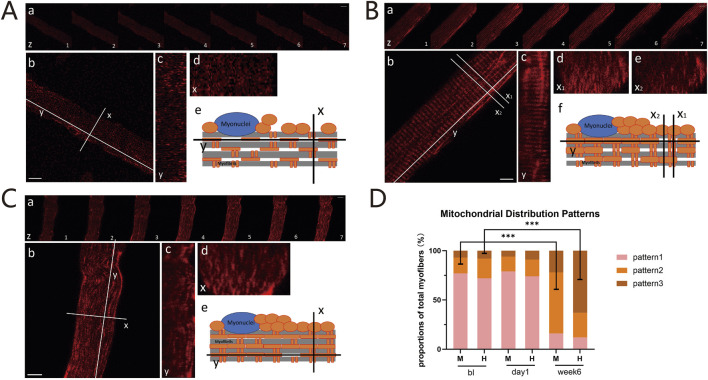
Exercise and physical activity confer health advantages, in part, by enhancing skeletal muscle mitochondrial respiratory function. The objective of this study is to analyze the impacts of high-intensity interval training (HIIT) and moderate-intensity continuous training (MICT) on the dynamics and functionality of the mitochondrial network within skeletal muscle. 20 young male participants were assigned to either HIIT or MICT group. Initial assessments of exercise-related indicators were conducted, followed by skeletal muscle biopsies from the vastus lateralis before, 1 day after, and 6 weeks post-experiment. We utilized multi-dimensional myofiber imaging to analyze mitochondrial morphology and arrangement, and assessed citrate synthase activity, complex I activity, and dynamics-related mRNA. Both training modalities increased VO, W, citrate synthase and complex I activities, mitochondrial content, and volume density, though the changes differed between the two groups. 6 weeks training induced remodeling of the mitochondrial network within skeletal muscle. Before training, the network appeared sparse and punctate. After MICT, it adopted a grid-like structure with partially robust longitudinal connections. In contrast, HIIT resulted in a less obvious grid structure but showed a stronger longitudinally oriented network. Training also increased mRNA expression of mitochondrial fusion proteins and decreased fission protein expression, with these effects being more pronounced in HIIT. Similarly, peroxisome proliferator-activated receptor γ coactivator 1-alpha mRNA expression showed a comparable trend, though the changes differed between 1 day and 6 weeks of training. In conclusion, HIIT and MICT induce distinct mitochondrial adaptation in skeletal muscle, reflected in different network remodeling and molecular pathways. These findings may be due to HIIT's more pronounced effect on mitochondrial dynamics or respiratory function, but the study has only conducted preliminary observational experiments and further evidence is required for confirmation.
运动和体育活动在一定程度上通过增强骨骼肌线粒体呼吸功能带来健康益处。本研究的目的是分析高强度间歇训练(HIIT)和中等强度持续训练(MICT)对骨骼肌线粒体内网络动态和功能的影响。20名年轻男性参与者被分配到HIIT组或MICT组。进行了与运动相关指标的初始评估,随后在实验前、实验后1天和实验后6周从股外侧肌获取骨骼肌活检样本。我们利用多维肌纤维成像分析线粒体形态和排列,并评估柠檬酸合酶活性、复合体I活性以及与动态相关的mRNA。两种训练方式均提高了VO₂、W、柠檬酸合酶和复合体I活性、线粒体含量以及体积密度,不过两组之间的变化有所不同。6周的训练诱导了骨骼肌线粒体内网络的重塑。训练前,网络显得稀疏且呈点状。MICT训练后,它呈现出网格状结构,部分纵向连接较为稳固。相比之下,HIIT导致的网格结构不太明显,但纵向取向的网络更强。训练还增加了线粒体融合蛋白的mRNA表达,降低了裂变蛋白表达,这些效应在HIIT中更为明显。同样,过氧化物酶体增殖物激活受体γ共激活因子1-α mRNA表达呈现出类似趋势,尽管在训练1天和6周时变化有所不同。总之,HIIT和MICT在骨骼肌中诱导了不同的线粒体适应性,体现在不同的网络重塑和分子途径上。这些发现可能是由于HIIT对线粒体动态或呼吸功能的影响更为显著,但该研究仅进行了初步观察实验,需要进一步证据来证实。