Kovochich Michael, Oh Su Cheun, Ferrari Benoit J D, Masset Thibault, Breider Florian, Unice Kenneth
Stantec, 350 North Orleans Street Suite 8000N, Chicago, IL, 60654-1610, USA.
Exponent, Unit 802-803, 12 Science Park West Avenue, Shatin, New Territories, Hong Kong.
Sci Rep. 2025 May 2;15(1):15372. doi: 10.1038/s41598-025-98902-3.
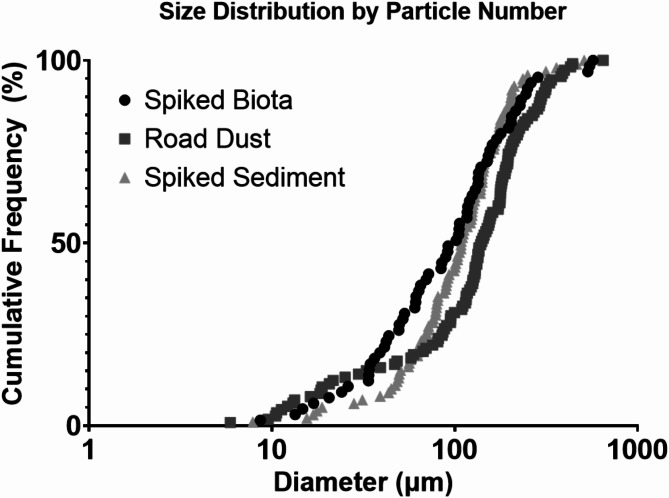
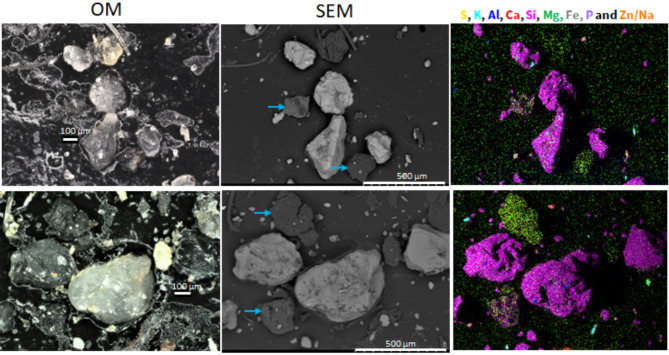
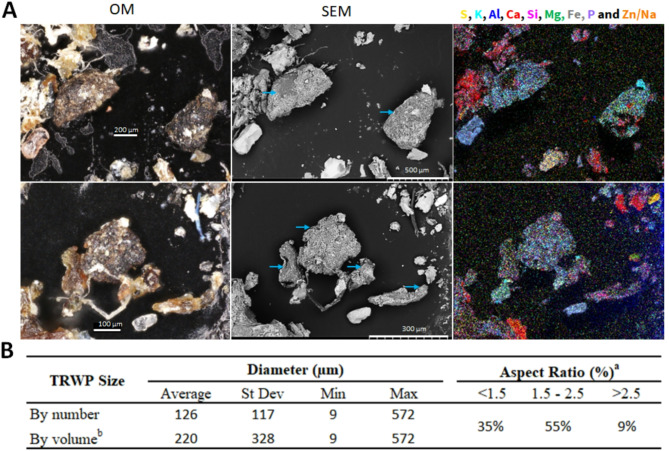
There is a growing interest in the development of reliable analytical methods for characterizing tire and road wear particles (TRWP). The current research extends the use of single particle analysis techniques to various experimental biota samples. TRWP and cryogenically milled tire tread (CMTT) were identified using a weight of evidence framework including density separation, optical microscopy, and chemical mapping (scanning electron microscopy coupled with energy dispersive X-ray spectroscopy). Our techniques successfully identified CMTT particles in laboratory earthworms exposed to soil spiked with CMTT. A river biota sample (bivalves) collected from the Seine with no detectable TRWP was spiked with road dust containing TRWP. Particle identification was performed after a biota digestion protocol and density separation of particles > 1.5 g/cm and < 2.2 g/cm which resulted in sufficient TRWP for identification and characterization. The average TRWP particle size from the road dust spiked biota sample was 126 μm by number and 220 μm by volume (range: 9 -572 μm). The size distribution overlay of TRWP identified from spiked biota were consistent with TRWP identified from the original road dust sample suggesting that the current method for biota digestion, dual density separation, and TRWP characterization is feasible for similar samples.
人们对开发用于表征轮胎和道路磨损颗粒(TRWP)的可靠分析方法的兴趣与日俱增。当前的研究将单颗粒分析技术的应用扩展到各种实验生物群样本。使用包括密度分离、光学显微镜和化学绘图(扫描电子显微镜与能量色散X射线光谱联用)在内的证据权重框架来识别TRWP和低温研磨的轮胎胎面(CMTT)。我们的技术成功地在暴露于掺有CMTT的土壤中的实验室蚯蚓中识别出了CMTT颗粒。从塞纳河采集的未检测到TRWP的河流生物群样本(双壳贝类)被添加了含有TRWP的道路灰尘。在生物群消化方案以及对密度大于1.5 g/cm且小于2.2 g/cm的颗粒进行密度分离后进行颗粒识别,这产生了足够用于识别和表征的TRWP。添加了道路灰尘的生物群样本中TRWP的平均粒径,按数量计为126μm,按体积计为220μm(范围:9 - 572μm)。从添加了道路灰尘的生物群中识别出的TRWP的尺寸分布叠加图与从原始道路灰尘样本中识别出的TRWP一致,这表明当前的生物群消化、双密度分离和TRWP表征方法对类似样本是可行的。