Fink Nicola, Sperl Jonathan I, Rueckel Johannes, Stüber Theresa, Goller Sophia S, Rudolph Jan, Escher Felix, Aschauer Theresia, Hoppe Boj F, Ricke Jens, Sabel Bastian O
Department of Radiology, University Hospital, LMU Munich, Munich, Germany.
Comprehensive Pneumology Center (CPC-M), Member of the German Center for Lung Research (DZL), Munich, Germany.
Eur Radiol Exp. 2025 May 2;9(1):48. doi: 10.1186/s41747-025-00579-w.
The growing demand for follow-up imaging highlights the need for tools supporting the assessment of pulmonary nodules over time. We evaluated the performance of an artificial intelligence (AI)-based system for automated nodule matching.
In this single-center study, patients with nodules and ≤ 2 chest computed tomography (CT) examinations were retrospectively selected. An AI-based algorithm was used for automated nodule detection and matching. The matching rate and the causes for incorrect matching were evaluated for the ten largest lesions (5-30 mm in diameter) registered on baseline CT. The dependence of the matching rate on nodule number and localization was also analyzed.
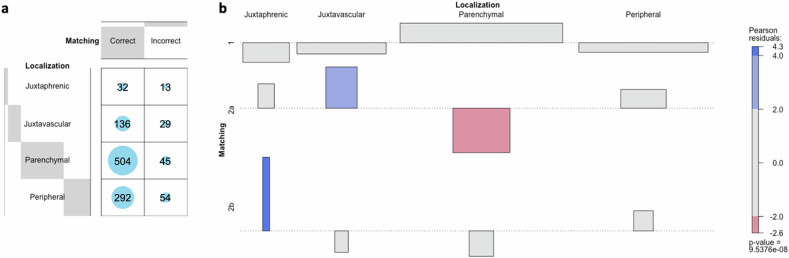
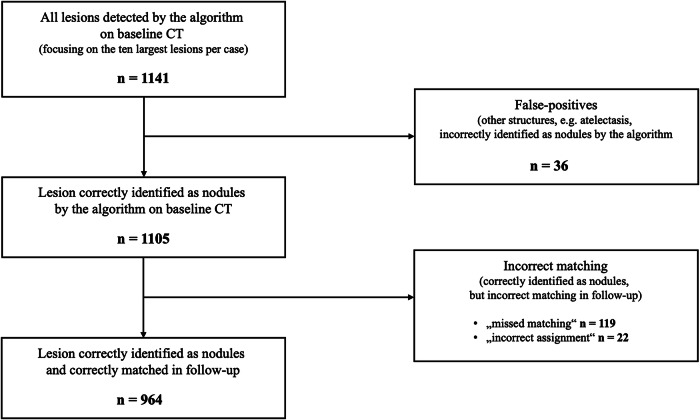
One hundred patients (46 females), with a median age of 62 years (interquartile range 57-69), and 253 CTs were included. Focusing on the ten largest lesions, 1,141 lesions were identified, of which 36 (3.2%) were other structures incorrectly identified as nodules (false-positives). Of the 1,105 identified nodules, 964 (87.2%) were correctly detected and matched. The matching rate for nodules registered in both baseline and follow-up scans was 97.8%. The matching rate per case ranged 80.0-100.0% (median 90.0%). Correct matching rate decreased in follow-up examinations to over 50 nodules (p = 0.003), with an overrepresentation of missed matching. Matching rates were higher in parenchymal (91.8%), peripheral (84.4%), and juxtavascular (82.4%) nodules than in juxtaphrenic nodules (71.1%) (p < 0.001). Missed matching was overrepresented in juxtavascular, and incorrect assignment in juxtaphrenic nodules.
The correct automated-matching rate of metastatic pulmonary nodules in follow-up examinations was high, but it depends on localization and a number of nodules.
The algorithm enables precise follow-up matching of pulmonary nodules, potentially providing a solid basis for standardized and accurate evaluations. Understanding the algorithm's strengths and weaknesses based on nodule localization and number enhances the interpretation of AI-based results.
The AI algorithm achieved a correct nodule matching rate of 87.2% and up to 97.8% when considering nodules detected in both baseline and follow-up scans. Matching accuracy depended on nodule number and localization. This algorithm has the potential to support response evaluation criteria in solid tumor-based evaluations in clinical practice.
对随访成像的需求不断增长,凸显了需要有工具来辅助评估肺部结节随时间的变化。我们评估了一种基于人工智能(AI)的系统进行自动结节匹配的性能。
在这项单中心研究中,回顾性选取了有结节且胸部计算机断层扫描(CT)检查次数≤2次的患者。使用基于AI的算法进行自动结节检测和匹配。对基线CT上登记的10个最大病变(直径5 - 30毫米)的匹配率及匹配错误的原因进行评估。还分析了匹配率对结节数量和定位的依赖性。
纳入了100例患者(46例女性),中位年龄62岁(四分位间距57 - 69岁),共253次CT扫描。聚焦于10个最大病变,共识别出1141个病变,其中36个(3.2%)是被错误识别为结节的其他结构(假阳性)。在1105个识别出的结节中,964个(87.2%)被正确检测和匹配。基线和随访扫描中均登记的结节的匹配率为97.8%。每例的匹配率范围为80.0 - 100.0%(中位值90.0%)。在随访检查中,当结节超过50个时,正确匹配率下降(p = 0.003),漏匹配情况较多。实质内结节(91.8%)、外周结节(84.4%)和血管旁结节(82.4%)的匹配率高于膈旁结节(71.1%)(p < 0.001)。血管旁结节漏匹配情况较多,膈旁结节存在错误匹配。
随访检查中转移性肺结节的自动匹配正确率较高,但取决于定位和结节数量。
该算法能够实现肺结节的精确随访匹配,可能为标准化和准确评估提供坚实基础。基于结节定位和数量了解算法的优缺点,可增强对基于AI结果的解读。
考虑基线和随访扫描中检测到的结节时,AI算法的正确结节匹配率达到87.2%,最高可达97.8%。匹配准确性取决于结节数量和定位。该算法有潜力支持临床实践中基于实体瘤的评估的反应评估标准。