Huang Xiaojuan, Sun Manman, Du Xiaoyu, Quan Lin, Chao Jinquan, Deng Xiaomin, Liao Hongze
Guangxi Key Laboratory of Polysaccharide Materials and Modification, School of Marine Sciences and Biotechnology, Guangxi Minzu University, 158 West Daxue Road, Nanning, 530008, China.
National Key Laboratory for Tropical Crop Breeding, Ministry of Agriculture and Rural Affairs Key Laboratory of Biology and Genetic Resources of Rubber Tree, State Key Laboratory Breeding Base of Cultivation and Physiology for Tropical CropsRubber Research Institute, Chinese Academy of Tropical Agricultural Sciences, Haikou, 570100, China.
BMC Plant Biol. 2025 May 2;25(1):581. doi: 10.1186/s12870-025-06615-6.
The mitogen-activated protein kinase (MPK) cascade pathway represents a highly conserved signal transduction mechanism in plants, playing a crucial role in growth, development, and stress response. Nevertheless, systematic analysis on the MPK cascade genes in rubber trees remains unexplored.
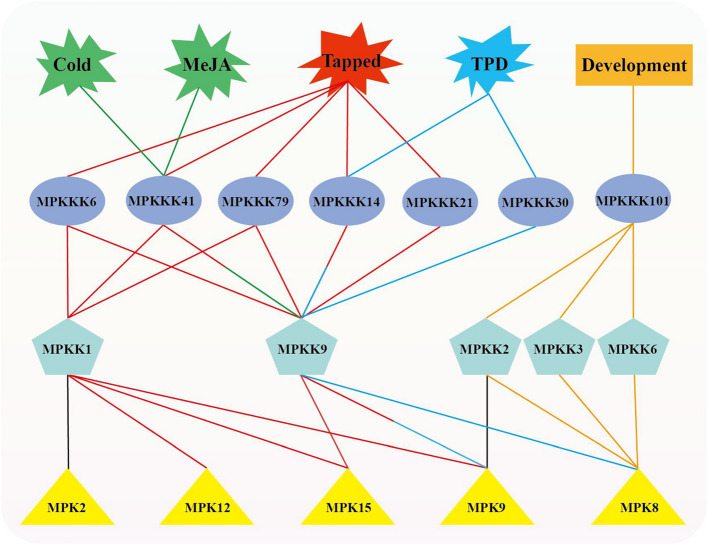
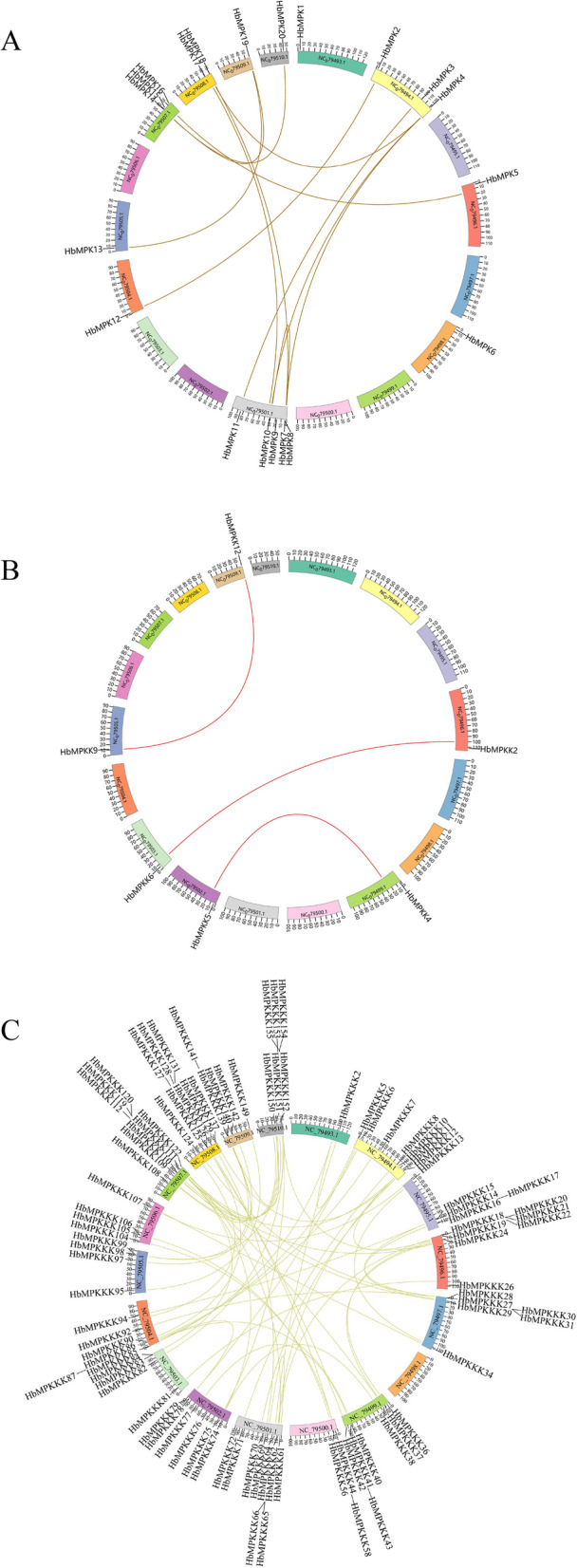
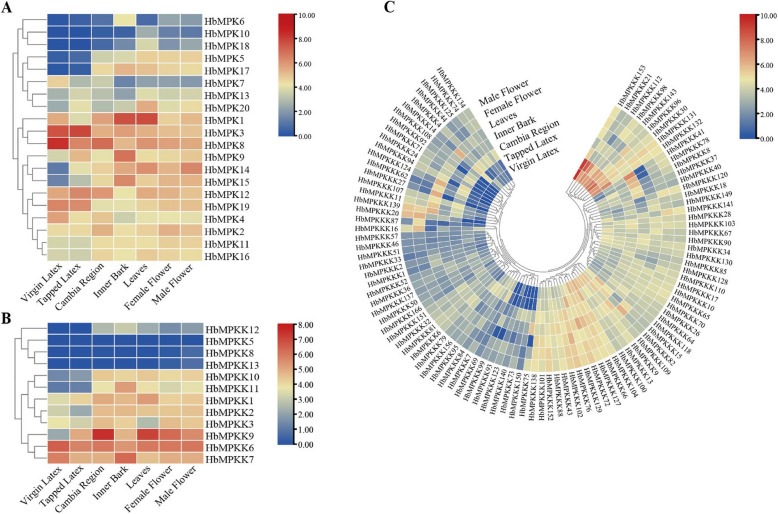
We conducted a comprehensive identification of the MPK cascade gene family of Hevea brasiliensis, identifying a total of 20 HbMPKs, 13 HbMPKKs, and 167 HbMAPKKKs genes. Through phylogenetic analysis and compared to Arabidopsis MPK cascade genes, HbMPKs and HbMPKKs were categorized into categorized four subgroups with no significant expansion or contraction, while the notably expanded HbMAPKKKs were divided into three subgroups: Raf, ZIK, and MEKK. Conserved motifs, gene structure, and motif analysis further bolster the validity of phylogenetic classification. Furthermore, expression profiling analysis based on public transcriptomic data revealed that these genes were differentially expressed in various tissues and differentially regulated in response to different stresses. Among them, the genes highly expressed in latex or the upregulated genes after tapped including HbMPK8, HbMPK12, HbMPK19, HbMPKK6, HbMPKK9, HbMPKKK15, HbMPKKK21 might be related to latex development and natural rubber (NR) yield. Through yeast two-hybrid assays, we successfully pinpointed 34 pairs of HbMPKKK-HbMPKK-HbMPK interaction modules. Integrating the interaction network and gene expression patterns, 12 potential HbMPK cascade signaling modules including HbMPKKK6/41/79-HbMPKK1-HbMPK9/12/15 and HbMPKKK6/14/21/41/79-HbMPKK9-HbMPK9/15 might involve in NR production and stress responses.
Our study comprehensively unveils the multidimensional characteristics of the MPK cascade gene family in rubber trees and successfully identifies its core signaling cascade module, laying a crucial foundation for future in-depth exploration of the biological functions of the MPK cascade signaling module in rubber trees.
丝裂原活化蛋白激酶(MPK)级联途径是植物中一种高度保守的信号转导机制,在生长、发育和应激反应中起关键作用。然而,橡胶树中MPK级联基因的系统分析仍未开展。
我们对巴西橡胶树的MPK级联基因家族进行了全面鉴定,共鉴定出20个HbMPK、13个HbMPKK和167个HbMAPKKK基因。通过系统发育分析并与拟南芥MPK级联基因比较,HbMPK和HbMPKK被分为四个亚组,无明显的扩增或收缩,而显著扩增的HbMAPKKK被分为三个亚组:Raf、ZIK和MEKK。保守基序、基因结构和基序分析进一步支持了系统发育分类的有效性。此外,基于公共转录组数据的表达谱分析表明,这些基因在不同组织中差异表达,并在不同胁迫下受到差异调控。其中,在胶乳中高表达或割胶后上调的基因,包括HbMPK8、HbMPK12、HbMPK19、HbMPKK6、HbMPKK9、HbMPKKK15、HbMPKKK21,可能与胶乳发育和天然橡胶(NR)产量有关。通过酵母双杂交试验,我们成功确定了34对HbMPKKK-HbMPKK-HbMPK相互作用模块。整合相互作用网络和基因表达模式,12个潜在的HbMPK级联信号模块,包括HbMPKKK6/41/79-HbMPKK1-HbMPK9/12/15和HbMPKKK6/14/21/41/79-HbMPKK9-HbMPK9/15,可能参与NR生产和应激反应。
我们的研究全面揭示了橡胶树中MPK级联基因家族的多维特征,并成功鉴定了其核心信号级联模块,为未来深入探索橡胶树中MPK级联信号模块的生物学功能奠定了关键基础。