Chen Yan, Gilliland Ashley, Liang Qiaochu, Han Xiao, Yang Hyungjun, Chan Jocelyn, Lévesque Dominique, Moon Kyung-Mee, Daneshgar Parandis, Boisvert François-Michel, Foster Leonard, Zandberg Wesley F, Bergstrom Kirk, Yu Hong B, Vallance Bruce A
Division of Gastroenterology, Department of Pediatrics, University of British Columbia, Vancouver, BC, Canada.
Department of Immunology and Cell Biology, Université de Sherbrooke, Sherbrooke, Canada.
Gut Microbes. 2025 Dec;17(1):2494717. doi: 10.1080/19490976.2025.2494717. Epub 2025 May 5.
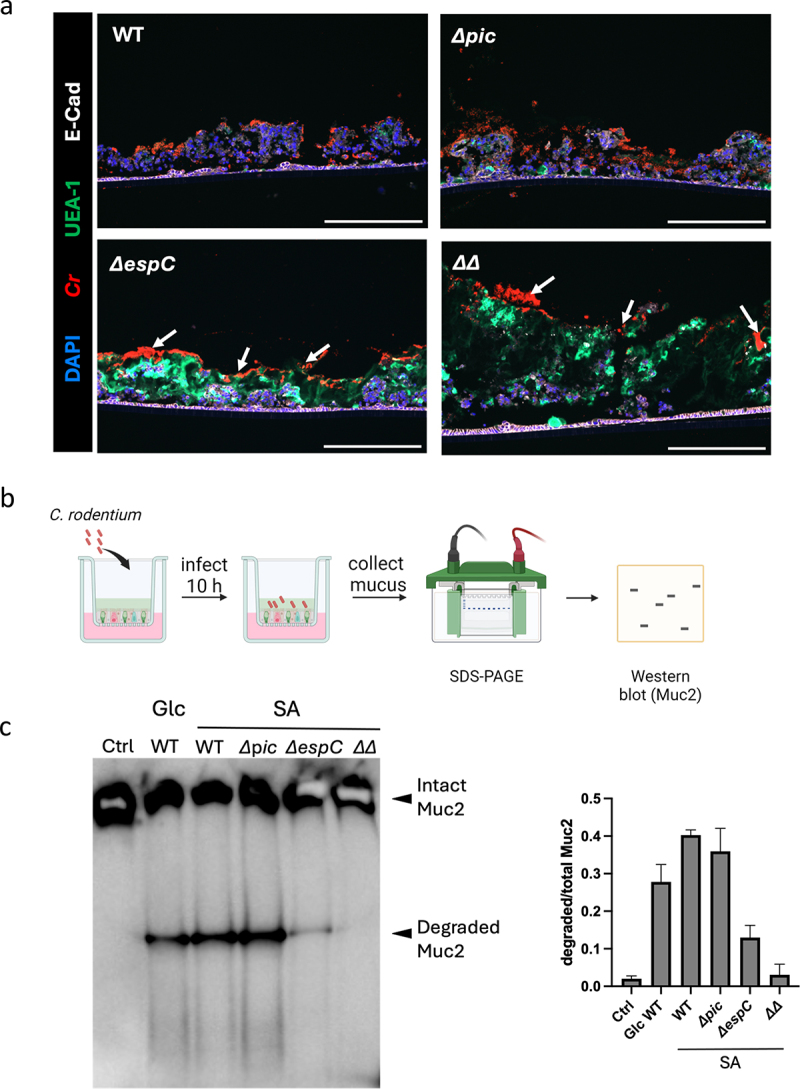
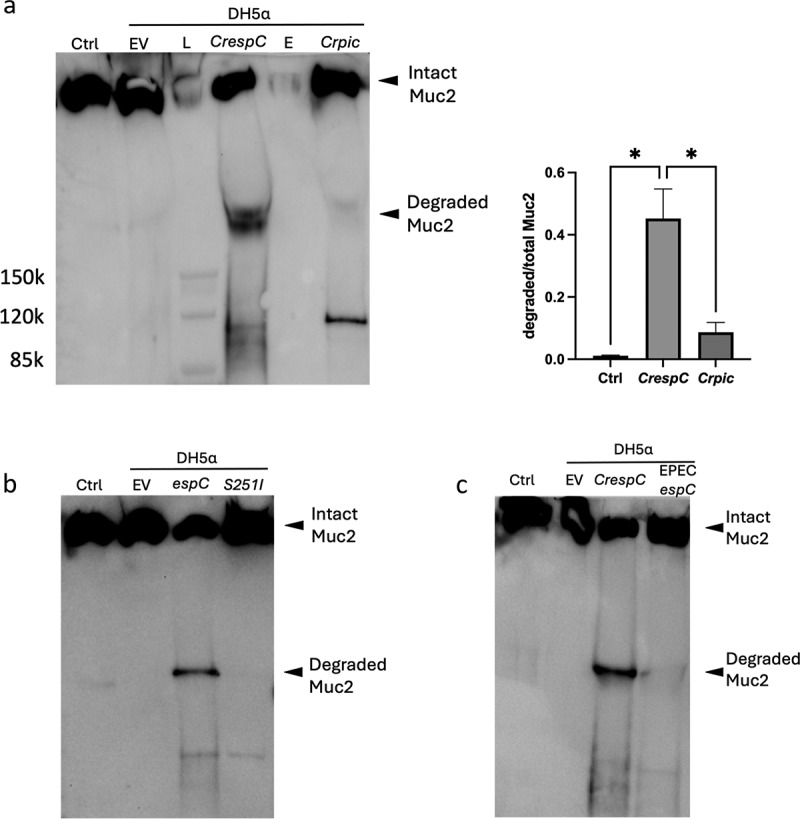
Enteric bacterial pathogens pose significant threats to human health; however, the mechanisms by which they infect the mammalian gut in the face of daunting host defenses remain to be fully defined. For the attaching and effacing (A/E) bacterial family member and murine pathogen , its virulence strategy appears to involve penetration of the colonic mucus barrier to reach the underlying epithelium. To better define these interactions, we grew colonoids under air-liquid interface (ALI) conditions, producing a thick mucus layer that mimicked mucus composition and glycosylation. 's penetration of ALI-derived mucus was dramatically enhanced upon exposure to sialic acid, in concert with the secretion of two serine protease autotransporter of (SPATE) proteins, Pic and EspC. Despite Pic being a class II SPATE, and already recognized as a mucinase, it was EspC, a class I SPATE family member, that degraded ALI-derived mucus, despite class I SPATEs not previously shown to possess mucinase activity. Confirming this finding, DH5α carrying a plasmid that expresses -derived EspC was able to degrade the mucus. Moreover, recombinant EspC alone also displayed mucinolytic activity in a dose-dependent manner. Collectively, our results reveal the utility of ALI-derived mucus in modeling microbe-host interactions at the intestinal mucosal surface, as well as identify EspC as an atypical class I SPATE that shows significant mucinolytic activity toward ALI-derived mucus.
肠道细菌病原体对人类健康构成重大威胁;然而,面对令人生畏的宿主防御机制,它们感染哺乳动物肠道的具体机制仍有待全面明确。对于黏附与脱落(A/E)细菌家族成员及鼠类病原体而言,其致病策略似乎涉及穿透结肠黏液屏障以抵达下层上皮组织。为了更好地界定这些相互作用,我们在气液界面(ALI)条件下培养类器官,形成了一层模拟黏液组成和糖基化的厚黏液层。暴露于唾液酸后,其对ALI衍生黏液的穿透能力显著增强,同时分泌两种紧密黏附素(SPATE)蛋白,即Pic和EspC。尽管Pic属于II类SPATE,且已被确认为黏蛋白酶,但降解ALI衍生黏液的却是I类SPATE家族成员EspC,尽管此前未显示I类SPATE具有黏蛋白酶活性。携带表达衍生自的EspC质粒的大肠杆菌DH5α能够降解黏液,这证实了上述发现。此外,单独的重组EspC也以剂量依赖方式表现出溶黏蛋白活性。总体而言,我们的研究结果揭示了ALI衍生黏液在模拟肠道黏膜表面微生物-宿主相互作用方面的效用,并确定EspC是一种非典型的I类SPATE,对ALI衍生黏液具有显著的溶黏蛋白活性。