
如何以及由谁来做?审视炎症性关节炎患者在常规临床护理中使用电子患者报告结局智能手机应用程序的实际参与和使用证据。
How and Who? Examining Real-World Evidence of Engagement and Use of an Electronic Patient-Reported Outcome Smartphone Application in Routine Clinical Care for Patients With Inflammatory Arthritides.
作者信息
Biliavska Iuliia, Lenguerrand Erik, Tobias Jonathan H, Hamann Philip D H
机构信息
University of Bristol, Bristol, United Kingdom, and State Institution, National Scientific Center, The M.D. Strazhesko Institute of Cardiology, Clinical and Regenerative Medicine of the National Academy of Medical Sciences of Ukraine, Kyiv, Ukraine.
University of Bristol, Bristol, United Kingdom.
出版信息
ACR Open Rheumatol. 2025 May;7(5):e70049. doi: 10.1002/acr2.70049.
OBJECTIVE
We evaluate the use of an app to remotely collect electronic patient-reported outcomes (ePROs) in patients attending routine rheumatology clinics with inflammatory arthritis (IA) over a four year period.
METHODS
This is a secondary analysis of real-world data obtained from patients with IA who attended routine appointments between 2018 and 2022. Patients used an app to track their disease course by using Routine Assessment of Patient Index Data 3 (RAPID3), Health Assessment Questionnaire - Disability Index, or self-assessing tender and swollen joint counts. Elapsed days of the app use, number, and time between ePROs reports were analyzed using Poisson and Tobit regression models. Results were stratified by gender, age, diagnosis, baseline disease severity, and disability.
RESULTS
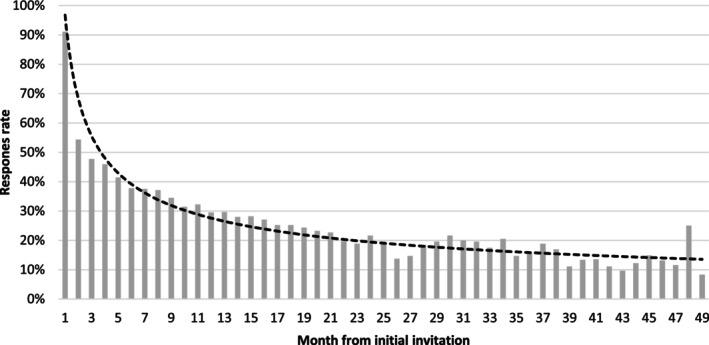
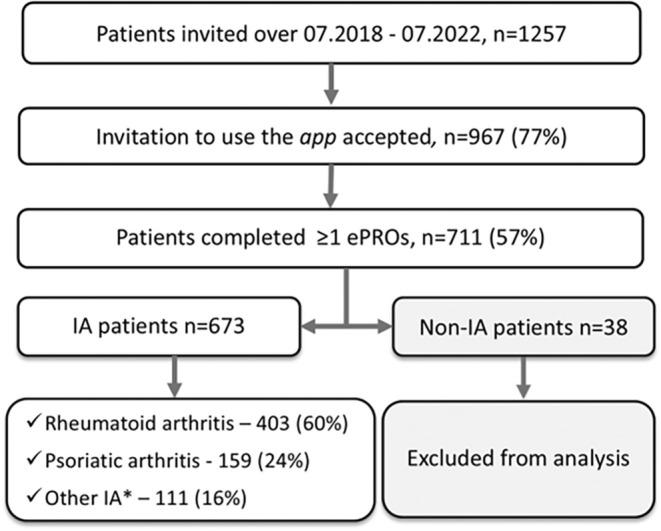
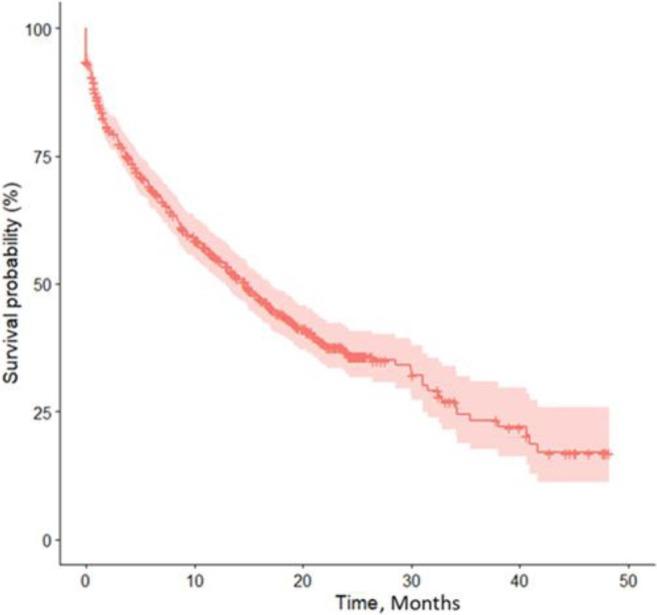
At least one ePRO report was provided by 673 patients. Mean age was 53.7 ± 13.9 years; 458 (68%) were female. RAPID3 was reported by 613 (91%) patients, 531 (79%) provided more than one RAPID3, and 82 (12%) provided one RAPID3; there was no difference between groups stratified by gender, age, IA type, and baseline arthritis severity. Median engagement was 14.8 months (interquartile range 12.8-17). The proportion of enrolled patients completing a RAPID3 every month reduced from 91% at baseline to 38% at 6 months, and 24% at month 12. Older patients (60-69 years old) were more likely to be long-term users than those aged less than 50 years old (P < 0.006). Patients aged over 60 provided more reports than younger users (P < 0.0001). Gender, baseline arthritis activity, and disability level were not associated with the length or frequency of app use.
CONCLUSION
This analysis offers insights into engagement and long-term sustainability of remote ePRO collection in a real-world rheumatology setting.
目的
我们评估一款应用程序在四年时间里用于远程收集炎症性关节炎(IA)常规风湿病门诊患者的电子患者报告结局(ePRO)的情况。
方法
这是对2018年至2022年间参加常规门诊的IA患者的真实世界数据进行的二次分析。患者使用一款应用程序,通过患者指数数据3的常规评估(RAPID3)、健康评估问卷-残疾指数或自我评估压痛和肿胀关节计数来跟踪他们的疾病进程。使用泊松回归模型和托比特回归模型分析应用程序使用的天数、ePRO报告之间的数量和时间。结果按性别、年龄、诊断、基线疾病严重程度和残疾情况进行分层。
结果
673名患者至少提供了一份ePRO报告。平均年龄为53.7±13.9岁;458名(68%)为女性。613名(91%)患者报告了RAPID3,531名(79%)提供了不止一份RAPID3,82名(12%)提供了一份RAPID3;按性别、年龄、IA类型和基线关节炎严重程度分层的组间无差异。中位参与时间为14.8个月(四分位间距12.8 - 17)。每月完成一份RAPID3的登记患者比例从基线时的91%降至6个月时的38%,12个月时为24%。年龄较大的患者(60 - 69岁)比年龄小于50岁的患者更有可能成为长期用户(P < 0.006)。60岁以上的患者比年轻用户提供的报告更多(P < 0.0001)。性别、基线关节炎活动度和残疾水平与应用程序使用的时长或频率无关。
结论
本分析为真实世界风湿病环境中远程ePRO收集的参与度和长期可持续性提供了见解。
 Zotero 插件