Tammineni Eshwar R, Figueroa Lourdes, Fill Michael, Riazi Sheila, Manno Carlo
Department of Physiology and Biophysics, Rush University Medical Center, Chicago, Illinois, USA.
Malignant Hyperthermia Unit, Department of Anesthesiology and Pain Medicine, University Health Network, University of Toronto, Toronto, Ontario, Canada.
Endocrinol Diabetes Metab. 2025 May;8(3):e70052. doi: 10.1002/edm2.70052.
Skeletal muscle is the primary site for insulin-mediated glucose uptake and is critical in maintaining whole-body glucose homeostasis. Muscle cells from malignant hyperthermia-susceptible (MHS) individuals exhibit elevated resting cytosolic calcium concentration ([Ca]), and MHS subjects have a higher incidence of hyperglycaemia. This study investigates the association between elevated resting [Ca] and fasting blood sugar (FBS) levels while accounting for subject demographics and clinical variables.
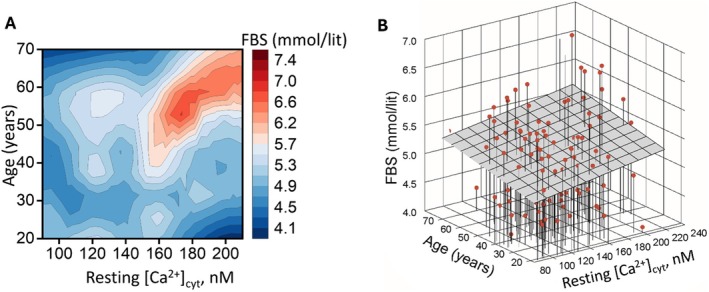
We measured resting [Ca] in myotubes derived from muscle biopsies of control and MHS subjects. We analysed the impact of [Ca] on FBS levels based on age, sex, and MH status through correlation and comparative analyses. Data were stratified by FBS, [Ca], and age, and heat map and 3D mesh plot analyses were performed to assess the risk of prediabetes in subjects with varying [Ca] and age.
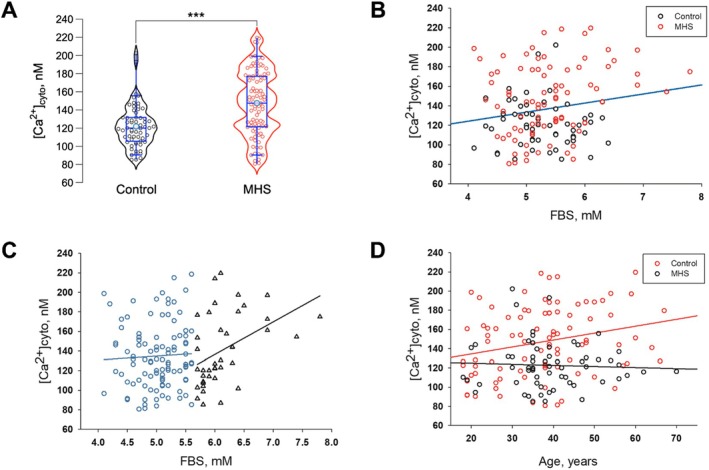
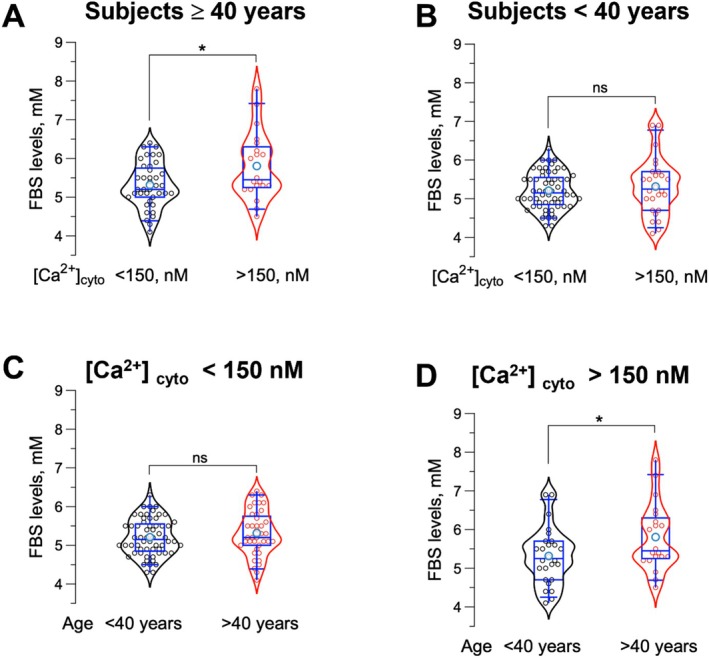
Between 2013 and 2024, muscle biopsies from 152 subjects (90 MHS, 62 controls) were used to establish primary myotube culture. MHS myotubes exhibited significantly higher resting [Ca] than controls and [Ca] positively correlated with fasting blood sugar (FBS) in MHS subjects (r = 0.227; p = 0.031) and across the entire cohort (r = 0.176; p = 0.034). This correlation was high in prediabetic individuals (r = 0.43; p = 0.005) but absent in those with normal FBS. Subjects over 40 years with [Ca] > 150 nM showed a higher risk of prediabetes. While aging is a significant risk factor for type 2 diabetes, increased age did not impact FBS levels in individuals with [Ca] below 150 nM. However, in those with [Ca] exceeding 150 nM, increasing age significantly influenced FBS.
Elevated resting [Ca] in skeletal muscle amplifies the risk of hyperglycemia and may contribute to the onset of type 2 diabetes.
骨骼肌是胰岛素介导的葡萄糖摄取的主要部位,对维持全身葡萄糖稳态至关重要。恶性高热易感(MHS)个体的肌肉细胞静息胞质钙浓度([Ca])升高,且MHS受试者患高血糖症的发生率更高。本研究在考虑受试者人口统计学和临床变量的情况下,调查静息[Ca]升高与空腹血糖(FBS)水平之间的关联。
我们测量了来自对照和MHS受试者肌肉活检的肌管中的静息[Ca]。我们通过相关性和比较分析,基于年龄、性别和MH状态分析了[Ca]对FBS水平的影响。数据按FBS、[Ca]和年龄分层,并进行热图和三维网格图分析,以评估不同[Ca]和年龄受试者的糖尿病前期风险。
在2013年至2024年期间,来自152名受试者(90名MHS,62名对照)的肌肉活检样本用于建立原代肌管培养。MHS肌管的静息[Ca]显著高于对照,且MHS受试者中[Ca]与空腹血糖(FBS)呈正相关(r = 0.227;p = 0.031),在整个队列中也是如此(r = 0.176;p = 0.034)。这种相关性在糖尿病前期个体中较高(r = 0.43;p = 0.005),而在FBS正常的个体中不存在。[Ca] > 150 nM的40岁以上受试者患糖尿病前期的风险更高。虽然衰老 是2型糖尿病的一个重要风险因素,但年龄增加对[Ca]低于150 nM的个体的FBS水平没有影响。然而,在[Ca]超过150 nM的个体中,年龄增加对FBS有显著影响。
骨骼肌静息[Ca]升高会增加高血糖风险,并可能导致2型糖尿病的发生。