Department of Medicine III, Division of Endocrinology and Metabolism, Medical University of Vienna, Vienna, Austria.
Gender Institute, Lapura Women's Health Resort, Gars am Kamp, Austria.
Diabetologia. 2023 Jun;66(6):986-1002. doi: 10.1007/s00125-023-05891-x. Epub 2023 Mar 10.
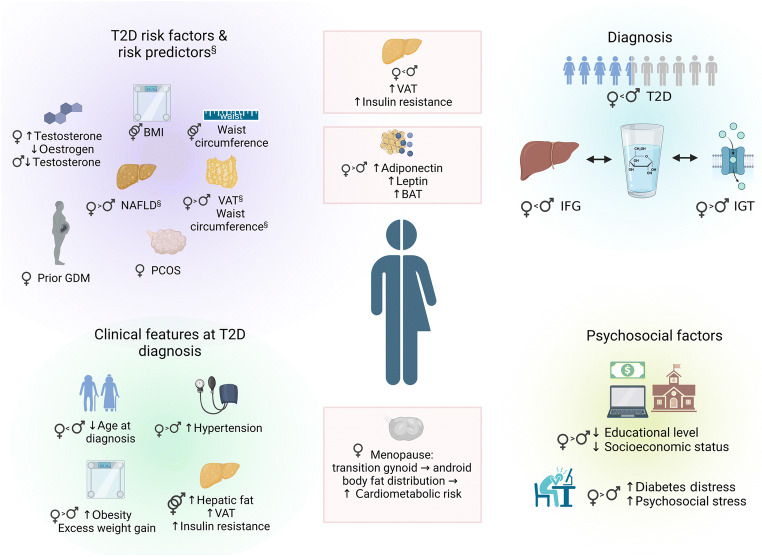
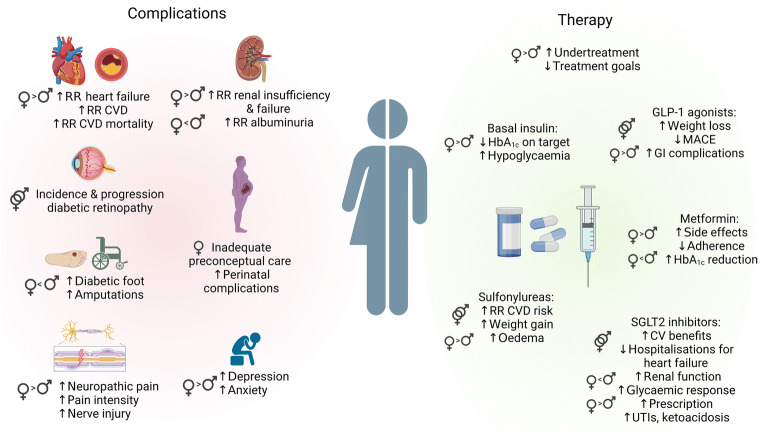
The prevalence of type 2 diabetes mellitus is increasing in both sexes, but men are usually diagnosed at a younger age and lower body fat mass than women. Worldwide, an estimated 17.7 million more men than women have diabetes mellitus. Women appear to bear a greater risk factor burden at the time of their type 2 diabetes diagnosis, especially obesity. Moreover, psychosocial stress might play a more prominent role in diabetes risk in women. Across their lifespan, women experience greater hormone fluctuations and body changes due to reproductive factors than men. Pregnancies can unmask pre-existing metabolic abnormalities, resulting in the diagnosis of gestational diabetes, which appears to be the most prominent risk factor for progression to type 2 diabetes in women. Additionally, menopause increases women's cardiometabolic risk profile. Due to the progressive rise in obesity, there is a global increase in women with pregestational type 2 diabetes, often with inadequate preconceptual care. There are differences between men and women regarding type 2 diabetes and other cardiovascular risk factors with respect to comorbidities, the manifestation of complications and the initiation of and adherence to therapy. Women with type 2 diabetes show greater relative risk of CVD and mortality than men. Moreover, young women with type 2 diabetes are currently less likely than men to receive the treatment and CVD risk reduction recommended by guidelines. Current medical recommendations do not provide information on sex-specific or gender-sensitive prevention strategies and management. Thus, more research on sex differences, including the underlying mechanisms, is necessary to increase the evidence in the future. Nonetheless, intensified efforts to screen for glucose metabolism disorders and other cardiovascular risk factors, as well as the early establishment of prophylactic measures and aggressive risk management strategies, are still required for both men and women at increased risk of type 2 diabetes. In this narrative review we aim to summarise sex-specific clinical features and differences between women and men with type 2 diabetes into risk factors, screening, diagnosis, complications and treatment.
2 型糖尿病的患病率在男性和女性中均呈上升趋势,但男性通常比女性更早被诊断出患病,且体脂量较低。在全球范围内,估计男性患糖尿病的人数比女性多 1770 万。女性在被诊断出 2 型糖尿病时似乎承担着更大的危险因素负担,尤其是肥胖。此外,心理社会压力可能在女性的糖尿病风险中发挥更突出的作用。在女性的整个生命周期中,由于生殖因素,她们经历的激素波动和身体变化比男性更大。妊娠可能会揭示出先前存在的代谢异常,导致妊娠期糖尿病的诊断,这似乎是女性发展为 2 型糖尿病的最突出危险因素。此外,绝经会增加女性的心血管代谢风险特征。由于肥胖的逐渐增加,患有孕前 2 型糖尿病的全球女性人数有所增加,而且往往缺乏孕前保健。男性和女性在 2 型糖尿病和其他心血管危险因素方面存在差异,包括合并症、并发症的表现以及治疗的开始和坚持。与男性相比,女性 2 型糖尿病患者发生 CVD 和死亡的相对风险更高。此外,目前年轻的 2 型糖尿病女性比男性更不可能接受指南推荐的治疗和 CVD 风险降低措施。目前的医学建议并未提供有关性别特异性或性别敏感的预防策略和管理的信息。因此,未来需要进行更多关于性别差异的研究,包括潜在机制,以增加证据。尽管如此,仍需要对处于 2 型糖尿病高风险的男性和女性进行强化筛查,以发现葡萄糖代谢紊乱和其他心血管危险因素,并早期采取预防措施和积极的风险管理策略。在本叙述性综述中,我们旨在将 2 型糖尿病女性患者的具体临床特征和性别差异总结为危险因素、筛查、诊断、并发症和治疗。