Kohigashi Shiori Saito, Uematsu Mizuho, Kitahara Go, Osawa Takeshi
Graduate School of Medicine and Veterinary Medicine, University of Miyazaki, Miyazaki 889-2192, Japan.
Laboratory of Theriogenology, Department of Veterinary Sciences, Faculty of Agriculture, University of Miyazaki, Miyazaki 889-2192, Japan.
J Reprod Dev. 2025 Jun 6;71(3):175-184. doi: 10.1262/jrd.2024-075. Epub 2025 May 8.
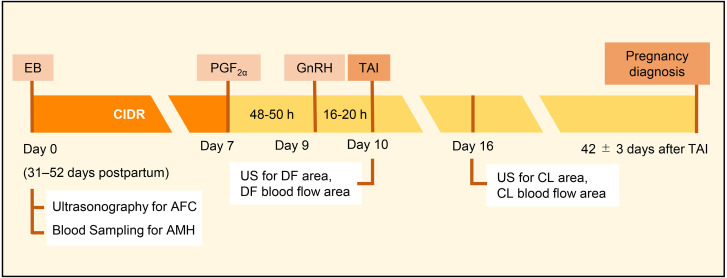
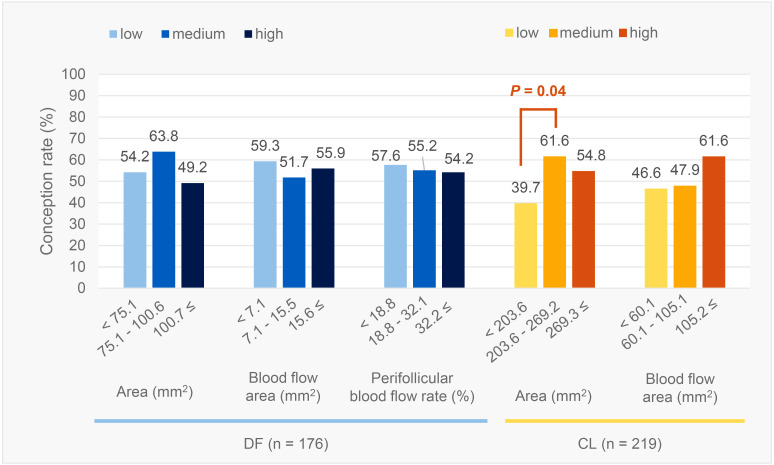
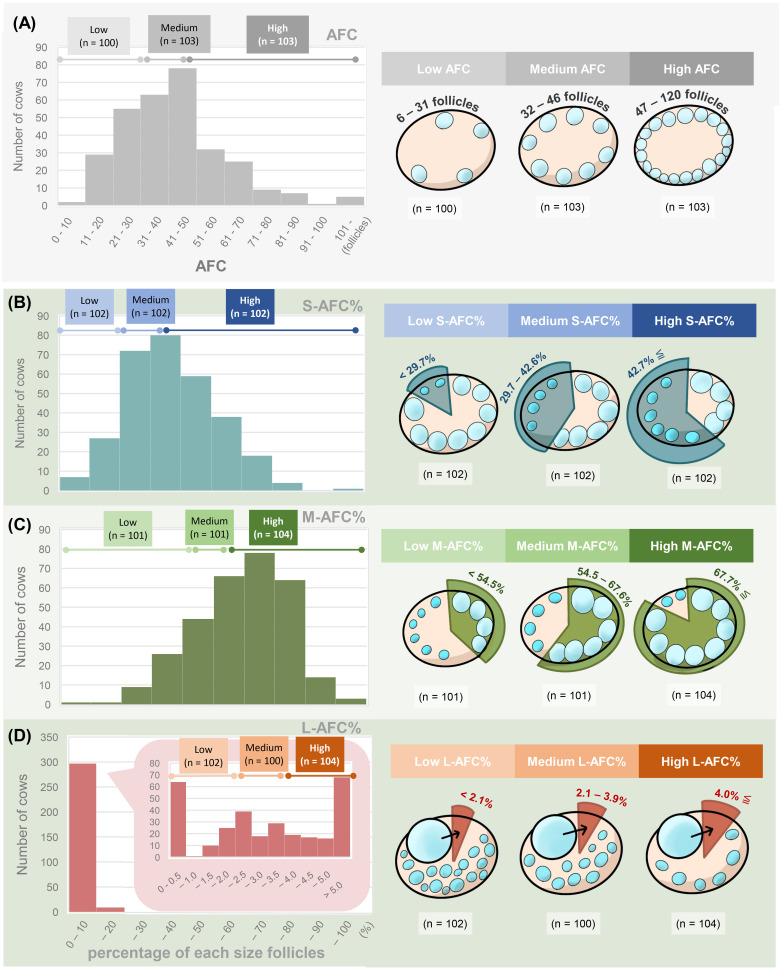
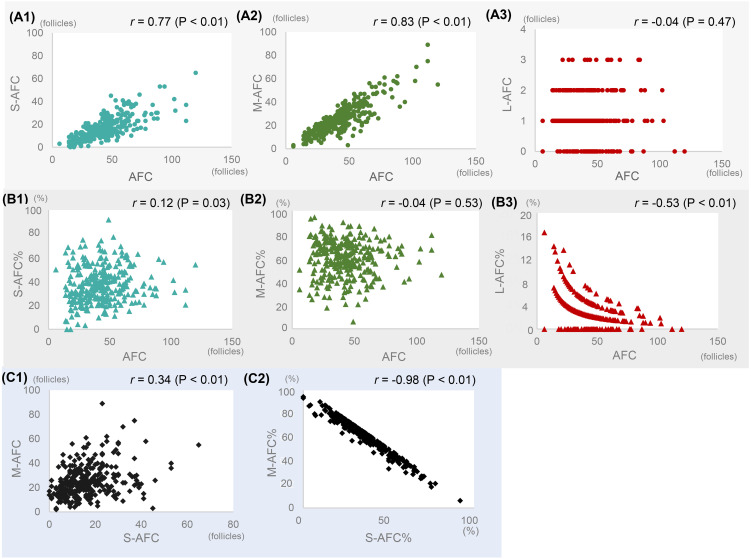
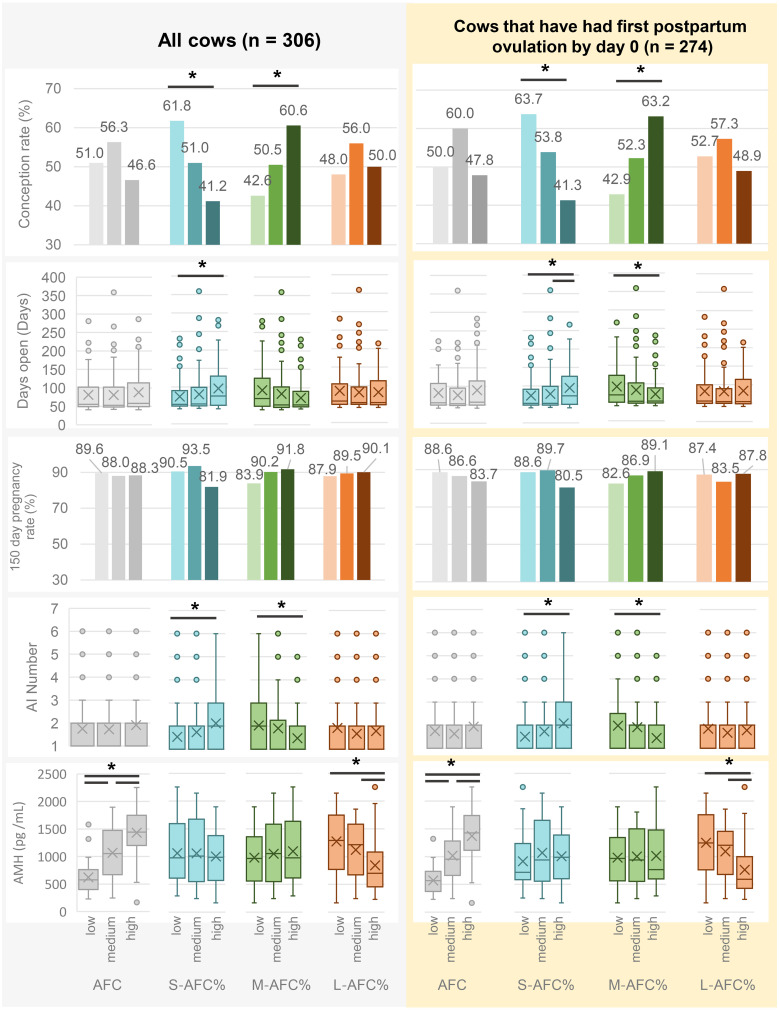
This study aimed to clarify the association between the percentage of follicle number by size over antral follicle count (AFC) and subsequent reproductive performance. A total of 306 Japanese Black cattle underwent timed artificial insemination (TAI) 41-62 days postpartum; the AFC and numbers of small, medium, and large follicles were recorded 10 days before TAI. The cross-sectional and blood flow areas of the dominant follicle (DF) on the day of TAI and the corpus luteum (CL) six days after TAI were recorded. The total number of follicles ≥ 2 mm was defined as the AFC, and the percentages of follicle number by each size defined as small (S-AFC%; 2-2.9 mm), medium (M-AFC%; 3-8.4 mm), and large (L-AFC%; ≥ 8.5 mm) follicles. The AFC and S-, M-, and L-AFC% were further grouped into low, medium, and high tertiles, and the subsequent reproductive performance compared among the groups. Plasma anti-Müllerian hormone (AMH) levels were quantified on the day of AFC measurement. No differences were observed in reproductive performance between the AFC and L-AFC% groups. The high-S-AFC% group showed a 20.6% lower conception rate, 0.58 more AI numbers, and 21.9 longer days open than those of the low-S-AFC% group (P < 0.05). The low-M-AFC% group showed an 18.0% lower conception rate after TAI and 0.54 more AI numbers than those of the high-M-AFC% group (P < 0.05). DF and CL parameters did not differ among the AFC, S-, M-, and L-AFC% groups. Plasma AMH levels in the low-AFC group were the lowest in the tertile. In conclusion, the percentage of follicles by size could be used to estimate subsequent reproductive performance.
本研究旨在阐明按大小划分的卵泡数量占窦状卵泡计数(AFC)的百分比与后续繁殖性能之间的关联。总共306头日本黑牛在产后41 - 62天接受定时人工授精(TAI);在TAI前10天记录AFC以及小、中、大卵泡的数量。记录TAI当天优势卵泡(DF)的横截面积和血流面积以及TAI后6天黄体(CL)的情况。将直径≥2 mm的卵泡总数定义为AFC,将每种大小的卵泡数量百分比定义为小卵泡(S - AFC%;2 - 2.9 mm)、中卵泡(M - AFC%;3 - 8.4 mm)和大卵泡(L - AFC%;≥8.5 mm)。将AFC以及S -、M -和L - AFC%进一步分为低、中、高三分位数组,并比较各组之间的后续繁殖性能。在测量AFC当天对血浆抗苗勒管激素(AMH)水平进行定量。AFC组和L - AFC%组之间在繁殖性能上未观察到差异。高S - AFC%组的受孕率比低S - AFC%组低20.6%,人工授精次数多0.58次,空怀天数长21.9天(P < 0.05)。低M - AFC%组在TAI后的受孕率比高M - AFC%组低18.0%,人工授精次数多0.54次(P < 0.05)。DF和CL参数在AFC、S -、M -和L - AFC%组之间没有差异。低AFC组的血浆AMH水平在三分位数中最低。总之,按大小划分的卵泡百分比可用于估计后续繁殖性能。