Mackay William, Baglin Chris, Baglin Paul, Chalmers Claire, Henriquez Fiona, Amaeze Ngozi
School of Health and Life Sciences, University of the West of Scotland, Glasgow, UK.
tensARC, Stirling, UK.
New Solut. 2025 Aug;35(2):173-187. doi: 10.1177/10482911251334843. Epub 2025 May 8.
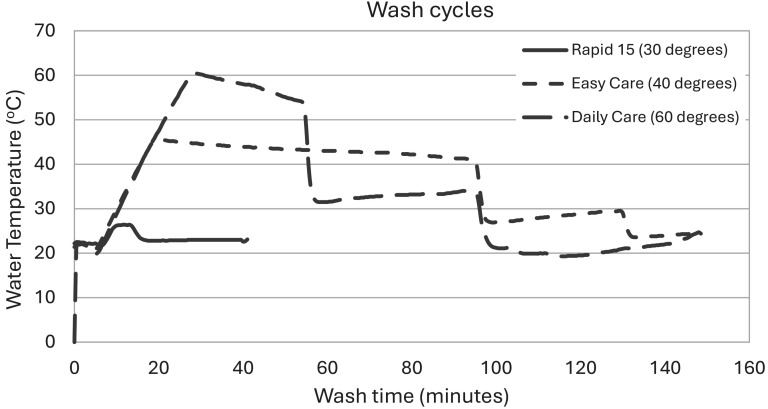
Mask shortages during COVID-19 led to the adoption of reusable textile masks; research into their performance and optimal washing conditions can guide domestic laundering to encourage their use, decreasing plastic pollution. The study tested four washing methods for cleaning artificially contaminated facepieces. These conditions included nonbiological detergent at 30°C, Reference Detergent 3 (RD3) at 40°C and 60°C, and fortified RD3 (sodium perborate + tetraacetylethylenediamine) at 40°C. After washing, the facepieces were tumble- or air-dried. The effectiveness was determined by measuring bacteria reduction by standard plate count, achieving a target reduction of ≥99.99% and a benchmark cleanliness requirement (for surgical masks) of ≤ 30 CFU/g (EN 14683: 2019). All met the benchmark except 30°C nonbiological detergent washes with air drying. Oxidative bleach reduced RD3 performance. This research demonstrates that heavily contaminated reusable masks can be effectively decontaminated using domestic machines on a normal wash cycle (40 degrees).
新冠疫情期间口罩短缺促使人们采用可重复使用的纺织口罩;对其性能和最佳洗涤条件的研究可为家庭洗涤提供指导,以鼓励使用此类口罩,减少塑料污染。该研究测试了四种清洗人工污染面罩的洗涤方法。这些条件包括30°C下使用非生物洗涤剂、40°C和60°C下使用参考洗涤剂3(RD3)以及40°C下使用强化RD3(过硼酸钠+四乙酰乙二胺)。洗涤后,对面罩进行滚筒干燥或风干。通过标准平板计数法测量细菌减少量来确定有效性,目标减少量≥99.99%,且(外科口罩的)基准清洁度要求≤30 CFU/g(EN 14683: 2019)。除了30°C非生物洗涤剂水洗并风干外,所有方法均达到了基准要求。氧化漂白剂会降低RD3的性能。这项研究表明,使用家用洗衣机在正常洗涤周期(40度)下可有效去除重度污染的可重复使用口罩上的污染物。