He William J, Geng Siyi, Tian Ling, Hu Frank B
Boston University Chobanian and Avedisian School of Medicine, Boston, Massachusetts, USA; Department of Nutrition, Harvard T.H. Chan School of Public Health, Boston, Massachusetts, USA.
Tulane University Translational Science Institute, New Orleans, Louisiana, USA.
JACC Adv. 2025 Jun;4(6 Pt 2):101744. doi: 10.1016/j.jacadv.2025.101744. Epub 2025 May 8.
Social determinants of health (SDOH) contribute to increased cardiovascular disease (CVD) mortality.
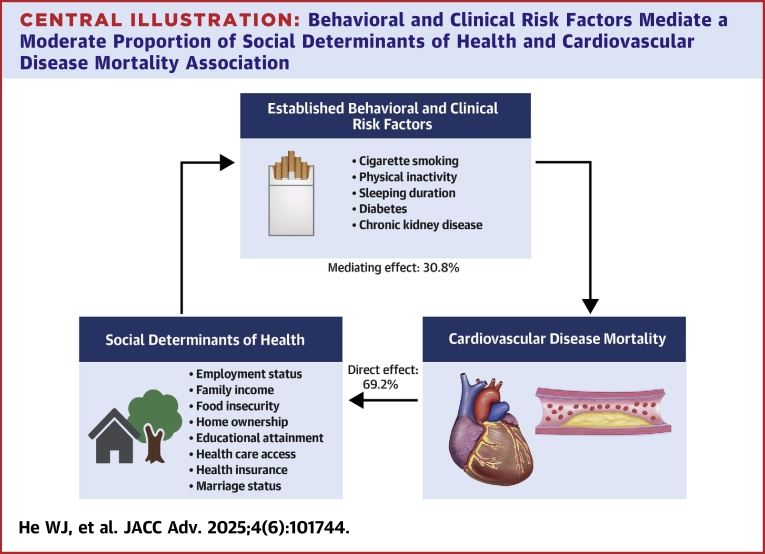
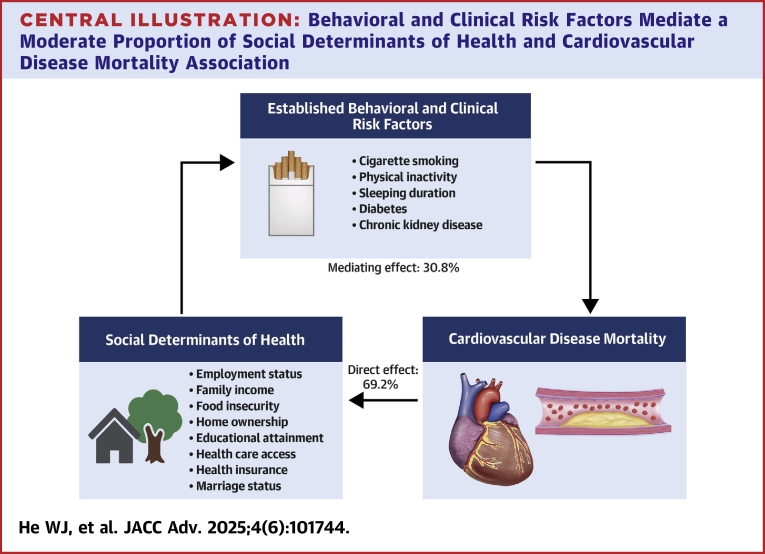
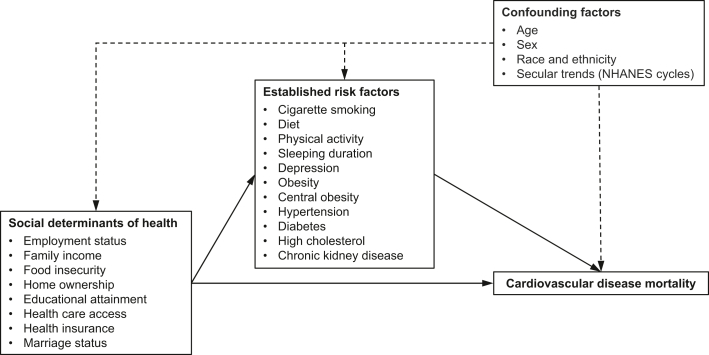
The authors investigated the mediating effects of behavioral and clinical risk factors in the association between SDOH and CVD mortality.
A total of 50,808 National Health and Nutrition Examination Survey participants aged ≥20 years were included in this analysis. Data on social, behavioral, and clinical risk factors were collected in each National Health and Nutrition Examination Survey, and CVD deaths were ascertained through linkage to the National Death Index with follow-up through 2019. Multiple mediation analysis was used to examine the contributions of behavioral and clinical risk factors to the SDOH-CVD mortality association.
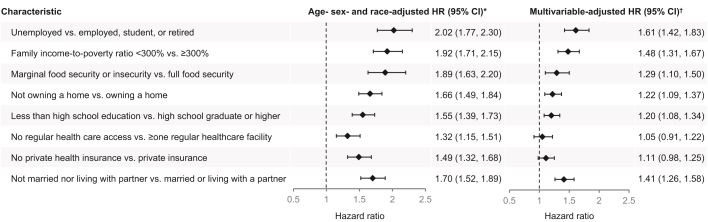
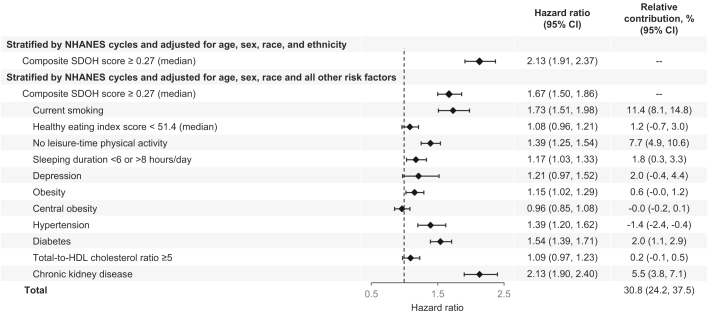
The mean age of participants was 47.2 years, and 48.8% were male. A dose-response association between the number of SDOH and CVD mortality was identified. Individuals with a composite SDOH score ≥ median have a 2.13-fold increased risk of CVD mortality (95% CI: 1.91-2.37) compared to those with a score < median. After adjusting for behavioral and clinical risk factors, the HR was reduced to 1.67 (95% CI: 1.50-1.86). Current smoking (relative contribution 11.4%; 95% CI: 8.1%-14.8%), physical inactivity (7.7%; 95% CI: 4.9%-10.6%), chronic kidney disease (5.5%; 95% CI: 3.8%-7.1%), diabetes (2.0%; 95% CI: 1.1%-2.9%), and unhealthy sleep duration (1.8%; 95% CI: 0.3%-3.3%) significantly mediated the association between CVD mortality and unfavorable SDOH. In aggregate, behavioral and clinical risk factors mediated 30.8% (95% CI: 24.2%-37.5%) of the overall CVD mortality attributable to unfavorable SDOH.
Behavioral and clinical risk factors partially mediate the association between unfavorable SDOH and increased CVD mortality.
健康的社会决定因素(SDOH)导致心血管疾病(CVD)死亡率上升。
作者研究了行为和临床风险因素在SDOH与CVD死亡率之间关联中的中介作用。
本分析纳入了50808名年龄≥20岁的国家健康与营养检查调查参与者。每次国家健康与营养检查调查都收集了社会、行为和临床风险因素的数据,并通过与国家死亡指数的关联确定CVD死亡情况,随访至2019年。采用多重中介分析来检验行为和临床风险因素对SDOH-CVD死亡率关联的贡献。
参与者的平均年龄为47.2岁,48.8%为男性。确定了SDOH数量与CVD死亡率之间的剂量反应关系。与SDOH综合评分<中位数的个体相比,SDOH综合评分≥中位数的个体CVD死亡风险增加2.13倍(95%CI:1.91-2.37)。在调整行为和临床风险因素后,HR降至1.67(95%CI:1.50-1.86)。当前吸烟(相对贡献11.4%;95%CI:8.1%-14.8%)、身体活动不足(7.7%;95%CI:4.9%-10.6%)、慢性肾病(5.5%;95%CI:3.8%-7.1%)、糖尿病(2.0%;95%CI:1.1%-2.9%)和不健康的睡眠时间(1.8%;95%CI:0.3%-3.3%)显著介导了CVD死亡率与不良SDOH之间的关联。总体而言,行为和临床风险因素介导了因不良SDOH导致的总体CVD死亡率的30.8%(95%CI:24.2%-37.5%)。
行为和临床风险因素部分介导了不良SDOH与CVD死亡率增加之间的关联。