More Kunal R, Devaraj Aishwarya, Robledo-Avila Frank H, Partida-Sanchez Santiago, Bakaletz Lauren O, Goodman Steven D
Center for Microbe and Immunity Research, Abigail Wexner Research Institute at Nationwide Children's Hospital, Columbus, OH, United States.
Department of Pediatrics, College of Medicine, Ohio State University, Columbus, OH, United States.
Front Immunol. 2025 Apr 22;16:1565252. doi: 10.3389/fimmu.2025.1565252. eCollection 2025.
Neutrophil Extracellular Traps (NETs) are vital for innate immunity, playing a key role in controlling pathogen and biofilm proliferation. However, excessive NETosis is implicated in autoimmunity, inflammatory and neoplastic diseases, as well as thrombosis, stroke, and post-COVID-19 complications. Managing NETosis, therefore is a significant area of ongoing research. Herein, we have identified a peptide derived from HMGB1 that we have modified via a point mutation that is referred to as mB Box-97. In our recent study in a murine lung infection model, mB Box-97 was shown to be safe and effective at disrupting biofilms without eliciting an inflammatory response typically associated with HMGB1. Here we show that the lack of an inflammatory response of mB Box-97 is in part due to the inhibition of NETosis of which we investigated the mechanism of action.
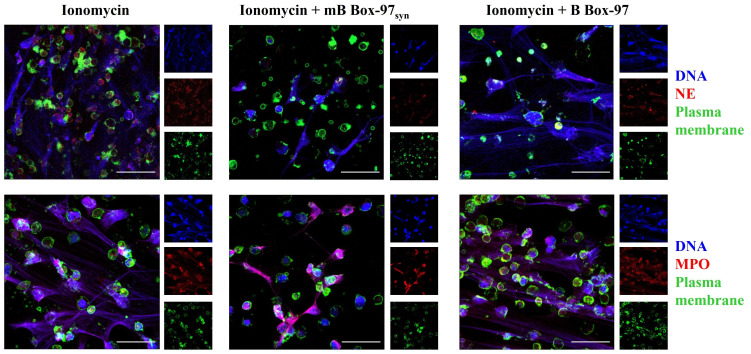
mB Box-97's anti-NETosis activity was assessed using human neutrophils with known NET inducers PMA, LPS, or Ionomycin. Additionally, mB Box-97's binding to Protein Kinase C (PKC), in addition to downstream effects on NADPH oxidase (NOX) activation, Reactive Oxygen Species (ROS) generation and thereby NETosis were assessed.
mB Box-97 significantly inhibited NETosis regardless of the type of induction pathway. Mechanistically, mB Box-97 inhibits PKC activity likely through direct binding and thereby reduced downstream activities including NOX activation, ROS production and NETosis.
mB Box-97 is a promising dual acting therapeutic candidate for managing NET-mediated pathologies and resolving biofilm infections. Our results reveal that PKC is a viable target for NETosis inhibition independent of NET inducer and worthy of further study. These findings pave the way for a novel class of therapeutics aimed at controlling excessive NETosis, potentially offering new treatments for a range of inflammatory and immune-related diseases.
中性粒细胞胞外陷阱(NETs)对先天免疫至关重要,在控制病原体和生物膜增殖中起关键作用。然而,过度的NETosis与自身免疫、炎症和肿瘤性疾病以及血栓形成、中风和新冠后遗症有关。因此,管理NETosis是当前研究的一个重要领域。在此,我们鉴定了一种源自高迁移率族蛋白B1(HMGB1)的肽,我们通过点突变对其进行了修饰,称为mB Box-97。在我们最近对小鼠肺部感染模型的研究中,mB Box-97被证明在破坏生物膜方面安全有效,且不会引发通常与HMGB1相关的炎症反应。在此我们表明,mB Box-97缺乏炎症反应部分归因于对NETosis的抑制,我们对其作用机制进行了研究。
使用已知的NET诱导剂佛波酯(PMA)、脂多糖(LPS)或离子霉素,对人中性粒细胞评估mB Box-97的抗NETosis活性。此外,评估mB Box-97与蛋白激酶C(PKC)的结合,以及对烟酰胺腺嘌呤二核苷酸磷酸氧化酶(NOX)激活、活性氧(ROS)生成及由此产生的NETosis的下游影响。
无论诱导途径的类型如何,mB Box-97均能显著抑制NETosis。从机制上讲,mB Box-97可能通过直接结合抑制PKC活性,从而降低包括NOX激活、ROS产生和NETosis在内的下游活性。
mB Box-97是一种有前景的双效治疗候选物,可用于管理NET介导的病理状况和解决生物膜感染。我们的结果表明,PKC是独立于NET诱导剂抑制NETosis的可行靶点,值得进一步研究。这些发现为旨在控制过度NETosis的新型治疗方法铺平了道路,可能为一系列炎症和免疫相关疾病提供新的治疗方法。