Heremans Elisabeth R M, Devulder Astrid, Borzée Pascal, Vandenberghe Rik, De Winter François-Laurent, Vandenbulcke Mathieu, Van Den Bossche Maarten, Buyse Bertien, Testelmans Dries, Van Paesschen Wim, De Vos Maarten
STADIUS Center for Dynamical Systems, Signal Processing and Data Analytics-Department of Electrical Engineering (ESAT), KU Leuven, Leuven, Belgium.
Laboratory for Epilepsy Research, KU Leuven Biomedical Sciences Group, Leuven, Belgium.
NPJ Aging. 2025 May 9;11(1):34. doi: 10.1038/s41514-025-00219-y.
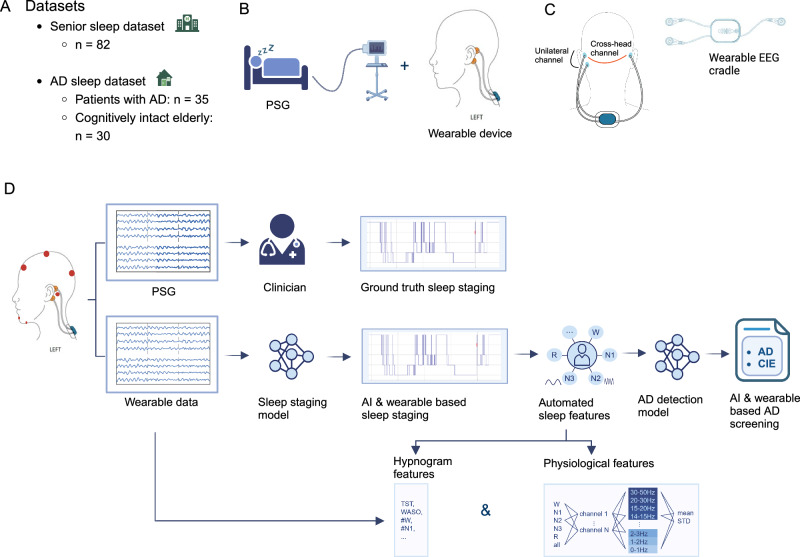
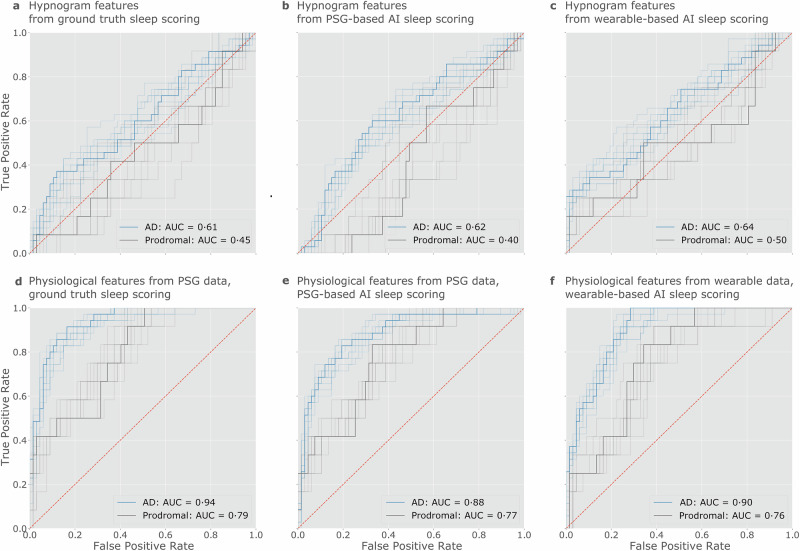
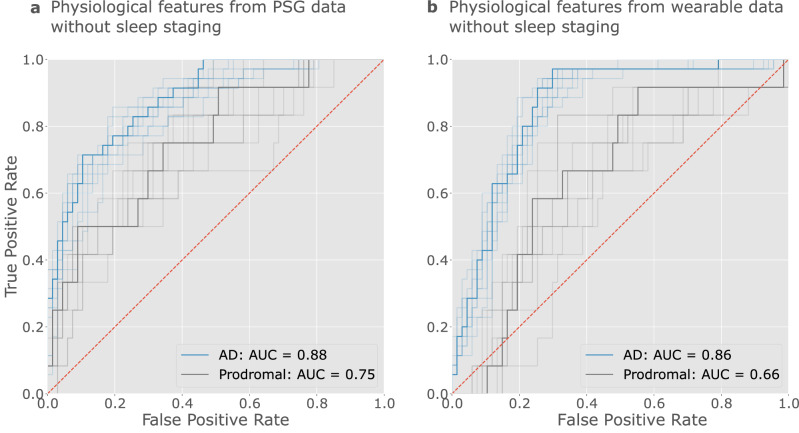
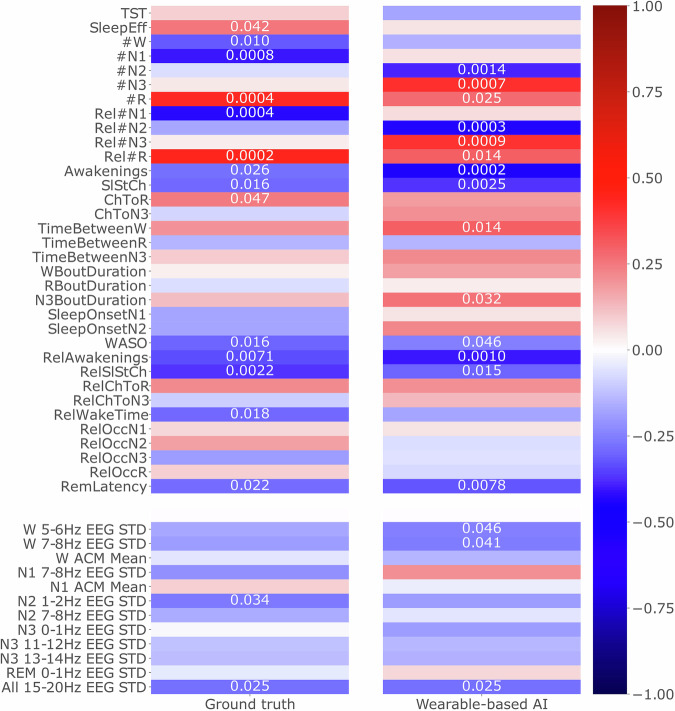
The recent emergence of wearable devices will enable large scale remote brain monitoring. This study investigated whether multimodal wearable sleep recordings could help screening for Alzheimer's disease (AD). Measurements were acquired simultaneously from polysomnography and a wearable device, measuring electroencephalography (EEG) and accelerometry (ACM) in 67 elderly without cognitive symptoms and 35 AD patients. Sleep staging was performed using an AI model (SeqSleepNet), followed by feature extraction from hypnograms and physiological signals. Using these features, a multi-layer perceptron was trained for AD detection, with elastic net identifying key features. The wearable AD detection model achieved an accuracy of 0.90 (0.76 for prodromal AD). Single-channel EEG and ACM physiological features captured sufficient information for AD detection and outperformed the hypnogram features, highlighting these physiological features as promising discriminative markers for AD. We conclude that wearable sleep monitoring augmented by AI shows promise towards non-invasive screening for AD in the older population.
近期可穿戴设备的出现将实现大规模远程脑部监测。本研究调查了多模态可穿戴睡眠记录是否有助于筛查阿尔茨海默病(AD)。对67名无认知症状的老年人和35名AD患者同时进行多导睡眠图和可穿戴设备测量,测量脑电图(EEG)和加速度计(ACM)。使用人工智能模型(SeqSleepNet)进行睡眠分期,随后从睡眠图和生理信号中提取特征。利用这些特征,训练多层感知器用于AD检测,弹性网络识别关键特征。可穿戴AD检测模型的准确率达到0.90(前驱期AD为0.76)。单通道EEG和ACM生理特征捕获了足够的AD检测信息,且优于睡眠图特征,突出了这些生理特征作为AD有前景的判别标志物。我们得出结论,人工智能增强的可穿戴睡眠监测在老年人群体中对AD的无创筛查显示出前景。