Radwan Rotana M, Bridges John F P, Hertz Daniel L, Lustberg Maryam B, Vachhani Hetal, Hickey Zacholski Erin, Sheppard Vanessa B, Salgado Teresa M
Department of Pharmacotherapy & Outcomes Science, School of Pharmacy, Virginia Commonwealth University, 410 N 12 Street, PO Box 98053, Richmond, VA, 23298, USA.
Department of Biomedical Informatics, College of Medicine, The Ohio State University Wexner Medical Center, 250 Lincoln Tower, 1800 Cannon Drive, Columbus, OH, 43210, USA.
Support Care Cancer. 2025 May 10;33(6):467. doi: 10.1007/s00520-025-09508-4.
To measure the importance of factors that influence the decision to discontinue treatment due to chemotherapy-induced peripheral neuropathy (CIPN) among patients with metastatic breast cancer (mBC).
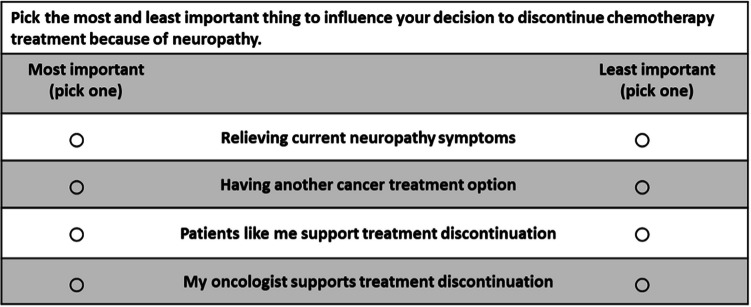
An online survey incorporating a best-worst scaling (BWS) was conducted among women in the USA with mBC and experiencing CIPN. In the BWS, women chose the most and least important factors influencing their decision to discontinue treatment due to CIPN. Seven factors were included: relieving current neuropathy symptoms, reducing risk of long-term neuropathy, having another cancer treatment option, understanding the risk of treatment discontinuation, and receiving support for treatment discontinuation from the oncologist, loved ones, or patients with similar experiences. To measure the importance of each factor, a conditional logit model estimated coefficients, which were subsequently rescaled to importance scores that summed to 100. The dependent variable was the choice of a factor as most or least important across seven choice tasks.
The sample included 189 women with a mean age of 52.5 (SD = 12.65) years, 52.9% were White, 33.9% were Black, and 64.6% held a bachelor's degree or higher. When faced with the decision to discontinue treatment due to CIPN, the most important factors were having another cancer treatment option (score 23.5), followed by understanding the risk of treatment discontinuation (score 19.2), and reducing risk of long-term neuropathy (score 19.1). The least important factors in the decision to discontinue treatment due to CIPN were: support from loved ones (score 5.2) and support from other patients (score 3.3).
When faced with the decision to discontinue treatment due to CIPN, women with mBC attributed more importance to survival and reducing the risk of long-term CIPN. Knowledge of what matters most to patients may assist with shared decision-making to optimize therapeutic outcomes in patients receiving neurotoxic chemotherapy.
评估影响转移性乳腺癌(mBC)患者因化疗引起的周围神经病变(CIPN)而决定停止治疗的因素的重要性。
对美国患有mBC且经历CIPN的女性进行了一项纳入最佳-最差尺度法(BWS)的在线调查。在BWS中,女性选择影响其因CIPN而决定停止治疗的最重要和最不重要的因素。包括七个因素:缓解当前神经病变症状、降低长期神经病变风险、有其他癌症治疗选择、了解停止治疗的风险,以及获得肿瘤学家、亲人或有类似经历患者对停止治疗的支持。为了衡量每个因素的重要性,使用条件logit模型估计系数,随后将其重新缩放到总和为100的重要性得分。因变量是在七个选择任务中选择一个因素作为最重要或最不重要的情况。
样本包括189名女性,平均年龄为52.5(标准差=12.65)岁,52.9%为白人,33.9%为黑人,64.6%拥有学士学位或更高学历。当面临因CIPN而决定停止治疗时,最重要的因素是有其他癌症治疗选择(得分23.5),其次是了解停止治疗的风险(得分19.2),以及降低长期神经病变风险(得分19.1)。因CIPN而决定停止治疗的最不重要因素是:亲人的支持(得分5.2)和其他患者的支持(得分3.3)。
当面临因CIPN而决定停止治疗时,mBC女性更重视生存和降低长期CIPN风险。了解对患者最重要的因素可能有助于在接受神经毒性化疗的患者中进行共同决策,以优化治疗结果。