
氢吗啡酮联合罗哌卡因在胸小肌平面阻滞对电视辅助胸腔镜肺叶切除术患者术后疼痛的影响:一项随机、双盲临床试验
The impact of hydromorphone combined with ropivacaine in serratus anterior plane block on postoperative pain in patients undergoing video-assisted thoracoscopic pulmonary lobectomy: a randomized, double-blind clinical trial.
作者信息
Chen Xuefeng, Zhang Weifeng, Wang Lin, Wang Weibing, Li Yuhong
机构信息
Department of Anesthesiology, Shangyu People's Hospital of Shaoxing, Shaoxing University, Shaoxing, Zhejiang, 312300, China.
Department of Epidemiology, School of Public Health, Fudan University, Shanghai, 200032, China.
出版信息
BMC Anesthesiol. 2025 May 10;25(1):237. doi: 10.1186/s12871-025-03101-2.
BACKGROUND
This study aimed to assess the effects of hydromorphone as an adjuvant to ropivacaine serratus anterior plane block (SAPB) on postoperative analgesia and inflammatory responses in patients undergoing video-assisted thoracoscopic surgery (VATS).
METHODS
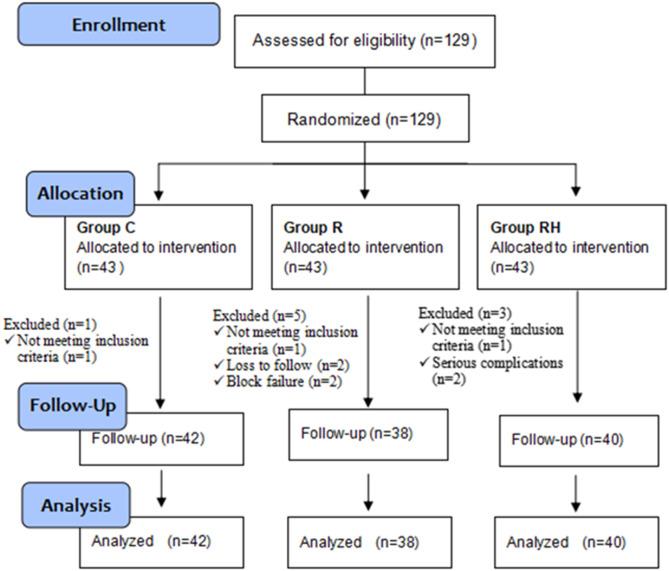
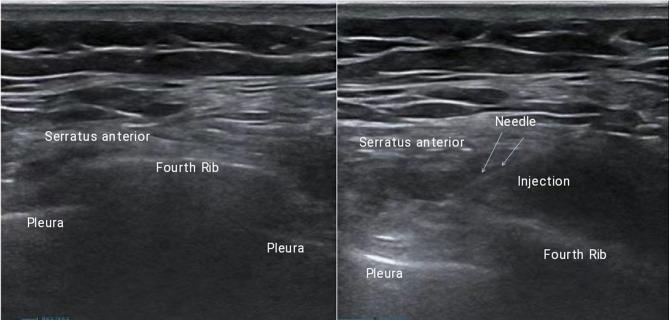
This was a prospective, randomized, double-blind clinical trial. A total of 120 lung cancer patients, aged 20-75 years, with an American Society of Anesthesiologists classification of I or II and a body mass index of 18-28 kg/m², were randomly assigned to three groups: ropivacaine combined with hydromorphone SAPB (HR group), ropivacaine SAPB (R group), and control (C group). Ultrasound-guided deep SAPB was used to inject medications. The main observed indicators were postoperative visual analog scale (VAS) pain scores, serum inflammatory markers (C-reactive protein (CRP), IL-6, TNF-α), intraoperative medication dosage, postoperative complication rates, and analgesic effects.
RESULTS
Postoperative VAS pain scores were significantly reduced in the HR and R groups compared to the C group, especially at 6 h postoperatively. The median VAS score in the HR group was 2.00 (inter-quartile ratio (IQR): 2.00, 2.00), which was significantly lower than that of the C group's score of 3.00 (IQR: 3.00, 3.00; P < 0.001). The CRP levels at 24 and 48 h postoperatively in the HR group were 23.80 mg/L and 21.65 mg/L, respectively, significantly lower than the C group's levels of 56.65 mg/L and 82.75 mg/L, P < 0.001. The levels of IL-6 and TNF-α were also significantly lower in the HR group than in the C group. Intraoperative propofol and remifentanil dosages in the HR group were reduced to 5.22 mg/kg/h and 7.59 µg/kg/h, respectively, lower than the C group's dosages of 5.93 mg/kg/h and 5.74 µg/kg/h, P < 0.001. The incidence of postoperative nausea and vomiting in the HR group was 12.5%, which was lower than that in Group C (35.7%, P = 0.032).
CONCLUSION
Ropivacaine adjuvant with hydromorphone in SAPB reducing postoperative pain and inflammatory in patients undergoing VATS, which contributed to rapid recovery. However, future studies should explore the long-term benefits and concenntration of hydromorphone of SAPB before it taken into clinical use.
TRIAL REGISTRATION
Chinese Clinical Trial Register on August 19, 2021, NCT number ChiCTR2100053893.
背景
本研究旨在评估氢吗啡酮作为罗哌卡因辅助剂用于前锯肌平面阻滞(SAPB)对接受电视辅助胸腔镜手术(VATS)患者术后镇痛及炎症反应的影响。
方法
这是一项前瞻性、随机、双盲临床试验。共120例年龄在20 - 75岁、美国麻醉医师协会分级为I或II级且体重指数为18 - 28kg/m²的肺癌患者,被随机分为三组:罗哌卡因联合氢吗啡酮SAPB组(HR组)、罗哌卡因SAPB组(R组)和对照组(C组)。采用超声引导下深部SAPB注射药物。主要观察指标为术后视觉模拟评分(VAS)疼痛评分、血清炎症标志物(C反应蛋白(CRP)、白细胞介素 - 6(IL - 6)、肿瘤坏死因子 - α(TNF - α))、术中用药剂量、术后并发症发生率及镇痛效果。
结果
与C组相比,HR组和R组术后VAS疼痛评分显著降低,尤其是术后6小时。HR组VAS评分中位数为2.00(四分位数间距(IQR):2.00,2.00),显著低于C组的3.00(IQR:3.00,3.00;P < 0.001)。HR组术后24小时和48小时的CRP水平分别为23.80mg/L和21.65mg/L,显著低于C组的56.65mg/L和82.75mg/L,P < 0.001。HR组IL - 6和TNF - α水平也显著低于C组。HR组术中丙泊酚和瑞芬太尼剂量分别降至5.22mg/kg/h和7.59μg/kg/h,低于C组的5.93mg/kg/h和5.74μg/kg/h,P < 0.001。HR组术后恶心呕吐发生率为12.5%,低于C组(35.7%,P = 0.032)。
结论
罗哌卡因联合氢吗啡酮用于SAPB可减轻VATS患者术后疼痛及炎症反应,有助于快速康复。然而,在临床应用前,未来研究应探索氢吗啡酮在SAPB中的长期益处及浓度。
试验注册
2021年8月19日在中国临床试验注册中心注册,NCT编号ChiCTR2100053893。
 Zotero 插件