
胎儿生长受限中关键线粒体自噬相关基因的鉴定
Identification of Key Mitochondrial Autophagy-Related Genes in Fetal Growth Restriction.
作者信息
Yao Yanru, Lei Gang, Pan Guangxin, Xiong Guoping, Shen Jian
机构信息
Obstetric, Centre Hospital of Wuhan, Huazhong University of Science and Technology, Wuhan, Hubei, 430014, People's Republic of China.
出版信息
Int J Womens Health. 2025 May 5;17:1249-1261. doi: 10.2147/IJWH.S510947. eCollection 2025.
OBJECTIVE
To identify key mitochondrial autophagy-related genes (MARGs) in fetal growth restriction (FGR)and evaluate their diagnostic potential through bioinformatics and machine learning approaches.
METHODS
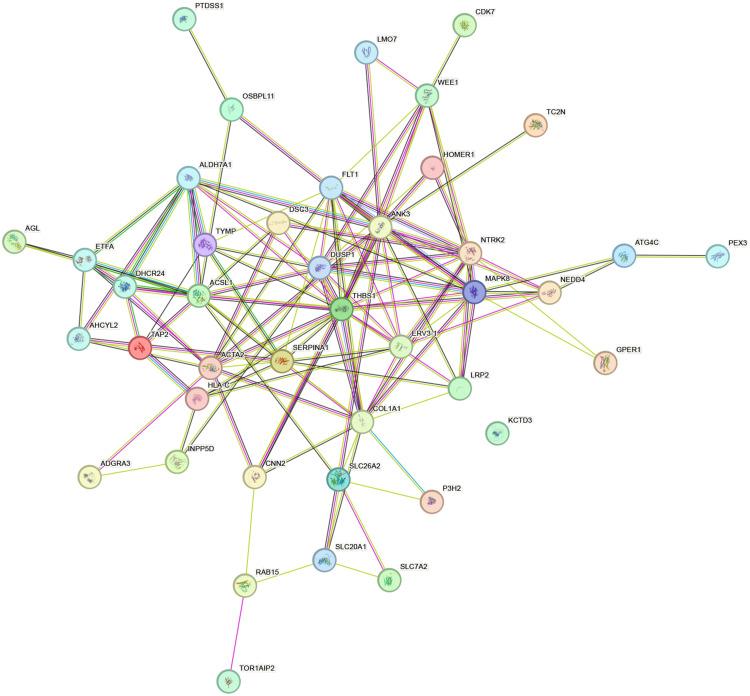
The GSE24192 dataset were obtained from Gene Expression Omnibus data base (GEO). Differentially expressed genes (DEGs) were identified using differentially expressed analysis. Mitochondrial autophagy-related genes (MARGs) were identified using GeneCards. Gene Ontology (GO) and Kyoto Encyclopedia of Genes and Genomes (KEGG) enrichment analyses were performed with the clusterProfiler package. Protein-protein interaction (PPI) network was constructed using STRING, and key genes were selected using machine learning. Receiver operating characteristic (ROC) curves assessed diagnostic performance of key genes. Immune infiltration analysis was used to evaluated immune microenvironment. The miRNAs were predicted in TargetScan website.
RESULTS
A total of 42 MARGs were identified in FGR samples, and three key genes (THBS1, RAB15, LMO7) were selected through machine learning methods. These genes showed high diagnostic potential with area under the curve (AUC) values of 0.97, 0.95, and 0.92, respectively. Immune infiltration analysis revealed significant increase of CD8+ T cells, endothelial cells, and macrophages in FGR samples. Correlation analysis indicated THBS1 was positively related to several immune cells, while RAB15 and LMO7 were negatively related to several immune cells. The miRNA-mRNA regulatory network revealed four miRNAs potentially regulating these key genes.
CONCLUSION
In conclusion, our study identified THBS1, RAB15, and LMO7 as key mitochondrial autophagy-related genes in FGR, with potential as diagnostic biomarkers.
目的
识别胎儿生长受限(FGR)中关键的线粒体自噬相关基因(MARG),并通过生物信息学和机器学习方法评估其诊断潜力。
方法
从基因表达综合数据库(GEO)获取GSE24192数据集。使用差异表达分析识别差异表达基因(DEG)。使用GeneCards识别线粒体自噬相关基因(MARG)。使用clusterProfiler软件包进行基因本体(GO)和京都基因与基因组百科全书(KEGG)富集分析。使用STRING构建蛋白质-蛋白质相互作用(PPI)网络,并使用机器学习选择关键基因。通过受试者工作特征(ROC)曲线评估关键基因的诊断性能。使用免疫浸润分析评估免疫微环境。在TargetScan网站预测miRNA。
结果
在FGR样本中总共识别出42个MARG,并通过机器学习方法选择了三个关键基因(THBS1、RAB15、LMO7)。这些基因显示出较高的诊断潜力,曲线下面积(AUC)值分别为0.97、0.95和0.92。免疫浸润分析显示FGR样本中CD8 + T细胞、内皮细胞和巨噬细胞显著增加。相关性分析表明THBS1与几种免疫细胞呈正相关,而RAB15和LMO7与几种免疫细胞呈负相关。miRNA-mRNA调控网络显示有四种miRNA可能调控这些关键基因。
结论
总之,我们的研究确定THBS1、RAB15和LMO7为FGR中关键的线粒体自噬相关基因,具有作为诊断生物标志物的潜力。




 Zotero 插件