Xiong Junlong, Ding Shiping, Zhou Jiangtao, Cui Yunqi, Chen Xiaona, Huang Lihong, Zhang Jiahao, Qi Wenbao, Liao Ming
Key Laboratory of Zoonoses, Ministry of Agriculture and Rural Affairs, South China Agricultural University, Guangzhou, People's Republic of China.
State Key Laboratory for Animal Disease Control and Prevention, South China Agricultural University, Guangzhou, People's Republic of China.
Emerg Microbes Infect. 2025 Dec;14(1):2505649. doi: 10.1080/22221751.2025.2505649. Epub 2025 May 30.
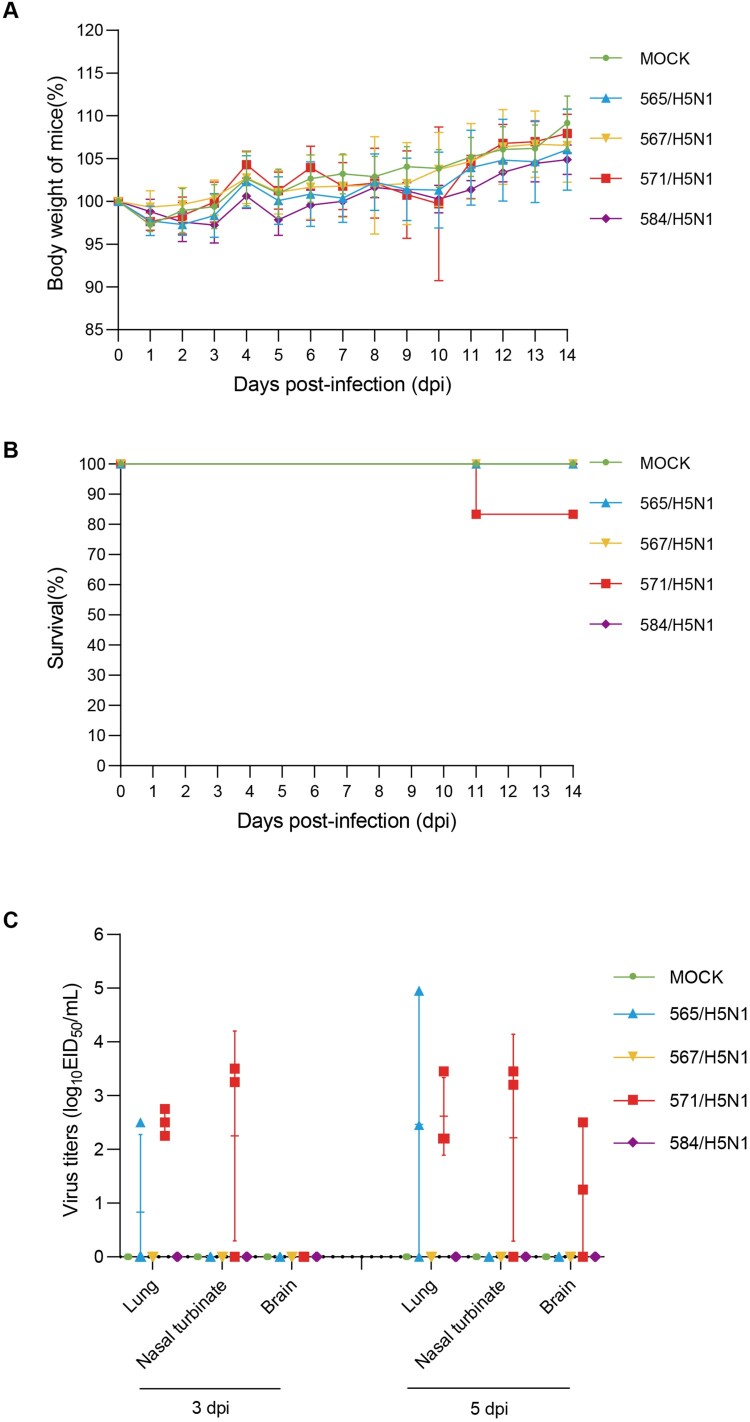
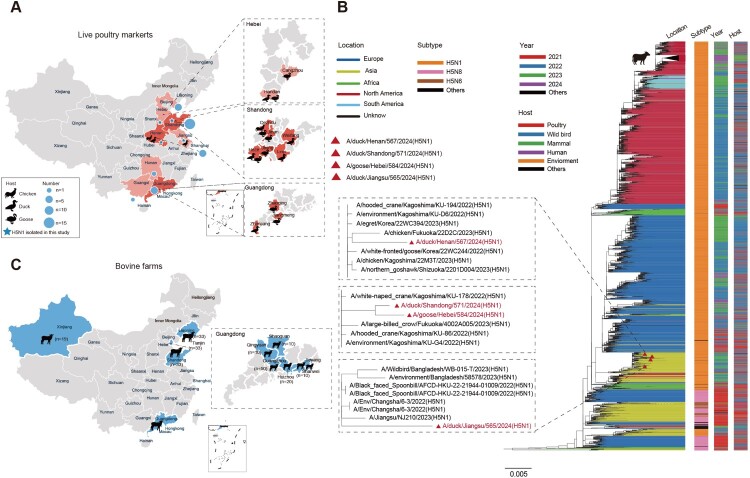
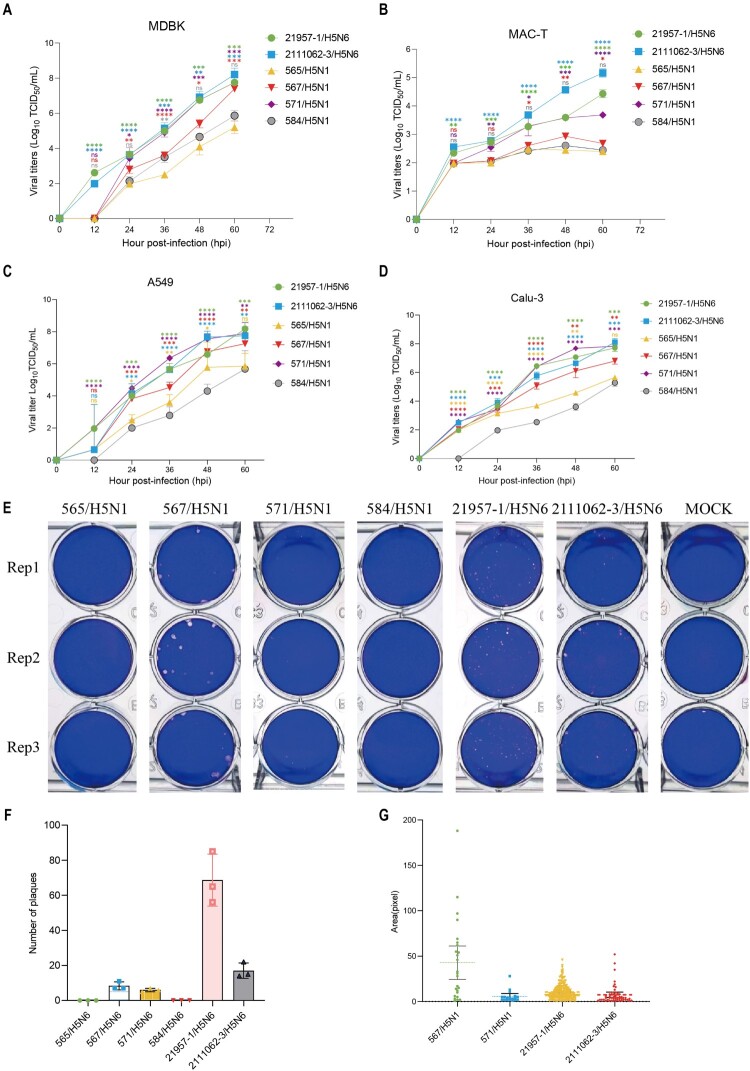
In February 2024, H5N1 highly pathogenic avian influenza viruses (HPAIVs) of clade 2.3.4.4b were first reported in dairy cows in the USA. Subsequent multiple outbreaks on dairy farms and sporadic human infections have raised substantial public health concerns. In the same year, four H5N1 HPAIVs of clade 2.3.4.4b were isolated from ducks and geese in live poultry markets (LPMs) spanning seven provinces in China. Evolutionary analysis demonstrated that these viruses had undergone two genetic reassortments with H5 influenza viruses from wild birds in different countries. Except for 565/H5N1, the other three viruses exhibited over 99% genetic homology with avian-origin H5N1 HPAIVs from South Korea and Japan. Notably, 571/H5N1 demonstrated high replication efficiency in bovine-derived cells, particularly in bovine mammary epithelial (MAC-T) cells, and caused 16.7% (1/6) mortality in mice at a dose of 10 EID/50 μL, indicating its zoonotic potential. Given the potential cross-species transmission risk of H5N1 HPAIVs to cattle herds, we collected 228 serum samples from 12 cattle farms across five provinces and conducted serological testing to investigate seroprevalence of H5N1 HPAIVs in Chinese cattle herds. All tested samples were negative, indicating no widespread infection in the sampled cattle populations. However, infections in cattle from other regions cannot be ruled out. Nevertheless, due to the high mutability of H5N1 HPAIVs, enhanced surveillance of avian influenza viruses is critical to ensure timely responses to potential outbreaks.
2024年2月,2.3.4.4b分支的H5N1高致病性禽流感病毒(HPAIVs)首次在美国的奶牛中被报告。随后奶牛场的多次疫情暴发和零星的人类感染引发了重大的公共卫生担忧。同年,在中国七个省份的活禽市场(LPMs)中,从鸭和鹅中分离出了4株2.3.4.4b分支的H5N1 HPAIVs。进化分析表明,这些病毒与来自不同国家野生鸟类的H5流感病毒发生了两次基因重配。除565/H5N1外,其他三种病毒与来自韩国和日本的禽源H5N1 HPAIVs的基因同源性超过99%。值得注意的是,571/H5N1在牛源细胞中表现出高复制效率,特别是在牛乳腺上皮(MAC-T)细胞中,并且在剂量为10 EID/50 μL时导致小鼠16.7%(1/6)的死亡率,表明其具有人畜共患病潜力。鉴于H5N1 HPAIVs对牛群存在潜在的跨物种传播风险,我们从五个省份的12个奶牛场收集了228份血清样本,并进行了血清学检测,以调查中国牛群中H5N1 HPAIVs的血清流行率。所有检测样本均为阴性,表明在抽样的牛群中没有广泛感染。然而,不能排除其他地区牛的感染情况。尽管如此,由于H5N1 HPAIVs的高变异性,加强禽流感病毒监测对于确保及时应对潜在疫情至关重要。