Halwe Nico Joel, Cool Konner, Breithaupt Angele, Schön Jacob, Trujillo Jessie D, Nooruzzaman Mohammed, Kwon Taeyong, Ahrens Ann Kathrin, Britzke Tobias, McDowell Chester D, Piesche Ronja, Singh Gagandeep, Pinho Dos Reis Vinicius, Kafle Sujan, Pohlmann Anne, Gaudreault Natasha N, Corleis Björn, Ferreyra Franco Matias, Carossino Mariano, Balasuriya Udeni B R, Hensley Lisa, Morozov Igor, Covaleda Lina M, Diel Diego G, Ulrich Lorenz, Hoffmann Donata, Beer Martin, Richt Juergen A
Institute of Diagnostic Virology, Friedrich-Loeffler-Institut, Greifswald - Insel Riems, Germany.
Department of Diagnostic Medicine/Pathobiology, College of Veterinary Medicine, Kansas State University, Manhattan, KS, USA.
Nature. 2025 Jan;637(8047):903-912. doi: 10.1038/s41586-024-08063-y. Epub 2024 Sep 25.
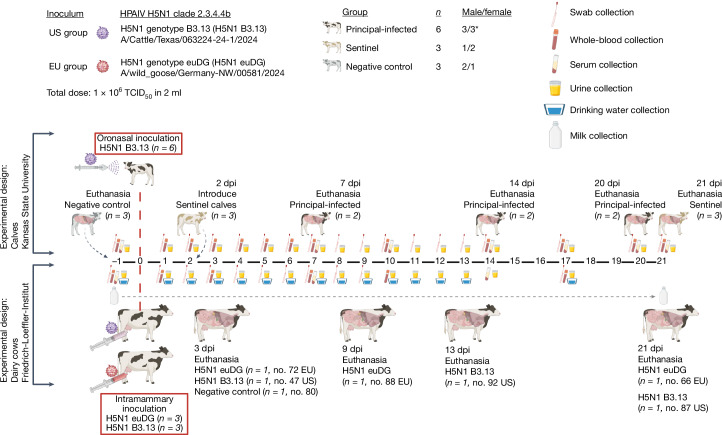
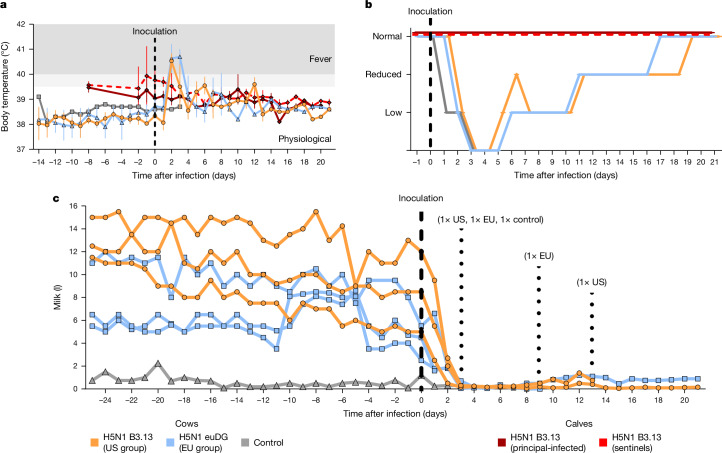
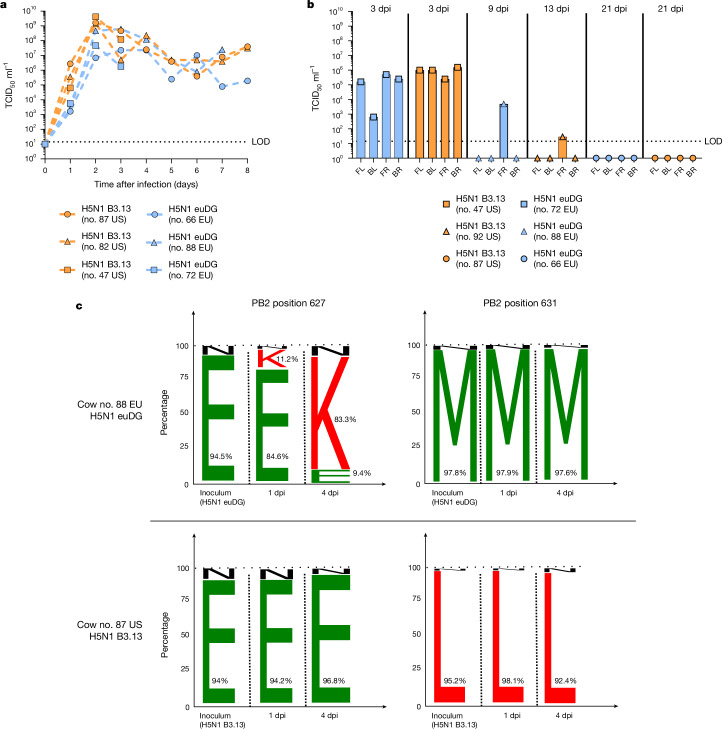
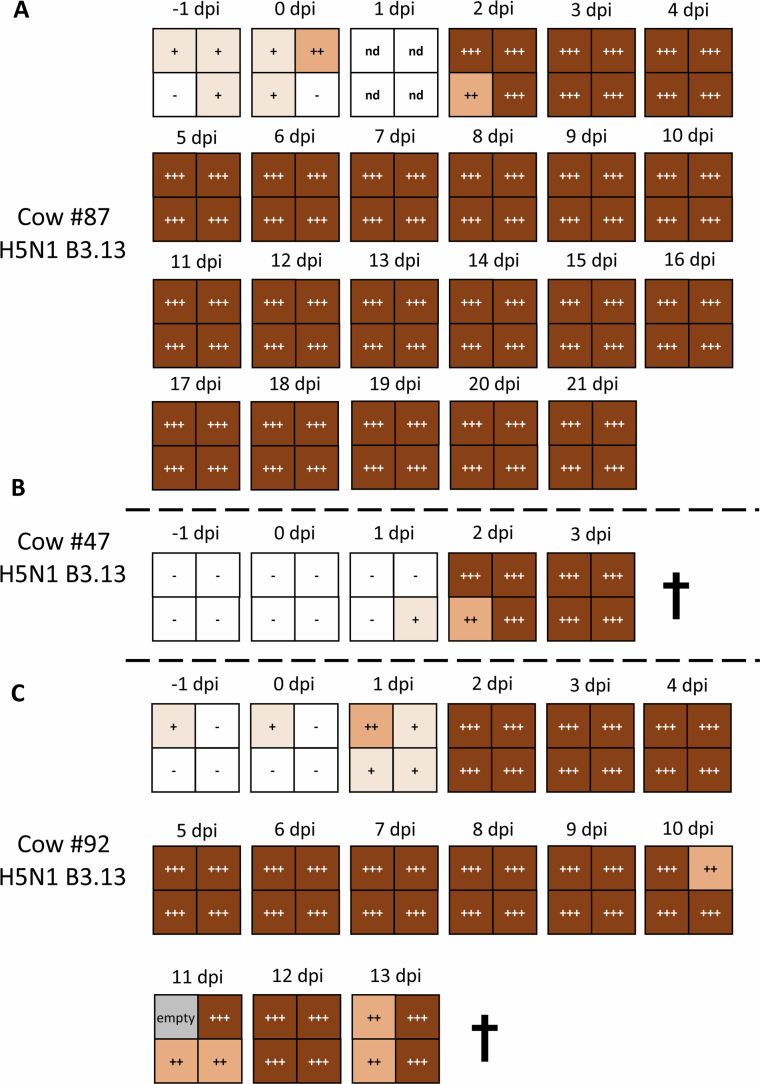
In March 2024, highly pathogenic avian influenza virus (HPAIV) clade 2.3.4.4b H5N1 infections were reported in dairy cows in Texas, USA. Rapid dissemination to more than 380 farms in 14 states followed. Here we provide results of two independent clade 2.3.4.4b experimental infection studies evaluating the oronasal susceptibility to and transmission of a US H5N1 bovine isolate, genotype B3.13 (H5N1 B3.13), in calves, and the susceptibility of lactating cows following direct mammary gland inoculation of either H5N1 B3.13 or a current EU H5N1 wild bird isolate, genotype euDG (H5N1 euDG). Inoculation of the calves resulted in moderate nasal replication and shedding with no severe clinical signs or transmission to sentinel calves. In dairy cows, infection resulted in no nasal shedding, but severe acute infection of the mammary gland with necrotizing mastitis and high fever was observed for both H5N1 isolates. Milk production was rapidly and markedly reduced and the physical condition of the cows was severely compromised. Virus titres in milk rapidly peaked at 10 50% tissue culture infectious dose (TCID) per ml, but systemic infection did not ensue. Notably, the adaptive mutation E627K emerged in the viral polymerase basic protein 2 (PB2) after intramammary replication of H5N1 euDG. Our data suggest that in addition to H5N1 B3.13, other HPAIV H5N1 strains have the potential to replicate in the udder of cows and that milk and milking procedures, rather than respiratory spread, are likely to be the primary routes of H5N1 transmission between cattle.
2024年3月,美国得克萨斯州的奶牛中报告了高致病性禽流感病毒(HPAIV)2.3.4.4b分支H5N1感染病例。随后该病毒迅速传播至14个州的380多个农场。在此,我们提供了两项独立的2.3.4.4b分支实验感染研究的结果,评估了美国H5N1牛分离株B3.13基因型(H5N1 B3.13)经口鼻途径感染犊牛的易感性及在犊牛中的传播情况,以及泌乳奶牛经乳腺直接接种H5N1 B3.13或当前欧盟H5N1野鸟分离株euDG基因型(H5N1 euDG)后的易感性。给犊牛接种后,出现了中度的鼻腔复制和排毒,没有严重的临床症状,也没有传播给哨兵犊牛。在奶牛中,感染后没有鼻腔排毒,但两种H5N1分离株均导致乳腺严重急性感染,伴有坏死性乳腺炎和高热。产奶量迅速且显著下降,奶牛的身体状况严重受损。牛奶中的病毒滴度迅速达到每毫升10个50%组织培养感染剂量(TCID)的峰值,但未发生全身感染。值得注意的是,H5N1 euDG在乳腺内复制后,病毒聚合酶碱性蛋白2(PB2)中出现了适应性突变E627K。我们的数据表明,除H5N1 B3.13外,其他HPAIV H5N1毒株也有可能在奶牛乳房中复制,并且牛奶及挤奶程序而非呼吸道传播可能是H5N1在牛之间传播的主要途径。