Pang Yan, Szücs Anna, Ricci-Cabello Ignacio, Gangannagaripalli Jaheeda, Goh Lay Hoon, Leong Foon Leng, Zhou Li Fan, Valderas Jose Maria
Department of Family Medicine, National University Health System (NUHS), Singapore, Singapore; Alice Lee Centre for Nursing Studies, Yong Loo Lin School of Medicine, National University of Singapore, Kent Ridge, Singapore.
Department of Family Medicine, National University Health System (NUHS), Singapore, Singapore; Division of Family Medicine, Department of Medicine, Yong Loo Lin School of Medicine, National University of Singapore, Kent Ridge, Singapore; Faculty of Behavioural and Movement Sciences, Vrije Universiteit Amsterdam, Amsterdam, the Netherlands.
Br J Gen Pract. 2025 Jun 26;75(756):e491-e499. doi: 10.3399/BJGP.2024.0369. Print 2025 Jul.
Engaging patients and families has been promoted as a key strategy for improving patient safety of health systems. However, evidence remains scarce on the effectiveness of this approach in primary care.
To assess the combined effectiveness of primary care interventions in randomised controlled trials (RCTs) promoting patient and family engagement in patient safety.
A systematic review and meta-analysis.
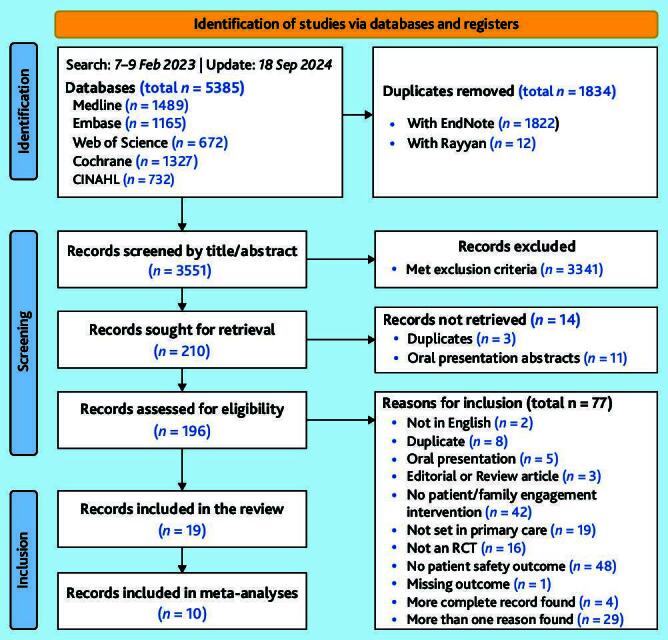
The review followed PRISMA and Cochrane guidelines. Five electronic databases (Medline, CINAHL, Embase, Web of Science, CENTRAL) were searched from inception to 18 September 2024 with keywords in four blocks (patient and family engagement; patient safety; primary care; randomised controlled trial). Patient and family engagement levels were appraised. Where appropriate, results were combined into meta-analyses.
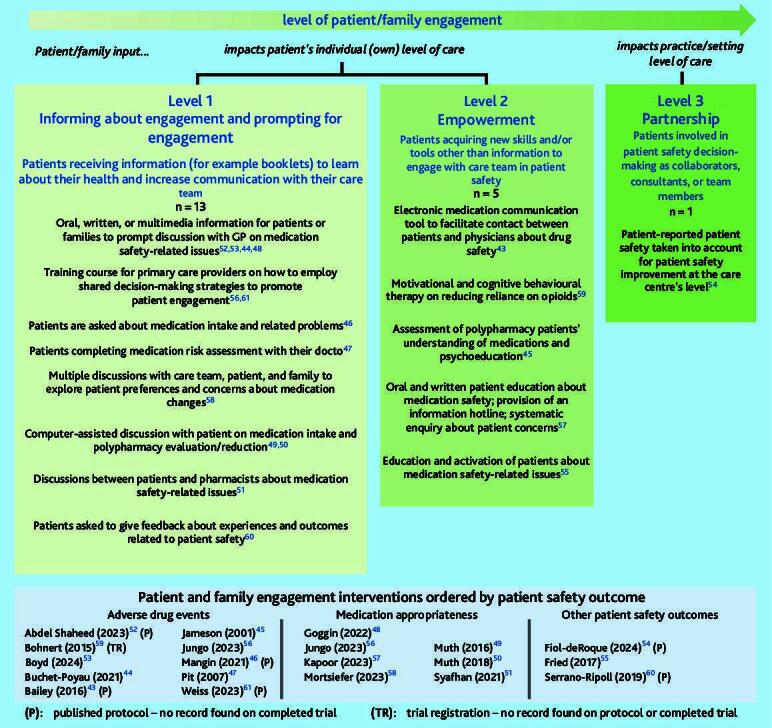
Of the 19 included records, 12 reported on completed RCTs. Only one intervention integrated patients/families into overall care safety (high engagement); six aimed at enhancing skills and tools (intermediate), and 12 informed patients/families how to engage and prompted them to do it (low). RCTs primarily targeted medication safety, with meta-analyses showing no significant effects on reducing adverse drug events (odds ratio [OR] 0.86, 95% confidence interval [CI] = 0.70 to 1.08) or improving medication appropriateness measured categorically (OR 0.92, 95% CI = 0.76 to 1.13) or continuously (mean difference 0.71, 95% CI = -0.10 to 1.52). Overall risk of bias was low and certainty of evidence very low to moderate.
Existing randomised controlled evidence on patient and family engagement in primary care remains inconclusive and limited in scope. Future interventions should include higher levels of engagement and address more diverse patient safety outcomes relevant for primary care.
让患者及其家属参与其中已被视为改善卫生系统患者安全的关键策略。然而,关于这种方法在初级保健中的有效性的证据仍然很少。
评估在促进患者及其家属参与患者安全的随机对照试验(RCT)中,初级保健干预措施的综合效果。
系统评价和荟萃分析。
该评价遵循PRISMA和Cochrane指南。从数据库建立至2024年9月18日,检索了五个电子数据库(Medline、CINAHL、Embase、Web of Science、CENTRAL),使用了四个板块的关键词(患者及家属参与;患者安全;初级保健;随机对照试验)。对患者及家属的参与程度进行了评估。在适当情况下,将结果合并进行荟萃分析。
在纳入的19份记录中,12份报告了已完成的随机对照试验。只有一项干预措施将患者/家属纳入了整体护理安全(高参与度);六项旨在提高技能和工具(中等参与度),12项告知患者/家属如何参与并促使他们这样做(低参与度)。随机对照试验主要针对用药安全,荟萃分析显示,在减少药物不良事件方面没有显著效果(优势比[OR]为0.86,95%置信区间[CI]=0.70至1.08),在分类衡量用药合理性方面也没有显著改善(OR为0.92,95%CI=0.76至1.13),在连续衡量用药合理性方面同样没有显著改善(平均差为0.71,95%CI=-0.10至1.52)。总体偏倚风险较低,证据确定性从非常低到中等。
关于患者及其家属参与初级保健的现有随机对照证据仍然没有定论,且范围有限。未来的干预措施应包括更高水平的参与度,并解决与初级保健相关的更多样化的患者安全结果。