Wibowo Arief, Amri Ikhwan, Surahmat Asep, Rusdah Rusdah
Department of Computer Science, Faculty of Information Technology, Universitas Budi Luhur, Jakarta, Indonesia.
Center for Disaster Studies, Universitas Gadjah Mada, Yogyakarta, Indonesia.
Jamba. 2025 Apr 7;17(1):1776. doi: 10.4102/jamba.v17i1.1776. eCollection 2025.
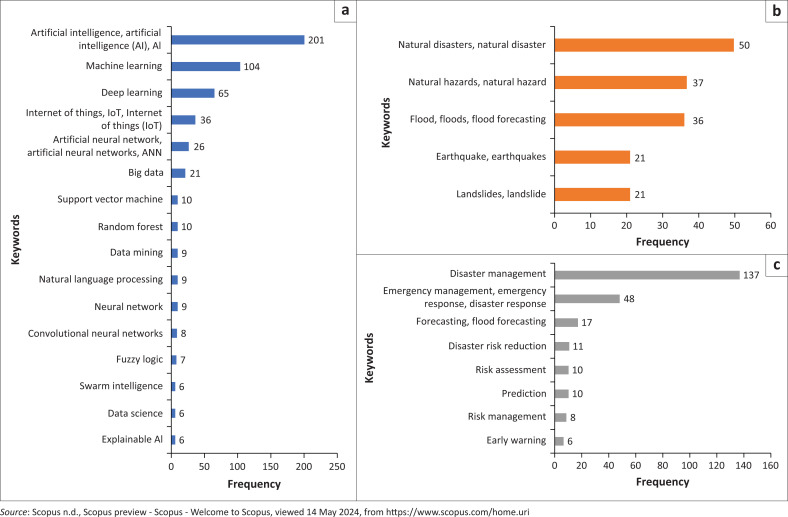
The advancement of artificial intelligence (AI) technology presents promising opportunities to improve disaster management's effectiveness and efficiency, particularly with the rising risk of natural hazards globally. This study used the Scopus database to offer a bibliometric review of AI applications in disaster management. Publications were chosen based on research scope (natural hazards), source type (journals and conference proceedings), document type (articles, conference papers and reviews) and language (English). VOSviewer and Biblioshiny were utilised to analyse trends and scientific mapping from 848 publications. The finding shows a rapid increase in AI studies for disaster management, with an annual growth rate of 15.61%. The leading source was the International Archives of the Photogrammetry, Remote Sensing and Spatial Information Sciences - ISPRS Archives. Amir Mosavi was the most prolific author, with 10 documents. The analysis reveals that China was the most productive country, while the United States was the most cited. Six research clusters were identified through keyword network mapping: (1) disaster monitoring and prediction using IoT networks, (2) AI-based geospatial technology for risk management, (3) decision support systems for disaster emergency management, (4) social media analysis for emergency response, (5) machine learning algorithms for disaster risk reduction, and (6) big data and deep learning for disaster management.
This research contributes by mapping the application of AI technology in disaster management based on peer-reviewed literature. This helps identify major developments, research hotspots, and gaps.
人工智能(AI)技术的进步为提高灾害管理的有效性和效率带来了充满希望的机遇,尤其是在全球自然灾害风险不断上升的情况下。本研究利用Scopus数据库对人工智能在灾害管理中的应用进行文献计量学综述。根据研究范围(自然灾害)、来源类型(期刊和会议论文集)、文献类型(文章、会议论文和综述)以及语言(英语)来选择出版物。利用VOSviewer和Biblioshiny对848篇出版物的趋势和科学图谱进行分析。研究结果表明,人工智能在灾害管理方面的研究迅速增加,年增长率为15.61%。主要来源是《国际摄影测量、遥感与空间信息科学档案 - ISPRS档案》。阿米尔·莫萨维是产量最高的作者,有10篇文献。分析显示,中国是产出最多的国家,而美国是被引用最多的国家。通过关键词网络映射确定了六个研究集群:(1)利用物联网网络进行灾害监测和预测,(2)基于人工智能的地理空间技术用于风险管理,(3)灾害应急管理的决策支持系统,(4)用于应急响应的社交媒体分析,(5)用于降低灾害风险的机器学习算法,以及(6)用于灾害管理的大数据和深度学习。
本研究通过基于同行评审文献绘制人工智能技术在灾害管理中的应用,做出了贡献。这有助于识别主要发展、研究热点和差距。