Bhattacharya Arkajyoti, Stutvoet Thijs S, Perla Mirela, Loipfinger Stefan, Jalving Mathilde, Reyners Anna K L, Vermeer Paola D, Drapkin Ronny, de Bruyn Marco, de Vries Elisabeth G E, de Jong Steven, Fehrmann Rudolf S N
Department of Medical Oncology, University Medical Center Groningen, University of Groningen, Groningen, Netherlands.
Cancer Biology and Immunotherapies Group, Sanford Research, Sioux Falls, United States.
Elife. 2025 May 13;13:RP101369. doi: 10.7554/eLife.101369.
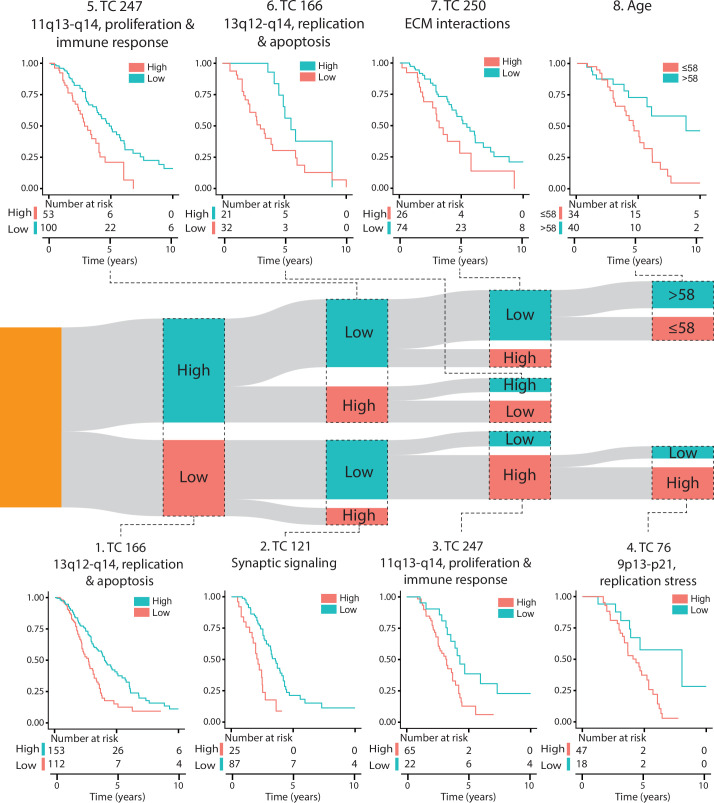
Bulk transcriptomic analyses of high-grade serous ovarian cancer (HGSOC) so far have not uncovered potential drug targets, possibly because subtle, disease-relevant transcriptional patterns are overshadowed by dominant, non-relevant ones. Our aim was to uncover disease-outcome-related patterns in HGSOC transcriptomes that may reveal novel drug targets. Using consensus-independent component analysis, we dissected 678 HGSOC transcriptomes of systemic therapy naïve patients-sourced from public repositories-into statistically independent transcriptional components (TCs). To enhance c-ICA's robustness, we added 447 transcriptomes from non-serous histotypes, low-grade serous, and non-cancerous ovarian tissues. Cox regression and survival tree analysis were performed to determine the association between TC activity and overall survival (OS). Finally, we determined the activity of the OS-associated TCs in 11 publicly available spatially resolved ovarian cancer transcriptomes. We identified 374 TCs, capturing prominent and subtle transcriptional patterns linked to specific biological processes. Six TCs, age, and tumor stage stratified patients with HGSOC receiving platinum-based chemotherapy into ten distinct OS groups. Three TCs were linked to copy-number alterations affecting expression levels of genes involved in replication, apoptosis, proliferation, immune activity, and replication stress. Notably, the TC identifying patients with the shortest OS captured a novel transcriptional pattern linked to synaptic signaling, which was active in tumor regions within all spatially resolved transcriptomes. The association between a synaptic signaling-related TC and OS supports the emerging role of neurons and their axons as cancer hallmark-inducing constituents of the tumor microenvironment. These constituents might offer a novel drug target for patients with HGSOC.
迄今为止,对高级别浆液性卵巢癌(HGSOC)的大规模转录组分析尚未发现潜在的药物靶点,这可能是因为与疾病相关的微妙转录模式被占主导地位的不相关模式所掩盖。我们的目标是在HGSOC转录组中发现与疾病预后相关的模式,这些模式可能揭示新的药物靶点。使用独立成分分析,我们将来自公共数据库的678例未经系统治疗的HGSOC患者的转录组解析为统计上独立的转录成分(TCs)。为了增强独立成分分析的稳健性,我们添加了来自非浆液性组织学类型、低级别浆液性和非癌性卵巢组织的447个转录组。进行Cox回归和生存树分析以确定TC活性与总生存期(OS)之间的关联。最后,我们在11个公开可用的空间分辨卵巢癌转录组中确定了与OS相关的TCs的活性。我们鉴定出374个TCs,捕捉到了与特定生物学过程相关的突出和微妙的转录模式。六个TCs、年龄和肿瘤分期将接受铂类化疗的HGSOC患者分为十个不同的OS组。三个TCs与影响参与复制、凋亡、增殖、免疫活性和复制应激的基因表达水平的拷贝数改变有关。值得注意的是,识别出OS最短患者的TC捕捉到了一种与突触信号相关的新转录模式,该模式在所有空间分辨转录组的肿瘤区域中均有活性。与突触信号相关的TC与OS之间的关联支持了神经元及其轴突作为肿瘤微环境中诱导癌症特征的成分的新作用。这些成分可能为HGSOC患者提供一个新的药物靶点。