Biswas Rupam, López-Serrano Ana Laura, Purohit Apoorva, Ramirez-Navarro Angelina, Huang Hsiang-Ling, Grandinetti Giovanna, Cheng Xiaolin, Heissler Sarah M, Deschênes Isabelle, Chinthalapudi Krishna
Department of Physiology and Cell Biology, Dorothy M. Davis Heart and Lung Research Institute, College of Medicine, The Ohio State University, Columbus, OH 43210.
Frick Center for Heart Failure and Arrhythmia Research, The Ohio State University Wexner Medical Center, Columbus, OH 43210.
Proc Natl Acad Sci U S A. 2025 May 20;122(20):e2416181122. doi: 10.1073/pnas.2416181122. Epub 2025 May 14.
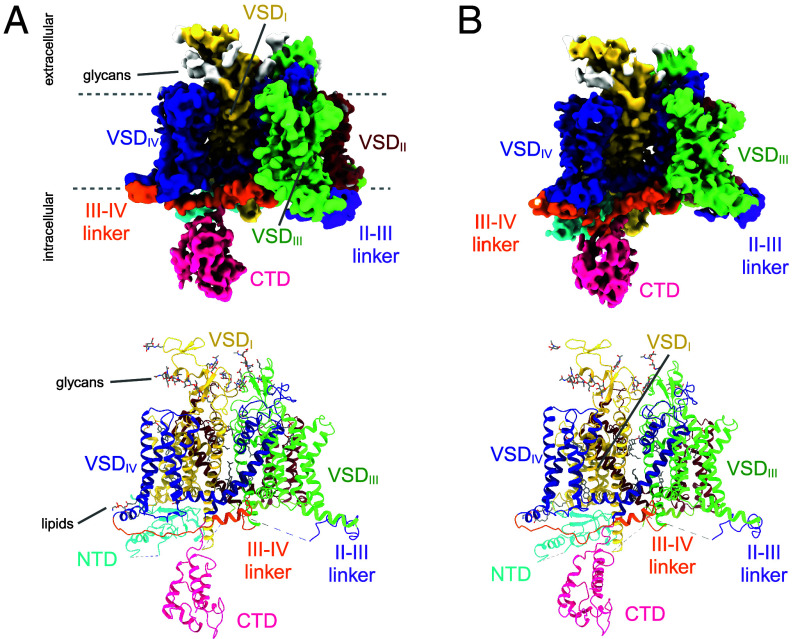
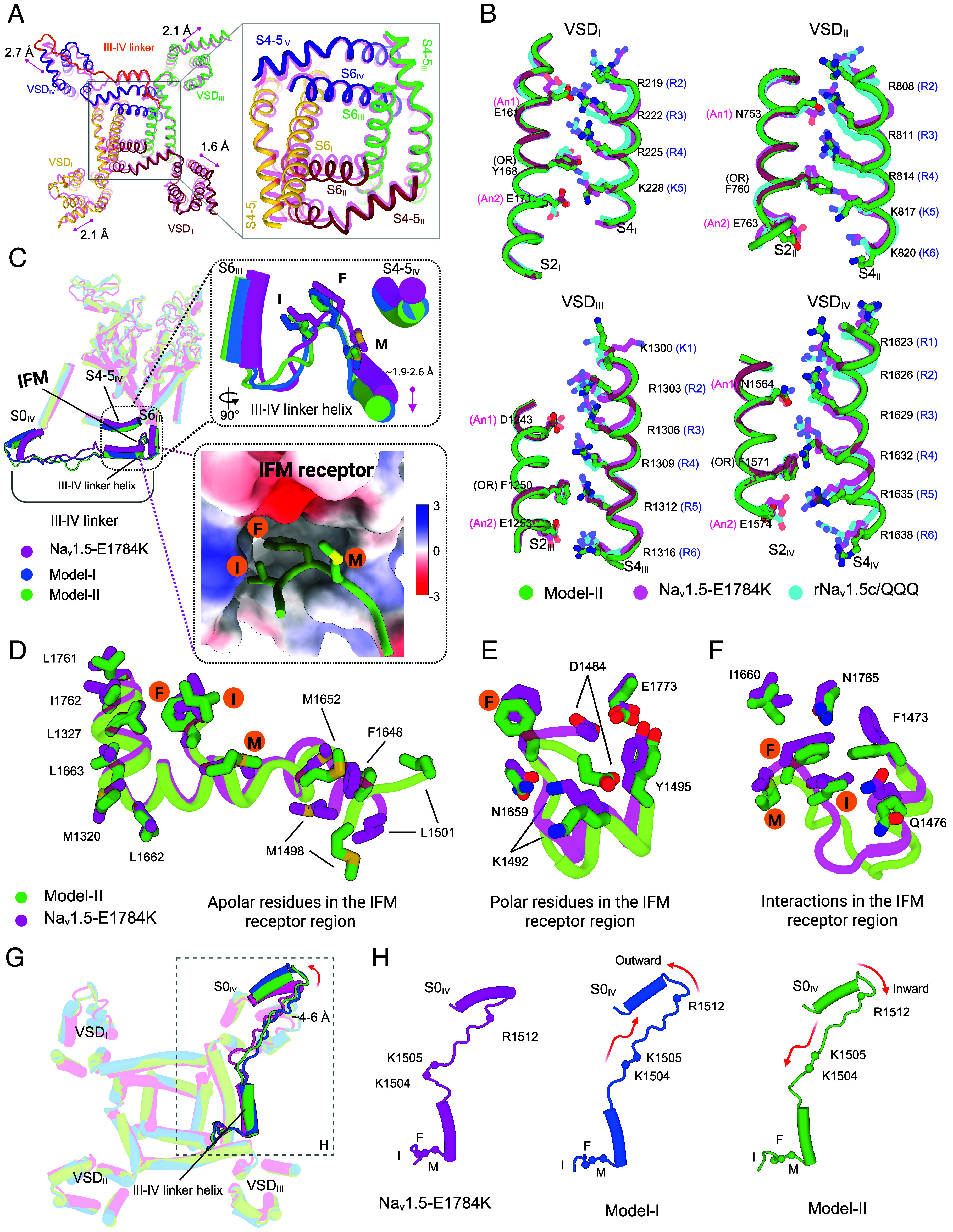
Voltage-gated Na1.5 channels are central to the generation and propagation of cardiac action potentials. Aberrations in their function are associated with a wide spectrum of cardiac diseases including arrhythmias and heart failure. Despite decades of progress in Na1.5 biology, the lack of structural insights into intracellular regions has hampered our understanding of its gating mechanisms. Here, we present two cryo-EM structures of human Na1.5 in open states, revealing sequential conformational changes in gating charges of the voltage-sensing domains (VSDs) and several intracellular regions. Despite the channel being in the open state, these structures show repositioning, but no dislodging of the IFM motif in the receptor site. Molecular dynamics analyses show our structures with CTD conduct Na ions. Notably, our structural findings highlight a dynamic C-terminal domain (CTD) and III-IV linker interaction, which regulates the conformation of VSDs and pore opening. Electrophysiological studies confirm that disrupting this interaction alters fast inactivation of Na1.5. Together, our structure-function studies establish a foundation for understanding the gating mechanisms of Na1.5 and the mechanisms underlying CTD-related channelopathies.
电压门控性Na1.5通道对于心脏动作电位的产生和传导至关重要。其功能异常与包括心律失常和心力衰竭在内的多种心脏疾病相关。尽管在Na1.5生物学领域取得了数十年的进展,但对细胞内区域缺乏结构上的深入了解阻碍了我们对其门控机制的理解。在此,我们展示了处于开放状态的人源Na1.5的两种冷冻电镜结构,揭示了电压传感结构域(VSD)和几个细胞内区域门控电荷的连续构象变化。尽管通道处于开放状态,但这些结构显示出受体位点中IFM模体的重新定位,但没有移位。分子动力学分析表明,我们具有C末端结构域(CTD)的结构能够传导钠离子。值得注意的是,我们的结构研究结果突出了动态的C末端结构域(CTD)与III-IV连接子的相互作用,该相互作用调节VSD的构象和孔道开放。电生理研究证实,破坏这种相互作用会改变Na1.5的快速失活。总之,我们的结构-功能研究为理解Na1.5的门控机制以及CTD相关通道病的潜在机制奠定了基础。