Bordbar Shima, Ahmadinejad Parvin, Bahmaei Jamshid, Vejdani Marjan, Yusefi Ali Reza
Health Human Resources Research Center, School of Health Management and Information Sciences, Shiraz University of Medical Sciences, Shiraz, Iran.
Occupational Health and Safety Engineering Department, School of Health, Shiraz University of Medical Sciences, Shiraz, Iran.
Sci Rep. 2025 May 16;15(1):16999. doi: 10.1038/s41598-025-02049-0.
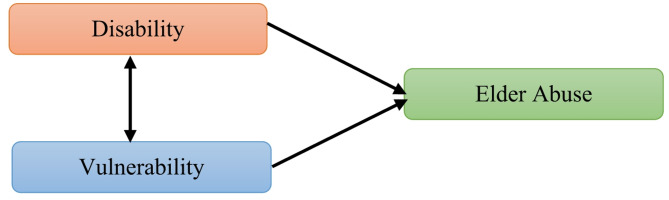
Disability and vulnerability are among the consequences of aging. This stage of life can be associated with the abuse of older adults by others. The present study aimed to examine the severity of disability and vulnerability among older adults and its impact on elder abuse in older adults residing in Jiroft County, southern Iran, in 2024. This descriptive-analytical cross-sectional study was conducted on 385 older adult individuals. The data collection tools included standardized questionnaires on disability, vulnerability, and elder abuse. Data were analyzed using t-test, ANOVA, Pearson correlation coefficient, and multiple linear regression with SPSS version 23 at a significance level 0.05. The mean scores for the severity of disability, vulnerability, and elder abuse among the older adult participants were 98.34 ± 7.56 out of 144, 9.75 ± 3.08 out of 15, and 12.01 ± 3.55 out of 49, respectively, indicating a moderate level of disability, a high level of vulnerability, and a low level of elder abuse. There was a statistically significant positive correlation between elder abuse and the severity of disability (r = 0.821, p < 0.001) as well as vulnerability (r = 0.795, p < 0.001) among older adults. According to the results of multiple linear regression, disability components-including disability in performing activities of daily living, self-care, walking, understanding and communication, lack of self-employment, interaction with others, and participation in social activities-and vulnerability components-including physical, psychological, and social vulnerability-were identified as predictors of elder abuse (P < 0.05). Among the older adult participants, disability was estimated at a moderate level, vulnerability at a high level, and elder abuse at a low level. Based on the results, disability, and vulnerability were identified as predictors of elder abuse, with an increase in these two variables leading to a rise in elder abuse. Therefore, the formulation of supportive policies and their implementation, especially in empowering and promoting self-care among older adults, is recommended. Additionally, attention should be paid to the psychological and social aspects of older adults, and providing a suitable living environment for this age group by all responsible individuals, from family members to municipal authorities, is suggested.
残疾和脆弱性是衰老的后果之一。人生的这个阶段可能会出现老年人被他人虐待的情况。本研究旨在调查2024年居住在伊朗南部吉罗夫特县的老年人的残疾和脆弱性严重程度及其对老年人虐待行为的影响。这项描述性分析横断面研究对385名老年人进行。数据收集工具包括关于残疾、脆弱性和老年人虐待的标准化问卷。使用SPSS 23版在显著性水平0.05下进行t检验、方差分析、Pearson相关系数分析和多元线性回归分析数据。老年参与者的残疾严重程度、脆弱性和老年人虐待的平均得分分别为144分中的98.34±7.56分、15分中的9.75±3.08分和49分中的12.01±3.55分,表明残疾程度为中等、脆弱性程度高、老年人虐待程度低。老年人虐待与残疾严重程度(r = 0.821,p < 0.001)以及脆弱性(r = 0.795,p < 0.001)之间存在统计学上显著的正相关。根据多元线性回归结果,残疾组成部分——包括日常生活活动、自我护理、行走、理解和沟通方面的残疾、缺乏自营职业、与他人互动以及参与社会活动——以及脆弱性组成部分——包括身体、心理和社会脆弱性——被确定为老年人虐待行为的预测因素(P < 0.05)。在老年参与者中,残疾程度估计为中等,脆弱性程度高,老年人虐待程度低。根据研究结果,残疾和脆弱性被确定为老年人虐待行为的预测因素,这两个变量的增加会导致老年人虐待行为的增加。因此,建议制定支持性政策并加以实施,特别是在增强老年人权能和促进其自我护理方面。此外,应关注老年人的心理和社会方面,并建议从家庭成员到市政当局等所有责任人为此年龄组提供适宜的生活环境。