Doni Lapo, Taviani Elisa, Bosi Emanuele, Pruzzo Carla, Martinez-Urtaza Jaime, Vezzulli Luigi
Department of Earth, Environmental and Life Sciences (DISTAV), University of Genoa, Genoa, Italy.
NBFC, National Biodiversity Future Center, Palermo, Italy.
Ann Glob Health. 2025 May 13;91(1):23. doi: 10.5334/aogh.4711. eCollection 2025.
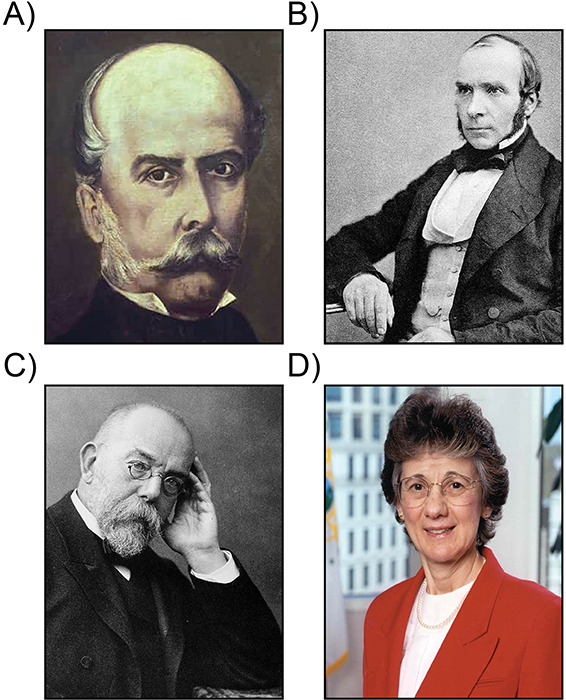
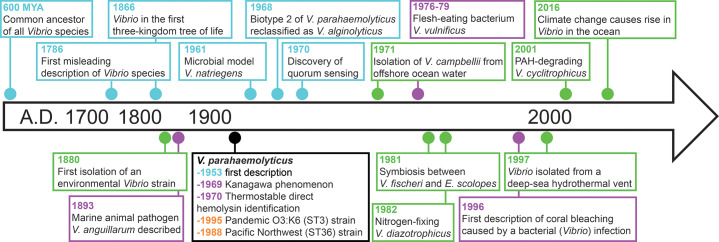
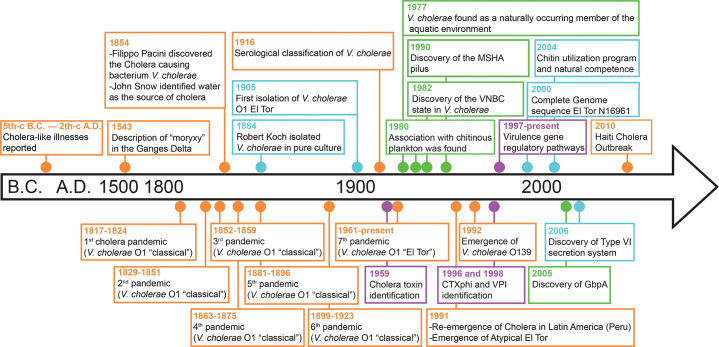
, a group of Gram‑negative bacteria found in the ocean, has become a significant global threat, intensified by climate change, owing to its crucial roles in environmental, human, and animal health. Research on these bacteria and the diseases they cause has greatly influenced scientific progress, resulting in major advancements in the fields of microbiology, epidemiology, and public health. This review aims to highlight the early groundbreaking discoveries in research, particularly those that have significantly impacted the science of microbiology and global health. A comprehensive literature search was conducted across vast databases of biomedical and life sciences literature including PubMed, EMBASE, and Scopus. Additionally, a search of the grey literature was performed. Studies that marked early groundbreaking discoveries in research, with wide implications for human society, were included. Research on has led to major advancements in our understanding of disease mechanisms, pathogen ecology, and the epidemiology of waterborne infections. A landmark discovery was the identification of in 1884, which played a crucial role in studying waterborne diseases such as cholera and led to the development of modern approaches to treat diarrheal diseases, such as the introduction of oral rehydration salt (ORS) therapy. Certain strains, such as , are important models for studying flesh‑eating diseases, while others, such as ST3, ST36, and O1, are the only marine bacteria known to cause global epidemics by spreading across continents. Key mechanisms in Gram‑negative bacteria, including the viable but nonculturable (VBNC) state, quorum sensing, and the type VI secretion system (T6SS), were first discovered in species. Today, research on bacteria remains crucial from a global health perspective, especially owing to the expanding effects of climate change on their worldwide distribution.
[细菌名称],一类存在于海洋中的革兰氏阴性菌,由于其在环境、人类和动物健康方面的关键作用,在气候变化的影响下已成为重大的全球威胁。对这些细菌及其引发疾病的研究极大地推动了科学进步,在微生物学、流行病学和公共卫生领域取得了重大进展。本综述旨在突出[细菌名称]研究中的早期开创性发现,特别是那些对微生物学和全球健康科学产生重大影响的发现。我们在包括PubMed、EMBASE和Scopus在内的生物医学和生命科学文献的大量数据库中进行了全面的文献检索。此外,还对灰色文献进行了搜索。纳入了在[细菌名称]研究中具有早期开创性发现且对人类社会有广泛影响的研究。对[细菌名称]的研究在我们对疾病机制、病原体生态学和水源性感染流行病学的理解方面取得了重大进展。一个具有里程碑意义的发现是1884年[细菌名称]的鉴定,它在研究霍乱等水源性疾病中发挥了关键作用,并导致了现代治疗腹泻病方法的发展,如口服补液盐(ORS)疗法的引入。某些[细菌名称]菌株,如[具体菌株名称],是研究食肉疾病的重要模型,而其他菌株,如[具体菌株名称]ST3、ST36和[具体菌株名称]O1,是已知的唯一通过跨大陆传播引发全球流行的海洋细菌。革兰氏阴性菌的关键机制,包括活的但不可培养(VBNC)状态、群体感应和VI型分泌系统(T6SS),最早是在[细菌名称]物种中发现的。如今,从全球健康角度来看,对[细菌名称]细菌的研究仍然至关重要,特别是由于气候变化对其全球分布的影响不断扩大。