Tsuneda Takao, Taketsugu Tetsuya
Institute for Chemical Reaction Design and Discovery (WPI-ICReDD), Hokkaido University, Sapporo, Japan.
Graduate School of System Informatics, Kobe University, Nada-ku, Kobe, Hyogo, Japan.
Commun Chem. 2025 May 19;8(1):158. doi: 10.1038/s42004-025-01556-5.
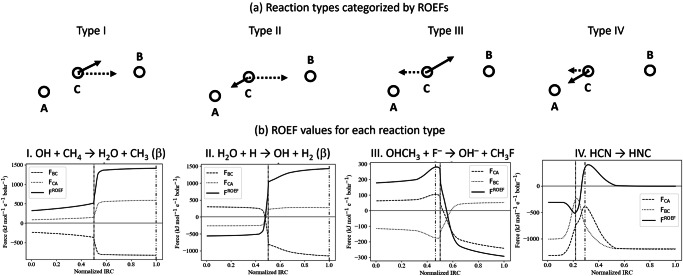
This study presents a physics-based framework for understanding chemical reactions, highlighting the critical role of the occupied reactive orbital, the most stabilized occupied orbital during a reaction, in guiding atomic nuclei via electrostatic forces. These forces, termed reactive-orbital-based electrostatic forces, arise from the negative gradient of orbital energy, creating a direct connection between orbital energy variations and nuclear motion. Through the analysis of 48 representative reactions, we identify two predominant types of force behavior: reactions that sustain reaction-direction forces either from the early stages or just before the transition state. These forces carve grooves along the intrinsic reaction coordinates on the potential energy surface, shaping the reaction pathway. This clarifies which types of electron transfer contribute to lowering the reaction barrier. This study provides a framework for understanding the driving forces behind chemical transformations, offering insights into the electronic basis of reaction mechanisms.
本研究提出了一个基于物理学的框架来理解化学反应,强调了占据反应轨道(反应过程中最稳定的占据轨道)在通过静电力引导原子核方面的关键作用。这些力被称为基于反应轨道的静电力,源于轨道能量的负梯度,在轨道能量变化和核运动之间建立了直接联系。通过对48个代表性反应的分析,我们确定了两种主要的力行为类型:在早期阶段或刚好在过渡态之前维持反应方向力的反应。这些力在势能面上沿着本征反应坐标刻出凹槽,塑造了反应路径。这阐明了哪种类型的电子转移有助于降低反应势垒。本研究提供了一个理解化学转化背后驱动力的框架,为反应机理的电子基础提供了见解。