Hillege Lars E, Trepka Kai R, Guthrie Benjamin G H, Fu Xueyan, Aarnoutse Romy, Paymar Maia R, Olson Christine, Zhang Chen, Ortega Edwin, Ramirez Lorenzo, de Vos-Geelen Judith, Valkenburg-van Iersel Liselot, van Hellemond Irene E G, Baars Arnold, Vestjens Johanna H M J, Penders John, Deutschbauer Adam, Atreya Chloe E, Kidder Wesley A, Smidt Marjolein L, Ziemons Janine, Turnbaugh Peter J
GROW-Research Institute for Oncology and Reproduction, Maastricht University, Maastricht, Limburg, the Netherlands.
Department of Surgery, Maastricht University Medical Center+, Maastricht, Limburg, the Netherlands.
mBio. 2025 Jun 11;16(6):e0093025. doi: 10.1128/mbio.00930-25. Epub 2025 May 20.
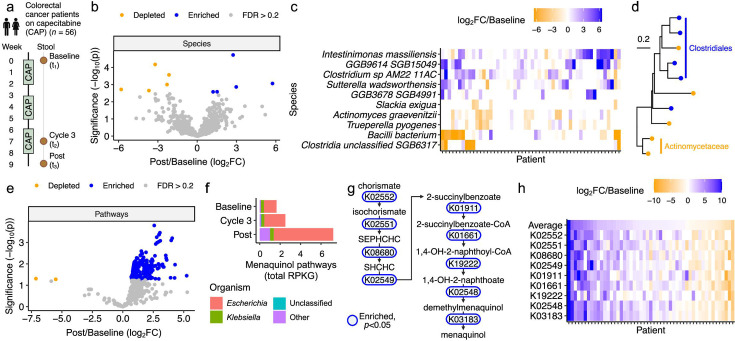
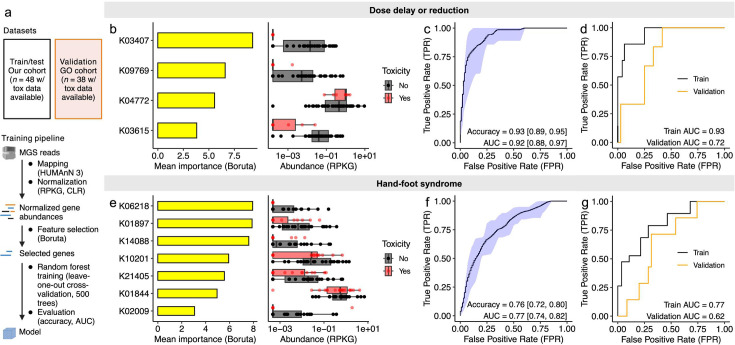
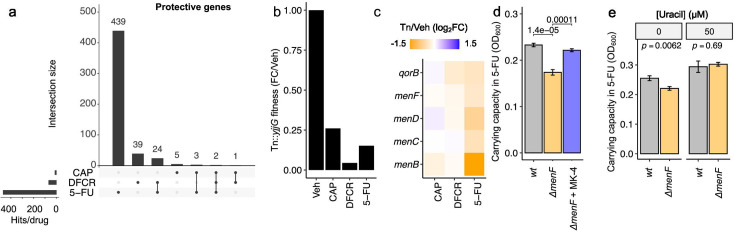
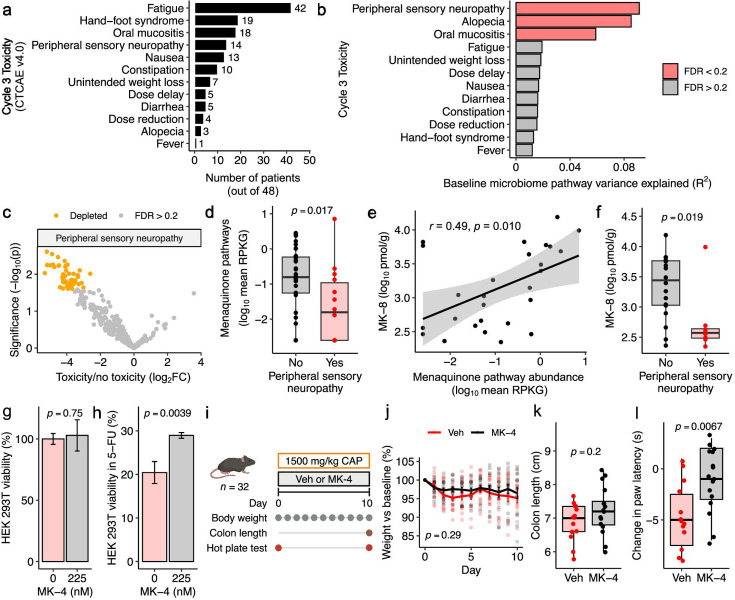
Dose-limiting toxicities pose a major barrier to cancer treatment. While preclinical studies show that the gut microbiota influences and is influenced by anticancer drugs, data from patients paired with careful side effect monitoring remains limited. Here, we investigate capecitabine (CAP)-microbiome interactions through longitudinal metagenomic sequencing of stool from 56 advanced colorectal cancer patients. CAP significantly altered the gut microbiome, enriching for menaquinol (vitamin K2) biosynthesis genes. Transposon library screens, targeted gene deletions, and media supplementation revealed that menaquinol biosynthesis protects from drug toxicity. Stool menaquinol gene and metabolite levels were associated with decreased peripheral sensory neuropathy. Machine learning models trained in this cohort predicted toxicities in an independent cohort. Taken together, these results suggest treatment-associated increases in microbial vitamin biosynthesis serve a chemoprotective role for bacterial and host cells. Further, our findings provide a foundation for in-depth mechanistic dissection, human intervention studies, and extension to other cancer treatments.IMPORTANCESide effects are common during the treatment of cancer. The trillions of microbes found within the human gut are sensitive to anticancer drugs, but the effects of treatment-induced shifts in gut microbes for side effects remain poorly understood. We profiled gut microbes in colorectal cancer patients treated with capecitabine and carefully monitored side effects. We observed a marked expansion in genes for producing vitamin K2 (menaquinone). Vitamin K2 rescued gut bacterial growth and was associated with decreased side effects in patients. We then used information about gut microbes to develop a predictive model of drug toxicity that was validated in an independent cohort. These results suggest that treatment-associated increases in bacterial vitamin production protect both bacteria and host cells from drug toxicity, providing new opportunities for intervention and motivating the need to better understand how dietary intake and bacterial production of micronutrients like vitamin K2 influence cancer treatment outcomes.
剂量限制性毒性是癌症治疗的主要障碍。虽然临床前研究表明肠道微生物群会影响抗癌药物并受其影响,但配对仔细监测副作用的患者数据仍然有限。在此,我们通过对56例晚期结直肠癌患者粪便进行纵向宏基因组测序,研究卡培他滨(CAP)与微生物群的相互作用。CAP显著改变了肠道微生物群,使甲萘醌(维生素K2)生物合成基因富集。转座子文库筛选、靶向基因缺失和培养基补充实验表明,甲萘醌生物合成可保护细胞免受药物毒性。粪便中甲萘醌基因和代谢物水平与周围感觉神经病变的减轻有关。在该队列中训练的机器学习模型可预测独立队列中的毒性。综上所述,这些结果表明,治疗相关的微生物维生素生物合成增加对细菌和宿主细胞起到化学保护作用。此外,我们的研究结果为深入的机制剖析、人类干预研究以及扩展到其他癌症治疗提供了基础。重要性癌症治疗期间副作用很常见。人类肠道内发现的数万亿微生物对抗癌药物敏感,但治疗引起的肠道微生物群变化对副作用的影响仍知之甚少。我们对接受卡培他滨治疗的结直肠癌患者的肠道微生物进行了分析,并仔细监测了副作用。我们观察到生产维生素K2(甲萘醌)的基因显著增加。维生素K2挽救了肠道细菌的生长,并与患者副作用的减少有关。然后,我们利用肠道微生物的信息开发了一种药物毒性预测模型,该模型在独立队列中得到了验证。这些结果表明,治疗相关的细菌维生素产量增加可保护细菌和宿主细胞免受药物毒性,为干预提供了新机会,并促使人们需要更好地了解饮食摄入以及维生素K2等微量营养素的细菌生产如何影响癌症治疗结果。