Statistics Modelling and Economics Department, United Kingdom Health Security Agency, London, UK; Department of Infectious Disease Epidemiology, London School of Hygiene & Tropical Medicine, London, UK; TB Modelling Group and Centre for Mathematical Modelling of Infectious Diseases, London School of Hygiene & Tropical Medicine, London, UK.
Global Immunization Division, Centers for Disease Control and Prevention, Atlanta, Georgia, USA.
Int J Infect Dis. 2023 Dec;137:149-156. doi: 10.1016/j.ijid.2023.09.003. Epub 2023 Sep 9.
Many countries introduced rubella-containing vaccination (RCV) after 2011, following changes in recommended World Health Organization (WHO) vaccination strategies and external support. We evaluated the impact of these introductions.
We estimated the country-specific, region-specific, and global Congenital Rubella Syndrome (CRS) incidence during 1996-2019 using mathematical modeling, including routine and campaign vaccination coverage and seroprevalence data.
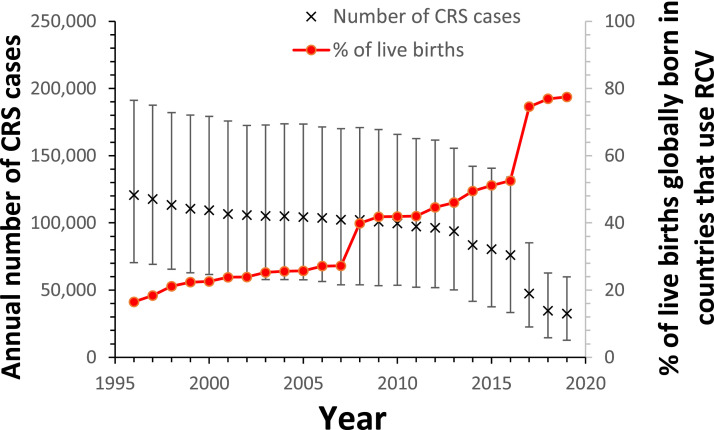
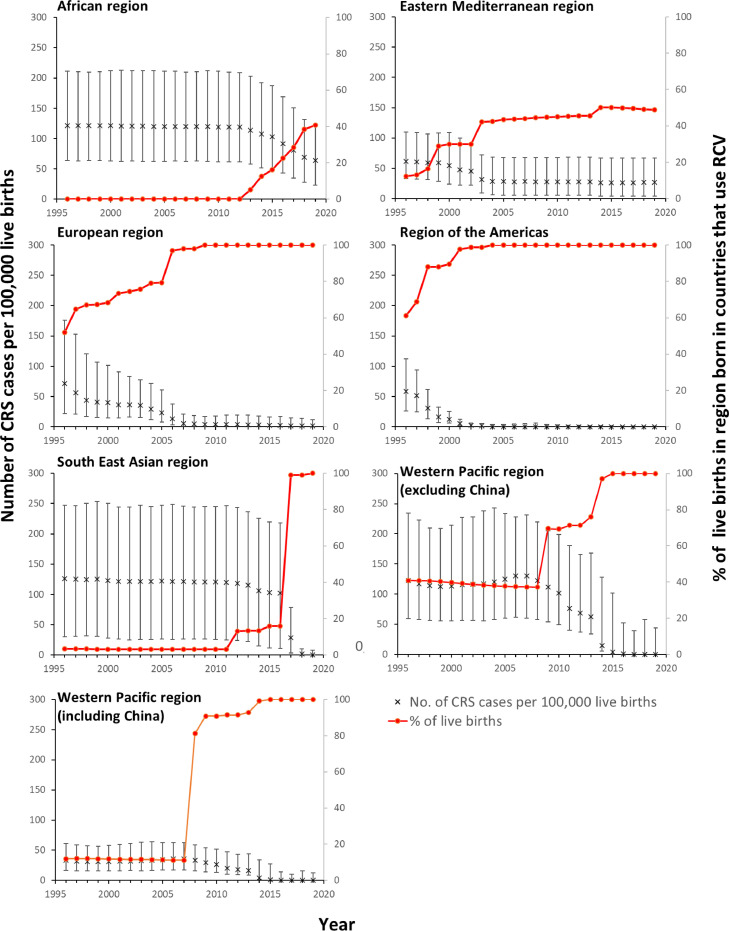
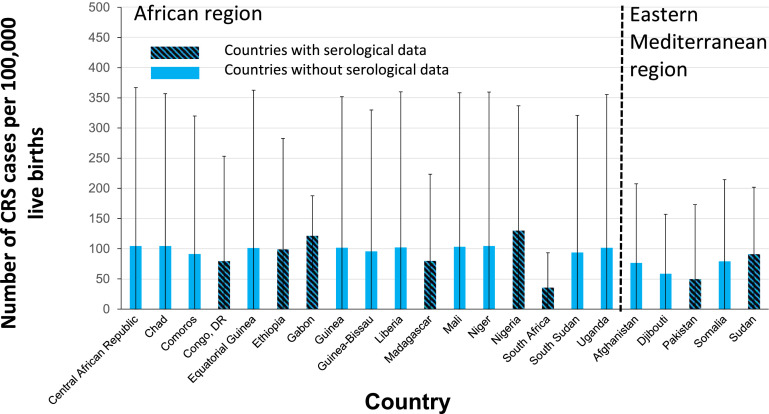
In 2019, WHO African and Eastern Mediterranean regions had the highest estimated CRS incidence (64 [95% confidence intervals (CI): 24-123] and 27 [95% CI: 4-67] per 100,000 live births respectively), where nearly half of births occur in countries that have introduced RCV. Other regions, where >95% of births occurred in countries that had introduced RCV, had a low estimated CRS incidence (<1 [95% CI: <1 to 8] and <1 [95% CI: <1 to 12] per 100,000 live births in South-East Asia [SEAR] and the Western Pacific [WPR] respectively, and similarly in Europe and the Americas). The estimated number of CRS births globally declined by approximately two-thirds during 2010-2019, from 100,000 (95% CI: 54,000-166,000) to 32,000 (95% CI: 13,000-60,000), representing a 73% reduction since 1996, largely following RCV introductions in WPR and SEAR, where the greatest reductions occurred.
Further reductions can occur by introducing RCV in remaining countries and maintaining high RCV coverage.
许多国家在 2011 年后引入了含风疹疫苗(RCV),这是根据世界卫生组织(WHO)疫苗接种策略和外部支持的变化做出的改变。我们评估了这些引入的影响。
我们使用数学模型估计了 1996 年至 2019 年期间特定国家、特定区域和全球先天性风疹综合征(CRS)的发病率,包括常规和疫苗接种活动覆盖范围以及血清阳性率数据。
2019 年,世界卫生组织非洲和东地中海区域的估计 CRS 发病率最高(分别为 64 [95%置信区间(CI):24-123]和 27 [95% CI:4-67]每 100000 例活产),而其中近一半的分娩发生在已引入 RCV 的国家。其他区域,即 >95%的分娩发生在已引入 RCV 的国家,估计 CRS 发病率较低(分别为东南亚 [SEAR]和西太平洋 [WPR]每 100000 例活产的<1 [95% CI:<1 至 8]和<1 [95% CI:<1 至 12],欧洲和美洲的情况类似)。2010-2019 年期间,全球 CRS 出生人数下降了约三分之二,从 100000 例(95% CI:54000-166000)降至 32000 例(95% CI:13000-60000),自 1996 年以来下降了 73%,这主要是由于 WPR 和 SEAR 引入了 RCV,而这两个区域的降幅最大。
在剩余国家中引入 RCV 并保持高 RCV 覆盖率,可以进一步减少发病率。