Cho Hye Joung, Yoo Jihwan, Choi Ran Joo, Lee Jae-Seon, Kim Ryong Nam, Park Junseong, Moon Ju Hyung, Kim Eui Hyun, Teo Wan-Yee, Chang Jong Hee, Kim Soo-Youl, Kang Seok-Gu
Department of Neurosurgery, Brain Tumor Center, Severance Hospital, Yonsei University College of Medicine, Seoul, Republic of Korea.
Brain Tumor Translational Research Laboratory, Department of Biomedical Sciences, Yonsei University College of Medicine, Seoul, Republic of Korea.
Cancer Cell Int. 2025 May 22;25(1):184. doi: 10.1186/s12935-025-03813-y.
Glioblastoma (GBM) is a highly resistant tumor, and targeting its bioenergetics could be a potential treatment strategy. GBM cells depend on cytosolic nicotinamide adenine dinucleotide (NADH), which is transported into the mitochondria via the malate-aspartate shuttle (MAS) for ATP production. N-phenylmaleimide (KN612) is a MAS inhibitor that targets SLC25A11, an antiporter protein of the MAS. Therefore, this study investigated the effects of KN612 in GBM treatment using in vitro and in vivo models.
We examined the biological effects of KN612 in GBM tumorspheres (TSs), including its effects on cell viability, ATP level, cell cycle, stemness, invasive properties, energy metabolic pathways, and transcriptomes. Additionally, we investigated the in vivo efficacy of KN612 in a mouse orthotopic xenograft model.
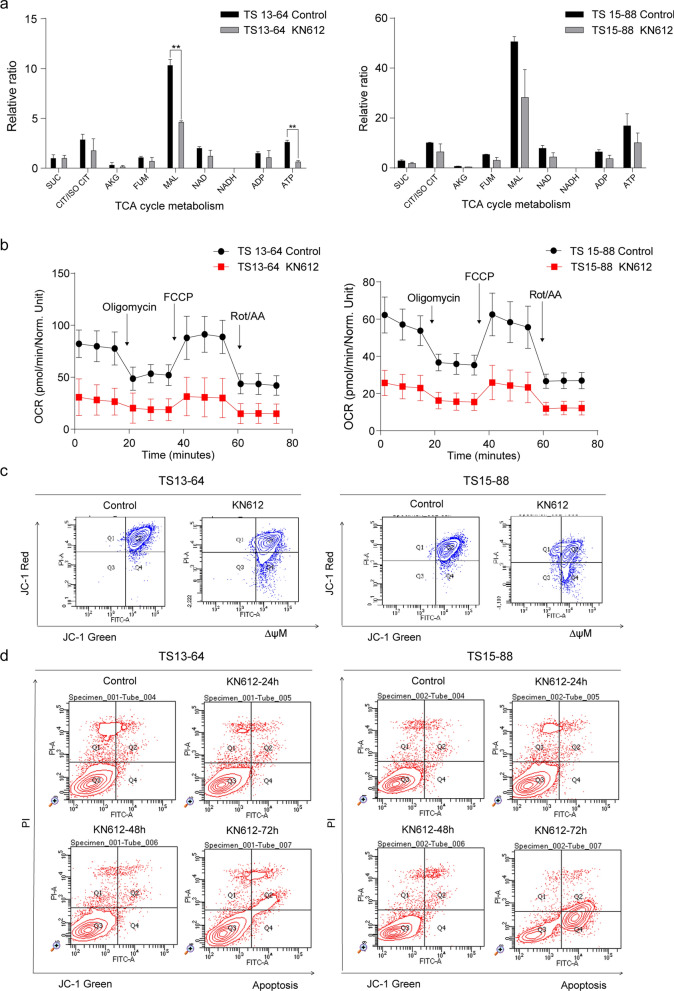
Transcriptomic analysis showed that SLC25A11 mRNA expression was significantly higher in GBM TSs than in normal human astrocytes. Additionally, siRNA-mediated SLC25A11 knockdown and KN612-mediated MAS inhibition decreased the oxygen consumption rate, ATP levels, mitochondrial activity, and cell viability in GBM TSs and decreased the stemness and invasion ability of GBM cells. Moreover, gene ontology functional annotation indicated that KN612 treatment inhibited cell-cycle and mitotic processes. Furthermore, KN612 treatment reduced tumor size and prolonged survival in an orthotopic xenograft model.
Targeting GBM bioenergetics using KN612 may represent a novel and effective approach for GBM treatment.
胶质母细胞瘤(GBM)是一种高度耐药的肿瘤,靶向其生物能量学可能是一种潜在的治疗策略。GBM细胞依赖于胞质烟酰胺腺嘌呤二核苷酸(NADH),它通过苹果酸 - 天冬氨酸穿梭(MAS)转运到线粒体中以产生ATP。N - 苯基马来酰亚胺(KN612)是一种靶向MAS的反向转运蛋白SLC25A11的MAS抑制剂。因此,本研究使用体外和体内模型研究了KN612在GBM治疗中的作用。
我们研究了KN612对GBM肿瘤球(TSs)的生物学作用,包括其对细胞活力、ATP水平、细胞周期、干性、侵袭特性、能量代谢途径和转录组的影响。此外,我们在小鼠原位异种移植模型中研究了KN612的体内疗效。
转录组分析表明,GBM TSs中SLC25A11 mRNA表达明显高于正常人星形胶质细胞。此外,siRNA介导的SLC25A11敲低和KN612介导的MAS抑制降低了GBM TSs中的耗氧率、ATP水平、线粒体活性和细胞活力,并降低了GBM细胞的干性和侵袭能力。此外,基因本体功能注释表明,KN612处理抑制了细胞周期和有丝分裂过程。此外,KN612处理在原位异种移植模型中减小了肿瘤大小并延长了生存期。
使用KN612靶向GBM生物能量学可能是一种治疗GBM的新型有效方法。